
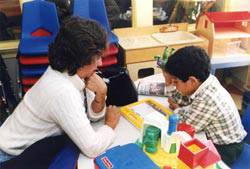
 The SPED Act or, SPECIAL EDUCATION ACT had its fundamental beginnings when provisions were written into law in the 1987 Philippine Constitution by two acts. Article II Section 17 indicates that the State must give priority to education, whereas Article XIV Section 1 indicates that education be provided equally and accessibly for all, and that adequate steps be taken to achieve this goal. From that period until today, a few moves were made, such as the creation of the Special Education Division of the Department of Education, and most recently the most productive step forward, the pending ratification of House Bill 82, or the SPED ACT, principally authored by Tarlac Second District Rep. Susan Yap-Sulit.
The Department of Education estimates that 13% of the student population (around 5.5 miliion individuals) have aforesaid “special needs”. Of this figure, 1.27 million are “gifted” or especially talented children, while Persons with Disabilities or PWDs comprise 4.2 million.
Referring to the 2007 version of the Special Education Act, the following groups are identified:
1. Gifted children and fast learners
2. Mentally handicapped/mentally retarded
3. Visually impaired
4. Hearing impaired
5. Children with behavior problems
6. Orthopedically handicapped
7. Children with special health problems
8. Children with learning disabilities (perceptual handicap, brain injury, minimal brain dysfunction, dyslexia and developmental aphasia)
9. Speech impaired
10. Persons with Autism
According to this law, a child with the above characteristics should be taught by accredited SPED centers, by SPED certified instructors to ensure their academic and social well being. The Vision of the Department of Education’s Special Education Division indicates that a child with special needs be “adequately provided with basic education, fully realize his/her own potentials for development and productivity, as well as being capable of self expression of his/her rights in society” as well as being “God loving and proud of being Filipino”.
Click here to learn more about the SPED Act.
[previous|page|next]
Read on to learn more about the SPED Act.
This all may sound good on paper, as well as the fact that there are many specialized private institutions and tutorial services and a plethora of options for those who can allocate funds for this. However, the majority of children with these particular needs are from average or below average income families, therefore sufficient government subsidy is essential. Education Secretary Mona D. Valismo stresses that only 2% of children with special needs are supported by the government, while not unexpectedly, 100% of these children in other countries receive state aid. And if you’re thinking about the United States, the United Kingdom and Japan, note that even neighboring Malaysia and it’s Ministry of Education has a comprehensive and complete program.
Most recently, Senators Miriam Defensor-Santiago and Juan Miguel Zubiri sponsored Senate Bill 2020, while representatives Dodo Pingoy Jr. and Monica Louise Prieto-Teodoro authored and sponsored House Bill 6750, allowing for the passage of a law that will allow for the following for Children with Special Needs (CSNs):
1. The creation of Bureau of Special Education with existing bureaus of elementary, secondary, and alternative learning.
2. The establishment of at least one SPED center in each city or province
3. To formulate a proper and suitable curriculum for each type of student
4. Financial and medical assistance and nutritional aide for underprivileged yet deserving individuals
5. An incentive program for the private sector to encourage aid (tax deductions, loan assistance, medical and scientific support and the like)
With regards to House Bill 82, which was meant for congressional hearing last November 23, there are no current updates according to the website of the Philippine Congress (congress.gov.ph) as yet.
If this bill is passed, a P600 million yearly budget will be appropriated for SPED for the next five years plus an additional P20 million in annual reserve.
As of June this year, there are only 230 SPED centers in the country and as juxtaposed with the 10,066 registered private and public schools, the figure is quite depressing.
A huge leap needs to be taken by the current administration that many of these children may realize their full potential and may possibly become productive and even independent adults. Personally, I have hearing impaired friends who work as technicians and educators, and know a developmentally challenged person who engages and excels in power lifting. On a more personal note, I was diagnosed with dyslexia as a toddler, and this was treated with a few years of tutorial, instilling in me a love for reading and later, writing. So with this in mind, I believe that everybody deserves a shot in life. A chance not just to dream but to excel. Whether your child is gifted, has special needs or neither, support House Bill 82 by appealing to your congressman. Let’s move forward toward progress, for our children, for our nation.
Photo from commons.wikimedia.org

Lorem ipsum dolor sit amet, consectetur adipisicing elit, sed do eiusmod
Lorem ipsum dolor sit amet, consectetur adipisicing elit, sed do eiusmod
