
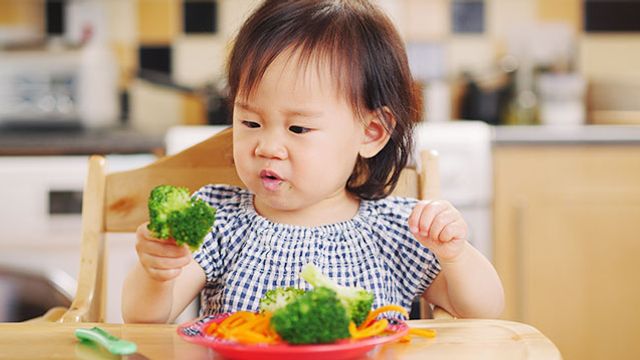
Throwing food — on the ground, the wall, your precious sofa — is fun for a toddler, but it can be maddening for a parent who needs to clean it up. But the mess isn't what worries you the most. You want to make sure your child grows up as someone who values food, not waste it. After all, food costs are not exactly going down.
Food throwing, however, is typical behavior. Some call it a milestone because when it happens the first few times, your child is showing curiosity. Your little one is figuring out how gravity works and the idea of object permanence (a.k.a. what happens to objects once they disappear), say pediatricians Dr. Jennifer Shu and Dr. Laura A. Jana in the book Food Fights.
Think of it this way. When your child sees your expression the first time he does throw his food, your reaction, whether it's laughter, wide-eyed shock, or murderous stare, he wants to see it again and again. Why do you think he laughs?
However, in toddlers aged 3 to 4 years old, that food throwing is a different story. “Food throwing at this age can definitely get out of hand because it tends to be a matter of defiance and/or disinterest,” said the pediatricians. Getting sick of picking up food from the floor? Here's what you can do about it:
1. Keep calm.
There’s a mess to clean up, and the constant bending over is straining your back, but try your best not to let your frustration show. “Babies and toddlers are natural attention seekers who thrive off a reaction. To avoid encouraging the behavior, do your best to stay calm and neutral,” said Sarah Remmer, a dietician and an expert in child and family nutrition, in an article for Today’s Parent.
Pick up the food and stick with a phrase you say every time this happens like, “Food stays on the tray” — which explains what you want to happen as opposed to saying “no” or “don't,” advised Remmer.
What other parents are reading
2. Don’t pile on too much food on her plate.
An easy solution may be to stick to food portion sizes that you know your toddler can finish. “Don't give him too much food,” said Meghan Leahy, a certified parent coach, in a Q&A session for The Washingon Post. Kids are tempted to play with large or overwhelming portions. If your child eats everything on her plate (hooray!), offer her more food if she's still hungry.
3. Remove the high chair tray.
Some older babies and young toddlers find it fascinating to watch food fall splat on the floor. “It becomes an exercise in learning cause-and-effect. What will happen if I throw this bowl full of oatmeal? Will it make a noise? Where will it go? Will it come back?” said Remmer.
If this is the case for your little one, ditch the tray, bring the high chair forward, and let your child eat at the dining table. “Your baby will now be focused more on his food and interacting with other family members, which is less isolating and includes them more in the family meal,” she added.
What other parents are reading
4. Enlist the help of suction bowls and plates
Get smart! Opt for suction bowls and plates if your toddler likes throwing her whole bowl or plate overboard. “Keep in mind though that while these are enough to prevent a casual grab-and-chuck they won't stop a child who's amazed to find her dish ‘stuck’ and is determined to pry it off,” said BabyCenter.
If your child doesn’t eat with a spoon yet, try giving her one. It may just distract her enough from throwing food and start trying to get it into her mouth.
5. Pay attention
Food throwing usually happens when your tot has already lost interest in his food, said Janet Lansbury, parenting advisor and host of the podcast Respectful Parenting. So, before you get mad, pay attention to what your little one is trying to tell you. He might be saying he's done eating and you can nip the behavior in the bud before things get really messy.
Lansbury suggested saying something like, “I’m going to stop you from dropping that…Looks like you’re no longer interested in eating the food. Are you all finished?” See if your child returns to eating, but if he throws his food again, it may be time to get him out of his highchair.
Worried your child isn't eating enough? Don't worry just yet, said Remmer. “Babies are born intuitive eaters — they know how much they need and when to stop, so we need to trust this and not pressure them to eat more. By offering five to six eating opportunities daily (meals and snacks), with lots of variety, we can rest assured that our little ones will meet their nutrition needs over the period of a week.”
There's also this tip from mom Marjorie Tablang-Jocson, who tagged us when she shared the video below on her Instagram. Her son accidentally spilled his drink on the floor. Instead of cleaning it up herself, Marjorie asked his son to wipe the floor because he could slip and fall. For her, it was a good teaching moment.
What other parents are reading

Lorem ipsum dolor sit amet, consectetur adipisicing elit, sed do eiusmod
Lorem ipsum dolor sit amet, consectetur adipisicing elit, sed do eiusmod
