
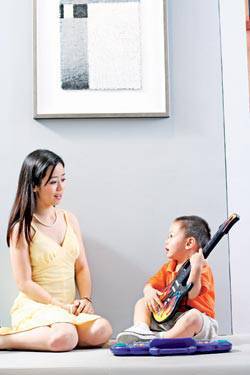
 “Toddlers absorb almost anything they see and hear—much like a sponge,” explains Jardine Davies Torno, M.D., a diplomate in Psychiatry and a member of the Philippine Psychiatric Association. Children almost automatically imitate whatever adults say and do. Parents should thus be extra careful when in front of their children. Even toddlers can and do understand what is happening around them. And while they may remain quiet, they may already be forming their own interpretations. Dr. Torno adds, “Toddlers also look to grownups for emotional cues or how to respond to novel events.”
According to Anna Vasquez-Genuino, Ph.D., child psychiatrist and consultant at the Makati Medical Center in Makati City, a child learns words and word meanings exponentially during the toddler stage. “So if the parents are using words their child is familiar with, the child may take this in the wrong context,” Dr. Vasquez-Genuino adds. What do toddlers make out from what grownups say and do?
Here’s a lowdown of common conversation and situations, and how parents can address negative reactions.
Word wars
Sometimes, grownups forget that a child is present when in the heat of an argument. “Toddlers are still egocentric and self-centered, and they think everything that happens around them is in reference to them. So if a child witnesses a fight, he would think, ‘Maybe they are fighting or hurting each other because of something I did,’” Dr. Vasquez-Genuino explains.
It is important that parents explain the situation to the child. “Parents need to clarify that the child is not to blame for anything—that the fight has nothing to do with him,” advises Dr. Vasquez-Genuino. He needs reassurance that everything will be okay. “Maybe Mom and Dad can shake hands or hug afterwards to show that they have patched things up,” she suggests. “Show the child na nagkakasundo rin kayo after a fight; let him witness the reconciliation, too.”
Click here to read more about how your toddler interprets your words and actions, depending on the situation.
[previous|page|next]
Read on to learn more about how your toddler interprets your words and actions, depending on the situation.
Misery mystery
It is hard to hide one’s emotions from a child especially since he is still very sensitive to how grownups react to different situations. He may be used to crying, but not in seeing Mommy cry or in anguish. This makes the child wonder what is going on.
“It is okay to cry as it is a natural reaction. Crying in front of your child only shows there is a wide range of emotions that people go through—and that it’s okay to express these emotions,” adds Dr. Vasquez-Genuino. However, parents must be wary that they may also be shifting the stress or anxiety to the child whenever he sees his mommy sad. “Parents should also be able to explain the reason why they were crying,” Dr. Torno advises.
Gossip mom
Everybody knows it is bad, yet people can’t help but engage in gossiping. However, it is something most grownups should not do in front of children—even toddlers. “You should be aware of the content and language used because that is what the child hears and what he will be learning,” says
Dr. Torno. “Kids can easily learn bad habits. Grownups should exercise caution, lest children would think talking ill of other people behind their backs is acceptable.”
“I’m busy, sweetie”
Sometimes, you get so involved with what you are doing that you tend to ignore your little ones. When a child calls your attention, you would ask him not to interrupt. But don’t forget that toddlers are typically impatient, explains Dr. Vasquez-Genuino, “A toddler’s concept of time is such that if you make him wait for a minute, it is like hours or days in ‘toddler time.’”
Moreover, ignoring or dismissing your child might make him feel rejected, leading to feelings of anxiety and stress, Dr. Torno says. “This is the time when a child is just mastering autonomy. He might grow up always doubting himself and his actions if he is always being ignored or sent away.”
Toddler TLC
It may not be so easy to shield your toddler away from these off-putting situations all the time, but you can try to keep it to a bare minimum. “A child who is constantly exposed to a negative environment has a higher chance of developing psychopathology, which may be difficult to reverse,” stresses Dr. Torno. If you can’t steer clear of it, “communication is very important,” says Dr. Vasquez-Genuino. Take time to explain the situation to your child, and do it right away.
“A big part of being a responsible parent is making sure your child grows up in an enriching, positive environment,” says Dr. Torno. “Part of awareness is being able to know one’s self better, accepting one’s limitations and weaknesses, and working towards changing things that can be changed.” ✱
Photography by Jun Pinzon
SOURCES:
• Jardine Davies R. Torno, M.D., diplomate in Psychiatry; member, Philippine Psychiatric Association
• Anna Vasquez-Genuino, Ph.D., child psychiatrist; consultant, Makati Medical Center, Makati City

Lorem ipsum dolor sit amet, consectetur adipisicing elit, sed do eiusmod
Lorem ipsum dolor sit amet, consectetur adipisicing elit, sed do eiusmod
