
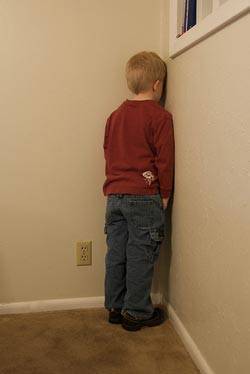
 Time-out is probably the most famous and most misused child discipline technique of all. Conceived by child psychologists Montrose Wolfe and Arthur Statts, it involves the elimination of inadvertent positive reinforcement for unacceptable behavior. Experts agree that this must be used when children have lost self-control (e.g. whining, yelling, throwing tantrums, aggression).
Many parents use time-out as a punishment or indirect consequence to misbehavior all the time. For time-out to work, however, it should be used as one tool in an arsenal of other discipline techniques for kids aged two (2) to eight (8). This technique can be very effective when used sparingly. Children who view time-out as a punishment may not use the time-out situation as the parent or caregiver intends, so you need to make sure you’re on the right track when enforcing time-outs.
Some Guidelines In Using Time-Out
• The rule is “one minute for each year of your child’s age.”
• Use a timer. Restart the timer if your child leaves the time-out earlier than scheduled.
• Use other discipline techniques if time-out doesn’t work.
• Don’t use time-out as a threat (“Yell one more time and I’ll put you in a time-out!”), or punishment. Time-out is designed to be an immediate and brief cooling-off period, and it’s most effective when a child needs help changing a mood or disposition. Preschool teacher Lolita David says that during a time-out, the parent should ignore the child until both of them calm down. So don’t mind whatever your child says or does during timeout; don’t say even a word of reproach. Talking to your child during time-out defeats the whole exercise.
Click here to read on about when and why time outs work.
[previous|page|next]
Read on to learn more about when and why time outs work.
When And Why It Works
Time-out is effective only if you keep in mind that the goal is to remove a child from a situation or an environment where she is getting gratification for her negative actions. A time-out is over once the mood has changed or once the child has calmed down and regained self control.
For kids aged five (5) and up, let them determine when a time-out is over; they need to learn to sense their own moods and rhythms. Studies have shown that time-out may be used for kids as young as 18 months up to age six (6). A single time-out will not change your child’s behavior in an instant, so use it until you get results. Feel free to change strategies when it seems that your child isn’t learning from it.
Photo from flickr.com
SOURCES:
• Lolita David, preschool teacher, Toddler’s Camp
• Valya Telep, Ph.D, child development specialist, Virginia State University
• Building Strong Families Positive Discipline Participant Work Book by Mary Gosche
• How to Behave So Your Children Will, Too! by Sal Severe, Ph.D.
• Website: focusonyourchild.com

Lorem ipsum dolor sit amet, consectetur adipisicing elit, sed do eiusmod
Lorem ipsum dolor sit amet, consectetur adipisicing elit, sed do eiusmod
