
Breastfeeding is still a sensitive topic in this day and age. While there is no doubt that breastmilk is the healthiest and most complete food you can give your baby, the act of breastfeeding entails a lot of other factors that may make it difficult for a mother. We brought together three moms to talk about their beliefs and misgivings about breastfeeding by reacting to general statements, with hopes that their opinions could help you sort out yours.
Meet our panel of moms*:
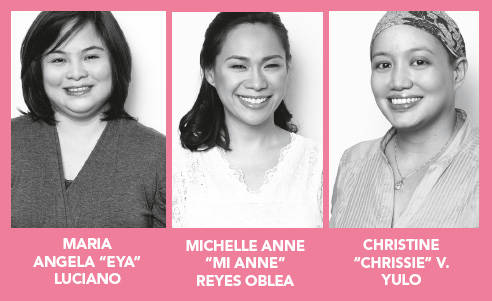
Mom who fed her baby formula: MARIA ANGELA "EYA" LUCIANO
Age: 37 years old
Occupation: Graduate student (Economics), finishing her thesis (at the time of the interview)
Single mom to Monty, 10, breastfed for three days, formula-fed until one year old
Mom who breasfed: MICHELLE ANNE "MI ANNE" REYES OBLEA
Age: 35 years old
Occupation: Business owner of BabyMama.ph (an online store selling affordable breast pumps and breastfeeding accessories)
Mom to Pilar, 3 (breastfed until two), and Tommy, 1 (still being breastfed)
Mom who couldn’t breastfeed due to a medical condition: CHRISTINE "CHRISSIE" V. YULO
Age: 36 years old
Occupation: Sales category manager
Mom to Miguel, 2 (breastfed for 17 months), and Matteo, 5 months, fed with donated breast milk for one month and then formula thereafter
1. Breastfed babies are healthier than formula-fed babies.
EYA: My son was breastfed for only three days. He was born with a heart defect, so he was a bit sickly. I can’t say that feeding him formula kept him sickly. But maybe if I had breastfed him, he would have been less sickly.
MI ANNE: I compared notes with my officemate who formula-fed her baby. Her baby would have diarrhea, constipation, or ear infections every month. My babies didn’t experience any of those. They would just have a cold or fever. Studies show that breastfed babies are healthier. Based on my own experiences, I could really see that my babies are healthier.
CHRISSIE: Of my kids, one was breastfed and one wasn’t. Miguel had a special medical condition and he had undergone four major operations by the time he was 10 months old. That was one of the reasons why my doctor told me it would be better if I breastfed him. Even with all of those operations, he was a very healthy baby. Maybe it was because of the breast milk.
My second son who wasn’t breastfed is also a pretty healthy kid. Except for Miguel’s operations, both of them hardly get sick.
MI ANNE: I also read somewhere that breastfed babies aren’t necessarily healthier, but they should be treated as the baseline. In the past, that was the only [source of] nutrition available to them. So their [breastfed babies] health should be treated as the norm rather than the exception.
[previous|page|next]
2. Breastfeeding enhances your child’s development and intelligence.
EYA: More than the kind of milk he drinks, it would really matter if your child is exposed to playmates or peers his age who could help him express himself. My son is an only child so it took some time for him to start talking. He didn’t hit his language milestones [on time].
CHRISSIE: I agree. It’s actually the nurturing part that counts. You don’t just rely on the milk but also on what your child is exposed to, and how much TLC and guidance he receives.
MI ANNE: While studies show that breastfed babies have a higher IQ, it seems pretty subjective pa rin. It’s funny if a breastfeeding mom would go around saying, My baby is breastfed therefore he’s smarter than your non-breastfed baby. (Everyone laughs). It really depends on a lot of factors.
3. Breastfeeding saves you money.
CHRISSIE: Formula is really expensive!
EYA: It is! Even during Monty’s time, it was already expensive.
CHRISSIE: I think the brand I’m using costs over P1,000 for 900 grams. Some cost P700 or P800 per can. When I was breastfeeding, the expenses I worried about were for breast-milk storage bags and the breast pump. The pump cost me about P25,000 then, minus the accessories. With formula, it’s a fixed amount. That’s P1,000 a week!
MI ANNE: The breast pump doesn’t have to be expensive. I sell double electric pumps for as low as P4,000. Other brands from the U.S. cost about P8,800 or P14,000.
4. Breast milk is superior to formula.
MI ANNE: I really believe that breast milk is superior to formula. For the 40 components in formula, there are thousands in breast milk. But it’s not just a rational thing, it’s a gut feeling, too.
CHRISSIE: Breastfeeding also gives you an opportunity to bond with your baby. Because of this, I think breastfeeding is better than formula feeding. But there’s a catch. The mom also has to eat healthy. Whatever she’s taking goes straight to her baby. It’s better to look at the whole picture; it’s not just the milk.
EYA: Breast milk is superior to formula but you also have to watch what you eat.
[previous|page|next]
5. Breastfeeding benefits the environment.
EYA: Manufacturing formula entails a lot of processing. Raising cows alone contributes to the global greenhouse gas emissions. So, formula affects the environment in a negative way. That can’t be denied.
MI ANNE: There’s also growing consumerism around breastfeeding. Before, you didn’t really need much to breastfeed -- just yourself and your baby. Ngayon, pagandahan na ng breast pump. For convenience, breastfeeding moms also use disposable plastic storage bags. So just because you breastfeed doesn’t mean you are helping the environment. It’s really up to you to be more environmentally friendly. For example, you can use glass bottles or reusable bottles instead of disposable breast-milk storage bags.
6. Breastfeeding, while ideal, is not for everybody.
CHRISSIE: I think it’s a personal choice. You can’t force someone to do it. Also, there are some people who want to but can’t (like me!).
EYA: I really wanted to breastfeed as well. But since I was on asthma medication, I felt that it wasn’t really for me anymore. I gave in to formula. But given another chance, I would want to [breastfeed].
MI ANNE: I think it’s a personal choice. But I also encounter some moms who come to me and say, I want to breastfeed. But do I have to breastfeed every day? (Everyone laughs) If you’re going to breastfeed, be prepared to do it.
7. Breastfeeding ties you down.
CHRISSIE: Breastfeeding wasn’t easy for me. I had a lot of breast milk! But that was because I was praning. I would eat a lot of malunggay and drink tons of water. I was afraid I wouldn’t have enough breast milk. I’d schedule my meetings around my pumping time, and I had several questions before accepting provincial trip assignments. That’s how ‘tied down’ I was. Even watching a movie was a big production. It was hard at the start, but we eventually got used to it.
MI ANNE: My husband and I went on vacation while I was breastfeeding. It was our first vacation together. But how could I feel sexy [after giving birth] when I was pumping every four hours? The spontaneity was gone. That’s one advantage I saw of formula feeding: You have more freedom. You don’t have to worry about your supply. You don’t have to worry if your baby is latching properly. When you’re breastfeeding, you have to be disciplined and maabilidad. But if you’re formula feeding, you also take one big emotional load off your chest.
EYA: Yes, I did feel that freedom while I was formula-feeding. You can take powdered milk anywhere with you without worrying that it would spoil. You can also delegate the milk preparation; you’re not physically involved in the milk production.
[previous|page|next]
8. Breastfeeding is difficult for moms who work.
CHRISSIE: It’s difficult only if you make it difficult. Find a way. It’s really a big adjustment at the start. If you’re determined, you’d do it.
EYA: That’s true. I’ve seen it in action. I attended a talk by an environmentalist, and in the middle of her speech, she got her baby from the audience and started to breastfeed. She told us that it was a choice she’d made and that it was part of her advocacy. She made it work for her.
9. More Filipinas need to be educated on breastfeeding.
MI ANNE: I think so. I know an OB-gyne who practices in the province, and she actually told me, “Hindi ako naniniwala sa breastfeeding. Hindi ko nga na-breastfeed ‘yung mga anak ko.” A lot of moms don’t have access to information. So when they go to OBs who don’t believe in breastfeeding, you end up with moms who formula-feed without having been given the right information. I don’t think it’s just the moms who need to be educated on breastfeeding; so do the doctors and the entire support system for pregnant women.
EYA: True! My OB did not give me any information about breastfeeding. A nurse was actually the one who helped me out at the hospital. It wasn’t really encouraged at the time. I thought it was just natural, some maternal instinct would take hold of me, and then I’d breastfeed. It’s not like that pala.
CHRISSIE: In my case, I was lucky (to have found) Channel 3 in Makati Med. During my first pregnancy, I was hospitalized and that was where I discovered videos on how to latch a baby and the different ways to hold the baby while breastfeeding. I also had the support of my friends who have breastfed ahead of me. If I didn’t have access to those videos and to my friends, I may never have discovered the how-tos of breastfeeding.
Related video: Breastfeeding 101: What you need to know to get started
10. Breastfeeding is only practical with certain lifestyles.
CHRISSIE: It really depends on you. It’s a commitment. Whatever lifestyle you have, you can breastfeed. The benefits are great, but you need to put effort into it. It will definitely eat up your time. If you’re willing to do it, then go ahead and breastfeed. It’s you who makes it work, not your lifestyle.
MI ANNE: Some people associate breastfeeding with attachment parenting. It’s a whole school of thought: baby-wearing, co-sleeping, etc. I breastfeed, but I don’t do babywearing. No matter what type of mom you are, you can breastfeed if you want.
EYA: I agree. Any mother can do it. It’s up to you if you can put up with the challenges that come with it. It depends on whether you want the benefits of breastfeeding and if you can commit to it.
* Given age of panelists and their kids are as of the time the interview was conducted.
Portrait photos by Dakila Angeles. Thumbnail image from heelssocialinnovation.com

Lorem ipsum dolor sit amet, consectetur adipisicing elit, sed do eiusmod
Lorem ipsum dolor sit amet, consectetur adipisicing elit, sed do eiusmod
