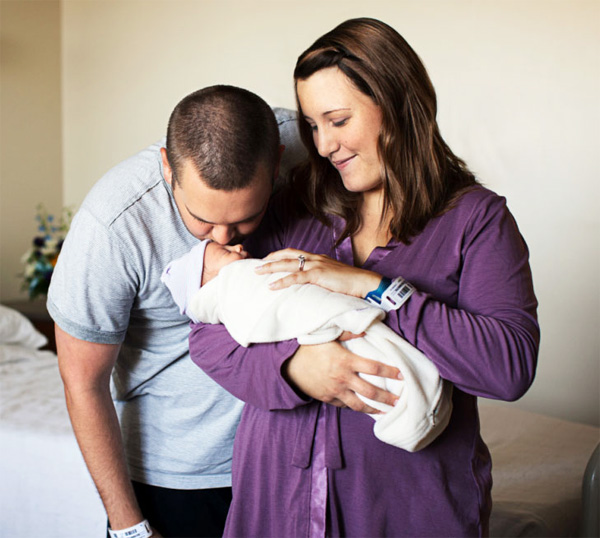
Photo from barnesjewish.org
After all the preparation and anticipation, it’s now time to bring Baby home - and you realize you’ve no clue what to do. If this sounds like you, don’t panic. When the reality sets in that another human being is now completely dependent upon you, it’s normal to feel overwhelmed and worried. Use this guide to help get you through the first night with Baby.
Bringing Baby Home
If you’re riding home in your own car, make sure that the car seat is installed and ready to go well before you set foot outside the hospital. It’s best to practice setting up the seat over and over with your partner while you’re still pregnant. That way, amidst the panic of getting to the hospital, it’ll be one less thing to worry about since it will be second nature to set it all up.
Ensure that the baby’s head is supported during the entire ride home. Baby might fall asleep on the way (newborns tend to love movement!), and it might tempt you to take the whole carseat-with-baby into the house, but most experts advise against it, claiming that sleeping upright may increase your newborn’s risk for SIDS (sudden infant death syndrome). Take Baby out of the carseat and lay him/her on the bed or crib.
Sleeping
Your baby can sleep up to 20 hours in a day, but not for long periods of time - usually only 1-4 hours at a time. You may already be anticipating sleepless nights, but it’s important to find time to sleep and care for yourself, too. It’s best to sleep when your baby sleeps, and it will be helpful to coordinate with someone- a partner, a grandparent, or a trusted yaya - to help watch the baby while you nap. Take advantage of your free time to get much-needed rest and finish doing things around the house.
Ensure that the room temperature is neither too hot nor too cold, Most experts agree that it’s best to designate a place for the baby to sleep and stick to it, whether it’s on a bed, in a crib, co-sleeper, or Moses basket. This will train your child so he/she knows that when he or she is in that space, it’s time to sleep.
Crying
You’re exhausted and probably feeling weak, and now your baby is constantly crying. Don’t let the frustration get the best of you. Crying happens when your child is hungry, needs changing, or isn’t feeling well and needs to get your attention. Through process of elimination you should be able to pinpoint the problem. If you suspect that there’s something wrong with the baby, seek help immediately. That being said, however, it’s a good idea to check for signs that indicate an emergency, such as fever or blood in the baby’s poo.
They love to be swaddled, as it replicates the cozy environment in your belly. However, there’s no “best” way to soothe a crying baby- you’ll have to experiment with different things to see what works for him/her: swaying back and forth, taking a walk, letting the baby suck on your finger, etc. Keep trying and your diligence will pay off once you realize what triggers your baby’s relaxation.
Remember that you don’t have to do everything yourself - make sure to discuss a schedule with your partner and relatives to help with taking care of the baby as well. If you’re breastfeeding, your partner or another relative can take over during non-feeding times. It’s a good idea to take the baby away from the room and only return when he or she is asleep. This allows you or your partner to get some uninterrupted zzz’s, and allows for a separate bonding time between parent and baby.
Feeding
Typically, your baby feeds about every 1-4 hours, counting the time at the start of each feeding. It’s best to listen to baby rather than force-feed him at exact intervals. If you’re breastfeeding, feeding on demand will help alleviate engorged breasts. Expect each feeding to take up to 45 minutes, but on average, a baby will spend 10-20 min on each breast, or go through several ounces of formula, whichever the case may be. However, there will be times when you’ll find yourself stuck in a rocker, couch, or chair for more than 45 minutes. Thus, it’s important to get comfortable, and have some water and healthy snacks handy, along with a book, magazine, TV remote, and telephone nearby.
If you choose to bottle-feed, don’t forget to take into consideration the time it takes to warm the bottles and prepare the milk. Familiarize yourself with the warmer ahead of time so that you’re not caught with a hungry baby in one hand and a milk-warmer manual on the other.
[previous|page|next]
Don’t forget to burp the baby during or after feeding, as he or she tends to swallow a lot of air while feeding. Place the baby upright against your chest or sitting on one knee, leaning against your palm, and gently pat baby on the back. Be warned: sometimes, the acidity of upchucked-milk can bleach the fabric on carpet, sofas, or clothing.
Remember to stay hydrated throughout the day: this is not only important for breastfeeding but also in the recovery from labor. Also, if you had a vaginal birth, you may bleed a little while breastfeeding - this is normal. Your doctor should tell you what other bodily changes to expect in the first few weeks post-partum.
Some women prefer to have a midwife, doula or lactation consultant visit with them everyday for the first few days, to help address concerns about breastfeeding. Remember that breastfeeding doesn’t always happen automatically, and an experienced professional can ensure that it becomes a beautiful, rewarding experience, rather than a painful and discouraging one.
Changing Diapers
Whether breastfed or bottle-fed, babies should go through 3-4 diaper changes within a 24-hour period. By day 4, the baby should be going through 4-8 diapers per day, pooping 6-8 times a day, and gaining some weight. Be prepared for different colors in baby’s poop. Baby’s first poo – meconium - will look tarry, black-ish for the first 2 days. After that, it will look greenish-brown, and then after about day 6, it will get closer to a mustard yellow. If you see blood in the stool, or if the stool is colorless, you should seek help immediately, as this could indicate a serious internal problem. If the order of poo colors goes backwards - from yellow to brownish-black - that’s also a sign to call the pediatrician.
It may be a good idea to practice changing diapers while you’re still pregnant, particularly if you’re never changed a diaper in your life. Veteran moms encourage learning how to change a diaper in the dark, or at least in dim settings, as you’ll be changing many diapers that way, and just makes it all the more easy to change diapers in well-lit environments.
When it comes to choosing wet wipes, diaper creams, or nappy liners, keep in mind that your baby may be highly sensitive to the chemicals/perfumes in those products. Whenever possible, use all-natural, scent-free products.
Preparing Yourself Mentally Beforehand
It’s often said that failing to plan is planning to fail. Here are several tips to help keep you sane, not just for the first night, but for the first week with Baby:
1. Talk to moms who have been there, done that, and bought the T-shirt
Veteran moms will give you all kinds of advice you won’t find in any parenting book on the market, from effective feeding techniques to inexpensive products that work as well or even better than expensive ones. Wisdom from experience is unbeatable.
2. Get Daddy involved, ASAP
He may not be enthusiastic about losing sleep, but Dads will want to be as big of a part in Baby’s life as you. Encourage him to spend time with the baby while you’re sleeping or getting your “me” time. Don’t linger around whenever he’s changing diapers or giving a bath - this may make him think you’re judging him. Give him space to be alone with the baby and allow him to develop his own ways of doing things, so that he, too, can feel confident in his own parenting skills.
3. Have a first week survival pack ready
Though this is list is by no means complete, here are the most recommended items from experienced moms: breast pads (to keep leaking milk from wetting your clothes), water jug (to stay hydrated without repeated trips to the kitchen), sanitary pads/napkins, nipple cream, extra pillows, healthy snacks, spritz bottle (for easy cleaning of perineal area, which could still be painful or swollen), “cool cups”- newborn diapers that you fill with water then stick in the freezer to make cooling “cups” that go inside your bra for about 20 minutes in between feedings to alleviate painful, engorged breasts
4. Designate someone to take care of you
This isn’t about spoiling yourself. Naturally, you’re going to forget about yourself because you’ll be focused on the baby, tending to the rest of your family, not to mention the rest of the household duties. But more than ever, your baby needs you to be as well-rested, well-nourished, and as sane as possible. So designate someone who can help remind you to take it easy when you’re in overdrive, volunteer to do some cleaning up, or go to the drugstore to pick up some things you need.
Remember, you don’t have to do everything on your own. Don’t be afraid to accept help from relatives and good friends who are gracious enough to make the offer. Finally, don’t forget to enjoy this learning process- your baby will grow up faster you think!

Lorem ipsum dolor sit amet, consectetur adipisicing elit, sed do eiusmod
Lorem ipsum dolor sit amet, consectetur adipisicing elit, sed do eiusmod