
Editor’s Note: This article is intended for information purposes only. It does not substitute a doctor. It is vital to always consult a medically trained professional for advice that suits your needs best.
Though psoriasis is a "serious global problem," according to the World Health Organization (WHO), the general public has so much to learn about this skin disease. The psoriasis cause, for instance, is still wrongfully believed to be through close contact.
That's why experts from the American Academy of Dermatology Association (AADA) have this clarification: "Psoriasis is not contagious. Unlike chickenpox or a cold, you cannot catch psoriasis from someone."
They also point out that you cannot get psoriasis through these actions:
- Swimming in a pool with someone who has psoriasis
- Touching someone who has psoriasis
- Having sex with someone who has psoriasis
What is psoriasis?
Experts from WHO define psoriasis as a "chronic, noncommunicable, painful, disfiguring and disabling disease for which there is no cure and with great negative impact on patients’ quality of life (QoL)."
They add that the disease "can occur at any age, and is most common in the age group 50–69." Additionally, the reported prevalence of psoriasis in countries ranges between 0.09% and 11.4%, which makes it a serious global problem.
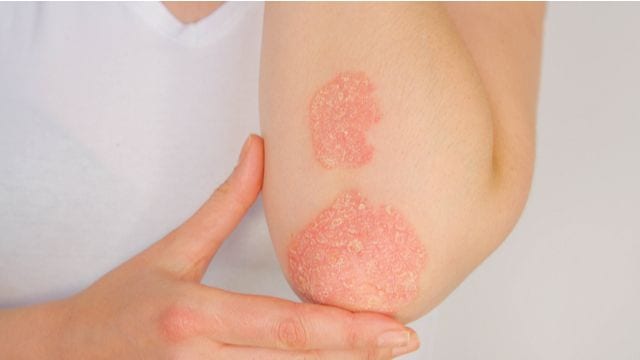
The dermatologists, on the other hand, explain that the skin condition develops "when the body makes skin cells too quickly, causing skin cells to pile up and form visible patches or spots on the skin."
Psoriasis causes
If psoriasis is not contagious and can't be passed on through close contact, how then can you get inflected with this disease? Experts all agree that the root cause of psoriasis is still unknown. But there are certain factors that cause the condition to develop.
Genetic predisposition
Experts from the AADA say that psoriasis runs in families. You have a higher risk of getting the disease if you have a parent, grandparent, brother, or sister already inflicted with it. They also point out that "scientists have found that people who have certain genes are more likely to get psoriasis."
However, they make it clear that scientists have also learned that "some people who get psoriasis don’t have genes that increase their risk of getting psoriasis." That's why they believe that a person, who has a family member with psoriasis, has to be first exposed to a trigger before he or she can actually get the disease.
Immune system
The role of the immune system as a psoriasis cause is also a major topic of research, according to experts from WHO. They also point out that "although there is a suggestion that psoriasis could be an autoimmune disease, no autoantigen that could be responsible has been defined yet."
The dermalologists have this explanation on how the immune system may cause psoriasis to develop in a person: "White blood cells, also called T-cells, are part of the body’s immune system. These cells help prevent us from getting sick by attacking things that can harm us, such as bacteria and viruses."
But if something goes wrong with your immune system due to psoriasis, for instance, your T-cells get confused and can't recognize their real targets. So what happens is they attack your body's skin cells instead. That attack subsequently causes your body to make new skin cells more than the normal rate. The new skin cells then pile up on the surface of your skin as manifestation of psoriasis.
Experts point out that once your T-cells start attacking the skin cells, they will not stop and will just continue for the rest of your life. But there is an exception: the guttate type of psoriasis. If you had it as a child, you may never have it again.
External and internal factors
Aside from having the genetic predisposition and the mixup in immune system, experts say that you may get psoriasis from external and internal triggers. These include:
- Mild trauma or injury to skin
- Sunburn
- Infections
- Systemic drugs
- Stress
Experts make it clear that psoriasis triggers vary from person to person. There are certain triggers that can worsen your psoriasis but may not have an effect on another person's condition. Thus it's important to know the psoriasis cause for your particular case, and always consult your doctor.
What other parents are reading

Lorem ipsum dolor sit amet, consectetur adipisicing elit, sed do eiusmod
Lorem ipsum dolor sit amet, consectetur adipisicing elit, sed do eiusmod
