
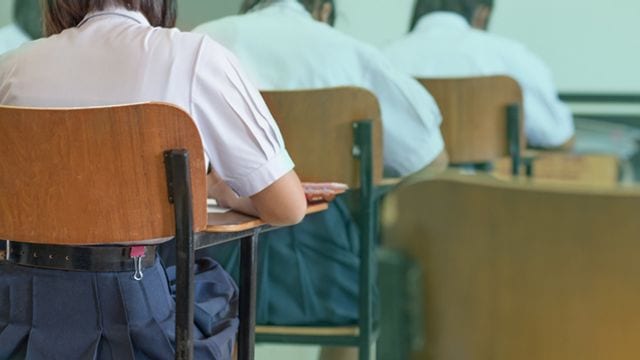
Filipino students aged 15 are reported to have poor creative thinking skills, according to a recent study by the Organisation for Economic Co-operation and Development (OECD).
In a global assessment by the OECD in 2022, the Philippines was ranked 63rd out of 64 countries. The country received a mean score of 16 in creative thinking, significantly below the global average of 33. Moreover, 1 in 4 students in the Philippines, Morocco, and Saudi Arabia said they found learning new things to be boring.
ALSO READ: How To Improve Your Child's Reading Comprehension
Meanwhile, Singapore secured the top position with a score of 41, followed by South Korea and Canada with a score of 38. The top 10 also included Australia (37), New Zealand (36), Estonia (36), Finland (36), Denmark (35), Latvia (35), and Belgium (35). Albania was at the bottom of the rankings.
The Programme for International Student Assessment (PISA) 2022 evaluated the abilities of 15-year-old students worldwide in mathematics, reading, and science. It also assessed their capability to generate and evaluate original ideas that could be translated into effective solutions.
PISA 2022 Key Findings
PISA 2022 defined the ability to think creatively as "the competence to engage in the generation, evaluation, and improvement of original and diverse ideas." One of the goals of the assessment was to see how well education systems are helping students learn to think outside the box across different types of tasks.
In the new OECD journal revealing the PISA 2022 results, some of the key findings were uncovered:
- Students can excel in creative thinking in all types of schools.
- There is a strong gender difference in creative thinking performance: in no country or economy did boys outperform girls.
- On average, students with higher socio-economic status performed better in creative thinking, scoring around 9.5 points higher than disadvantaged students.
- Students with an immigrant background scored lower in creative thinking than their non-immigrant peers, but performance differences can be explained by the socio-economic and linguistic barriers that they face.
For the assessment, students were given open-ended tasks with no single correct response. There were four different domain contexts: written expression, visual expression, social problem-solving, and scientific problem-solving. The tasks included generating a story idea for a comic strip and brainstorming different approaches for an awareness-raising campaign in school.
Click here to learn what is Singapore Math and how this mathematical teaching approach can be beneficial to your child.
More from sp

Lorem ipsum dolor sit amet, consectetur adipisicing elit, sed do eiusmod
Lorem ipsum dolor sit amet, consectetur adipisicing elit, sed do eiusmod
