

Trigger Warning: Discussion of suicide
Television host and broadcaster Ramon Tulfo Jr. revealed that his eldest grandson, Ramon Enrique (Ramonito), passed away on October 26.
ALSO READ: Mom Finds Note About Death On Teen Child's Phone; Here's What An Expert Suggests She Should Do
Ramon Tulfo Shares Heartbreaking News of Grandson’s Death
In an emotional Facebook post, Tulfo revealed that Ramonito struggled with depression, which ultimately led to the tragic outcome.
Tulfo expressed his deep sorrow and regret, wishing his grandson had sought support.
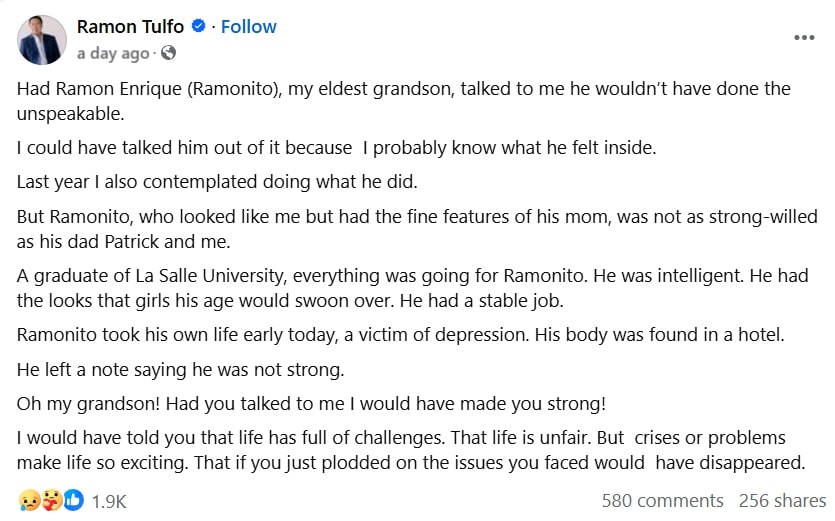
“I could have talked him out of it because I likely understand what he felt inside,” he continued, reflecting on his own past experience of contemplating suicide.
Ramonito was a graduate of De La Salle University. Tulfo emphasized that while his grandson was successful in his own right, he still grappled with feelings of inadequacy. “A graduate of [sic] La Salle University, everything was going for Ramonito. He was intelligent. He had the looks that girls his age would swoon over. He had a stable job,” he wrote.
Despite all outward signs of success, Ramonito was found lifeless, leaving behind a note that expressed his struggle, saying he felt he was “not strong.”
“Oh, my grandson! Had you talked to me, I would have made you strong!” Tulfo lamented. Reflecting on the challenges of life, Tulfo conveyed a message he wished his grandson had heard: that life is full of challenges and unfair moments, but these struggles bring “excitement.”
Condolences poured in from the veteran broadcaster's followers.
How the public should view suicide
The World Health Organization (WHO) has repeatedly emphasized that suicide isn’t caused by a single event, noting that “the factors that lead to suicide are usually multiple and complex.”
WHO identifies depression as a significant risk factor for suicide, which tragically claims hundreds of thousands of lives each year.
According to Dr. Shekhar Saxena of WHO, understanding depression and how to treat it is essential but is only the first step. He emphasizes that “sustained scale-up of mental health services accessible to everyone, even the most remote populations in the world” is needed to truly make a difference.
So, what exactly is depression? WHO describes it as a common mental health condition marked by a persistent sadness and lack of interest in activities that people usually find enjoyable. To meet the criteria for depression, these feelings must persist for two weeks or more, making everyday tasks feel overwhelming.
People struggling with depression often experience several symptoms: low energy, changes in appetite, sleeping too much or too little, anxiety, difficulty concentrating, restlessness, and a deep sense of worthlessness, guilt, or hopelessness. In some cases, these feelings can lead to thoughts of self-harm or suicide. Recognizing these signs and seeking support early on can make a meaningful difference.
While family's support is essential, professional help is often needed in treating depression.
Further, Rachel Gibbons, a consultant psychiatrist and psychoanalyst, asserts in her paper from Cambridge University Press that “no one is to blame for anyone else's death by suicide.”
Gibbons notes that suicide is a “shocking annihilatory loss,” leaving individuals suddenly and irretrievably gone, often without warning. This can present a challenging experience for bereaved families, who may find it helpful to understand that self-blame may hinder their healing process.
READ: Important Words To Help Your Child With Depression When She Won't Open Up
Mental Health Hotlines
If you or someone you know needs support, the Department of Health offers a National Crisis Hotline through the National Center for Mental Health to provide assistance for mental health concerns. You can reach the hotline at:
- Cellphone Lines: 0917-899-8727, 0966-351-4518, or 0908-639-2672
- Toll-free Luzon-wide Hotline: 1553
Click here for key phrases from an expert to help your child with depression when they won't open up.
More from sp

Lorem ipsum dolor sit amet, consectetur adipisicing elit, sed do eiusmod
Lorem ipsum dolor sit amet, consectetur adipisicing elit, sed do eiusmod
