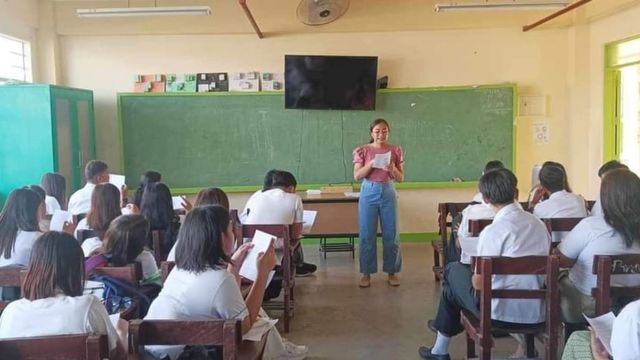
During his State of the Nation Address (SONA) on Monday, President Ferdinand Marcos Jr. announced his initiative to advance educational reforms through the use of digital technology.
"As we learn to address the classroom gap, the digital gap must also be addressed with equal intensity," said the President in his third SONA at the Batasang Pambansa.
In his address on education, Marcos Jr. acknowledged that Filipino students have been lagging behind in various learning areas compared to their international peers.
It can be recalled that data from the Programme for International Student Assessment (PISA) previously indicated that the scores achieved by the Philippines in Math, Reading, and Science were all below the global averages set by the Organization for Economic Co-operation and Development (OECD).
"Therefore, our national learning recovery program must proceed without the slightest distraction, especially in basic education," the President said.
He added, "Our system of education must be strategically calibrated to make sure that our youth are not only taught to become literate, but it has also consciously developed them to be problem solvers and into critical thinkers, hungry for success, ready for the future."
ALSO READ: Filipino Students Lag Behind In Creative Thinking—New OECD Study
Technological Integration
The President underscored the importance of leveraging technology to enhance educational delivery and accessibility.
“We are working towards the day when all students will be equipped with computers, smart TVs, essential programs, digital books, and access to reliable power and the internet,” Marcos Jr. said.
Moreover, he believes that digitalization and solar-powered electricity should "become the standard feature in our schools and our classrooms."
Earlier this year, the Department of Education (DepEd) launched its Digital Education 2028 or DigiEd 2028 program to help ease the burden on students and teachers who lack the necessary tools for effective online and blended learning.
This includes the distribution of tablets and laptops, the establishment of community internet hubs in remote areas, and the development of a comprehensive e-learning platform.
These efforts are designed to bridge the digital divide and ensure that all students, regardless of their geographical location, have access to quality education.
Read here to learn more about the pros and cons of both public and private schools.
More from sp

Lorem ipsum dolor sit amet, consectetur adipisicing elit, sed do eiusmod
Lorem ipsum dolor sit amet, consectetur adipisicing elit, sed do eiusmod