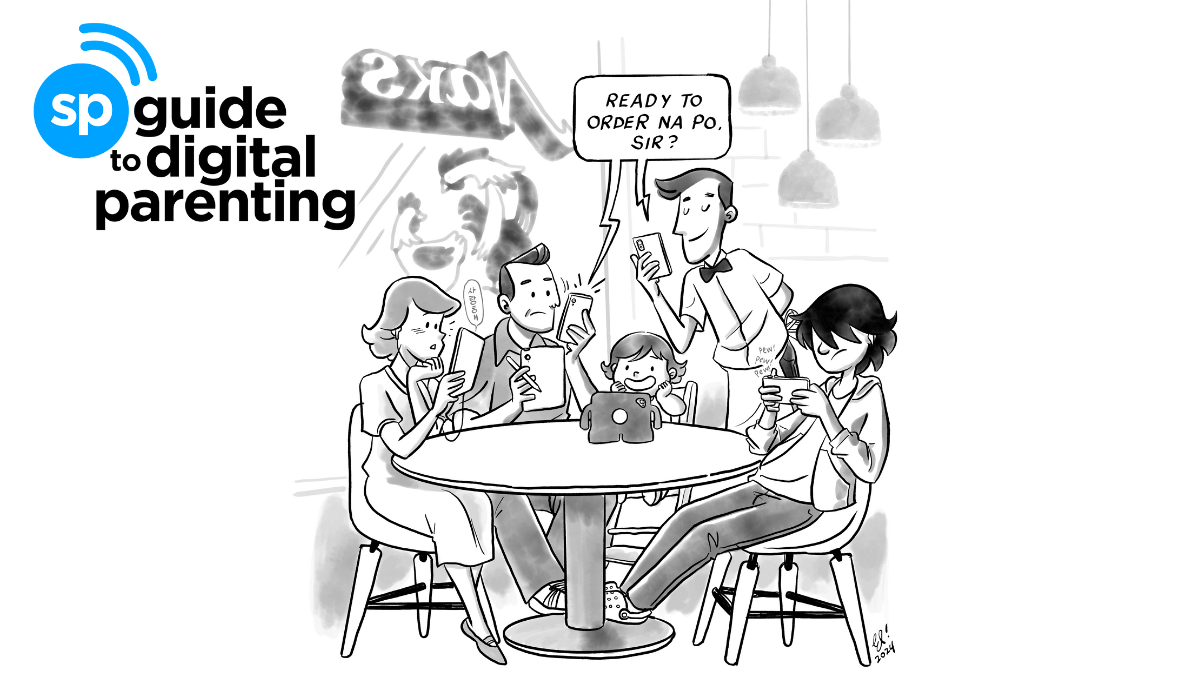

The scene is all too familiar: a young Filipino family enjoys a meal in a mall, and the toddlers, even babies, are busy with a screen. If you listen hard enough, you will inevitably hear music from a children’s show along with the usual noises of a restaurant. But surely, you don’t need to look far to see such a view.
This picture of a Filipino family is so common that these days, pulling out your mobile phone to keep your child entertained or seated at the table is hardly entwined in guilt. Children two years old and below can be seen watching on a smartphone while sitting in a stroller—presumably, so they remain seated inside the stroller.
There is hardly any pushback in 2024. Sneers, perhaps a little. The disapprovals that get on a parent’s nerves the most, however, are the ones posted on social media.
Don't judge us, mind your own parenting
“What do you think of this?” A friend asked me via direct message. A mom posted in a mommy Facebook community how unfortunate it is that young families no longer talk to each other while dining out. They’re all too busy, glued to their screens while they eat. “Talk to each other!” she ranted. Part of her post stated that she is a mom, too, but she does not allow her children to behave similarly while dining.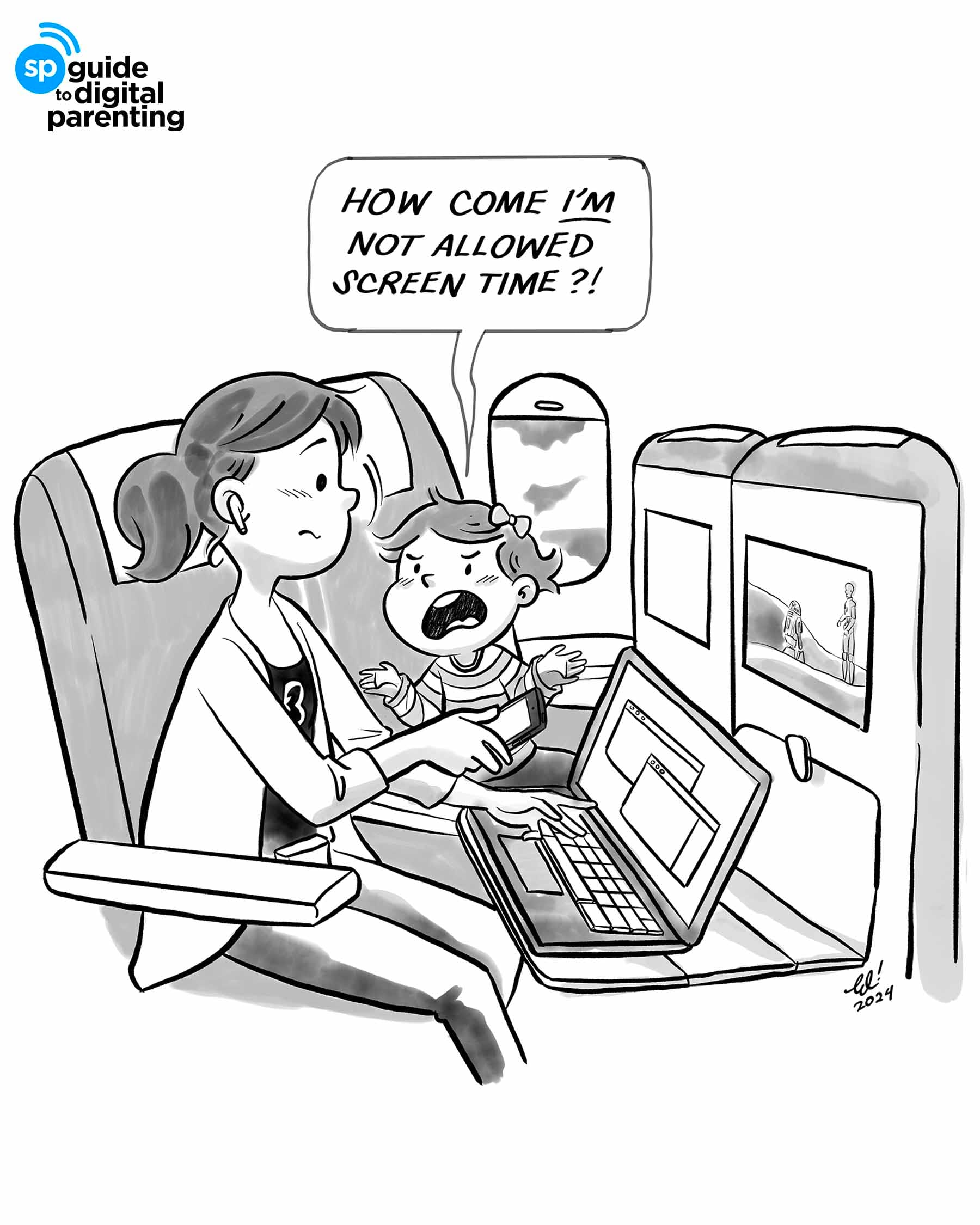
When I first became a parent over a decade ago, I always felt guilty using a screen to keep my eldest—at one or two years old—seated. Sometimes it was during a meal, sometimes it was just because I was too exhausted to chase after her while we were out with relatives, and as it turns out, even if they wanted to see the baby, no one really knew how to engage with a child who had yet to develop language. Peppa Pig was the easiest way to get her to sit for half an hour while we were in public, especially when there was no space for a curious toddler to run around.
Today’s parents often argue this viewpoint: A stranger will never know what a family has been doing before that exact moment when they saw a family dining together while the kids watched on their devices. It just might be the first 30 minutes that day when the parents allowed their kids to be on a device. They may have just come from a good time together bonding as a family, and they were just caught decompressing for a couple of minutes, and it was blown out of proportion—parents these days, tsk, tsk, they’re so neglectful.
We also find it difficult to listen to comments and observations from non-parents, particularly those older than us who probably no longer have any intention of becoming parents. Because for those our age or younger, we can smugly say, Just wait till you have a child. Come back to me without a screen when you’re trying to appease your toddler during a flight.
Data on Filipino children's digital and online use
A child’s digital use cannot be ignored from a data standpoint.
While most parents (87.4%) in the Philippines are confident they can engage their children on the topic of online safety according to Google’s latest Online Survey as reported in this news article in 2024, the number of parents who say it is difficult to find time to talk to their children about online safety is 53.2%. This is an increase compared to 2022 when the survey recorded only 40%.
In 2021, UNICEF Philippines published the study entitled Philippine Kids Online: The Online Experiences of Children in the Philippines: Opportunities, Risks, and Barriers. This study found that the average age a Filipino child begins to go online is 10 years old.
The alarming data hardly needs to be reiterated to parents. The disconnect, I surmise, lies in parents feeling helpless, almost to the point of having to contend with digital devices and social media.
Much of our data in the Philippines focuses on a child’s online habits and use, and 10 years old is likely when a child can create her own social media account. But a child who regularly watches his favorite Miss Rachel videos at two years old is already online, albeit with adult supervision.
The same UNICEF Philippines study above found that one in four children in the Philippines have encountered sexual images when online, while one in seven received sexual messages in the past year. Unfortunately, the same study notes that few children ask for help after such experiences, with only one in ten children reporting the person or problem on the relevant platform or account.
Correlations may be freely assumed between the country's poor academic performance outcome based on the Program for International Student Assessment (PISA) in 2018 and 2022 and the pervasive use of smartphones and social media by Filipinos under 18 but there is no actual data on it apart from Facebook comments. The data that is available, however, is the global decline in math, reading, and science beginning the early 2010s, as reported by social psychologist and author of bestsellerThe Anxious Generation, Jonathan Haidt, in his massively read article "End Phone-Based Childhood Now" published by The Atlantic.
Let's be honest: the alarming data hardly needs to be reiterated to parents. The disconnect, I surmise, lies in parents feeling helpless, almost to the point of having to contend with digital devices and social media. We sometimes convince ourselves that it can't be helped, because we don't want our children to feel left out by their peers.
RELATED: Screen Time Before 18 Months Old Can Lead To Behavioral Problems In Childhood
Smart Parenting Guide to Digital Parenting
In the US, movements and experts like Better Screen Time and Haidt have been making calls for healthy tech habits for kids and the family for years. In late June, Singapore announced it will be placing measures to manage device use in children. No matter the continent, the recommendations are the same: responsible use of digital devices must be addressed collectively and on multiple levels, in policies and laws, in schools, and last but certainly not least, by parents.
This is why Smart Parenting is launching the Smart Parenting Guide to Digital Parenting. We recognize that our children are quickly growing up in an environment that's even quicker to update and evolve, and the society they will eventually live and lead in is likely to be far more connected and digital than the one we’re raising them in today.
We must learn to move forward with the digital world as an ally rather than a director in raising our children.
We have published articles in recent years to meet the need, some of the top-performing articles include a parent's guide to Roblox, a reminder to teachers not to post content of their students online, and a dad's open letter to parents to get kids off screens, among others. But the need has now surpassed sporadic article pitches as a reaction to a horrifying headline or viral video.
In Smart Parenting Village, our Facebook community of over 100,000 Filipino parents, we often read anonymous posts of parents asking for advice on their kids’ digital use, ranging from age-appropriate learning apps, to helping their children navigate online and offline friends, and to the darker side of cyberbullying or online sexual abuse experience. A few have voiced out, through posts as well as comments, their regret for introducing their children to digital devices or "gadgets" too early.
We believe it is unfair and naive to chalk up the digital and online worlds as wholly negative and “bad”. It is simplistic to think it is merely a choice between the two: no devices or otherwise. Digitalization must be given credit too. It has allowed our children to continue their education during the COVID-19 pandemic, helps us stay in touch with family, and makes information and finding like-minded individuals accessible, to name a few. Our children are also continuing to grow through learning platforms that provide students in far-flung areas a chance at receiving education if they just have internet connection and a device. Without digitalization, such Filipino children's chances of completing their education would be lower.
There are global studies that are examining the positive outcomes of adolescents and digital media. One example, from a 2022 study, is developing understanding and empathy when exposed to others different from themselves. It is important to note that the study involves adolescents or children eight years old and older.
Digital is a double-edged sword. Given our reality, we must learn to move forward with the digital world as an ally rather than a director in raising our children.
We want to navigate this reality together with you. As always, we will provide you with up-to-date, relevant information and tools you can use to model digital literacy with integrity so that you are empowered to lead your children.
We at Smart Parenting are aware of the tension—we are a purely digital publication after all. However, our mission and our guiding light of raising happy, healthy Filipino families means we pause, look around, and ask ourselves, what is our role in raising the next generation of Filipinos? Are we here just to feature celebrities, poke fun at the light moments of parenting, or scare readers with health-related news?
We promised it earlier this year and it bears repeating, we are in the trenches of parenting with you. Whether recognized or not, raising children in the digital age requires a new manual that develops and modernizes akin to technology.
Parents are role models in digital, too
During last night's party, an adult asked my four-year-old if he liked his mama. It was her effort to connect with a child, asking an innocent question. "Yes," he answered, "but she's always on her phone."
While this series may be at its launch, here's the daunting and unnerving reminder that is the secret to our collective success—responsible and healthy digital use begins with us parents. It is the same parenting advice no one wants to hear. We are the leaders. And if we are to see any of our desired results, the power, quite literally, rests on our fingertips.
***
Ronna Capili Bonifacio is the Editor-in-Chief of Smart Parenting. She is a mom of three children.
Illustrations by Elbert Or. Elbert wears multiple hats throughout the week. He is a facilitator, coach, illustrator, and co-founder of Pushpin, a social impact design studio for non-profits and foundations. But his favorite hats are as husband to Lorra and dad to Oliver and Zoe.