
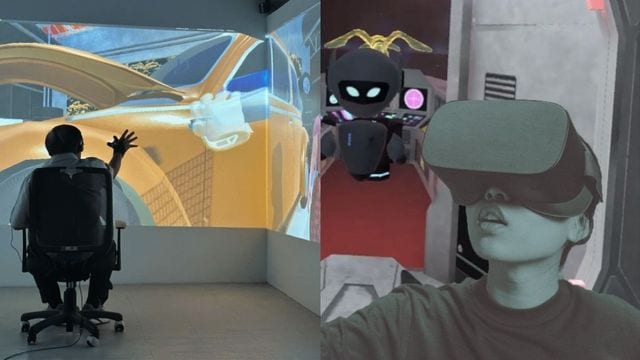
Therapy can be tough for some patients, but a new Filipino invention is turning it into something they can look forward to. Researchers from the University of the Philippines Manila have developed a virtual reality (VR) game that transforms therapy into an interactive and engaging experience.
ALSO READ: UST Researchers Make Smart Pen That Detects Signs of ADHD, Autism
The project, called the Immersive Gamification Technology System (ImGTS), was developed with support from the Department of Science and Technology – Philippine Council for Health Research and Development (DOST-PCHRD).
Dr. Maria Eliza Aguila, who leads the research team at UP Manila's AXEL group, said the system is especially helpful for children with cerebral palsy and older adults experiencing symptoms of dementia.
"Immersive kasi inilalagay namin iyong bata sa isang kapaligiran na hindi talagang iyon ang kapaligiran niya, iyong virtual environment. Nakikilaro sa kanya kung ano man iyong nasa virtual environment na iyon," explained Dr. Aguila.
"Tapos gamified kasi exercise siya pero hindi niya (patient) namamalayan na nag-exercise siya. Kasi ang alam niya, halimbawa, habang nakatuon iyong gawain sa balance, ang alam niya, naghahagis siya ng ball, kumukuha siya ng bowling ball, hinahagis niya, tinatamaan niya iyong aliens, ganoon," she added.
What Is ImGTS and How Does It Help?
The Immersive Gamification Technology System, or ImGTS, transforms therapy by combining physical and cognitive tasks with interactive virtual environments. It supports people with neurological conditions like cerebral palsy and dementia through game-based activities that are both engaging and goal-driven.
Instead of doing the same drills, patients step into colorful virtual settings where they might throw balls, hit targets, or practice balancing. These tasks feel like play, but each one is carefully developed to build specific skills such as coordination, memory, or strength.
In a Phase 1 study with patients experiencing dementia, researchers used both VR headsets and a Semi-CAVE setup, which projects virtual scenes across walls. Participants completed the exercises with ease, experienced little to no VR sickness, and gave neutral to positive satisfaction ratings. These results suggest that the system is safe and user-friendly.
On the other hand, a separate trial with children aged 6 to 12 who have cerebral palsy showed improvements in motor function. Kids described the experience as fun and showed minimal fatigue during sessions.
Currently, ImGTS is in Phase 2 of clinical trials, with two main areas of research. One focuses on children with cerebral palsy and the other on older adults with Alzheimer's disease who experience behavioral and psychological symptoms.
The system currently includes three game modules, with more on the way. It is undergoing further testing to assess its effectiveness in real clinical settings.
UP Manila aims to bring ImGTS to hospitals, clinics, and communities, especially in rural areas with limited access to therapists.
Click here to learn more about every child's milestones checklist.
More from sp

Lorem ipsum dolor sit amet, consectetur adipisicing elit, sed do eiusmod
Lorem ipsum dolor sit amet, consectetur adipisicing elit, sed do eiusmod
