
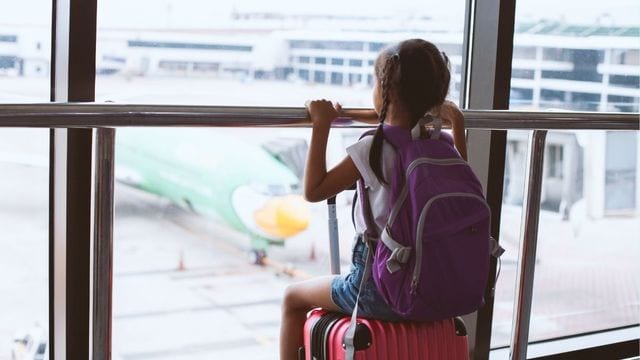
While children typically travel with their parents, there are situations where a minor may need to travel alone, like attending an international competition, studying abroad, or when their parents aren't able to be with them. But before they can travel solo, they must obtain a Travel Clearance from the Department of Social Welfare and Development (DSWD).
In the Philippines, minors aged 13 to 17 are required to obtain a Travel Clearance if they're traveling internationally without a parent or guardian. This clearance ensures that the trip has been authorized by the minor's parents or guardians. This guide will provide everything you need to know about obtaining a Travel Clearance for minors traveling
ALSO READ: How to Be Prepared for Anything When Traveling With a Child
What is a Travel Clearance?
A Travel Clearance is a document issued by the DSWD that grants permission for a minor to travel without a parent or legal guardian. The clearance ensures that the minor's trip is not only safe but also in line with Philippine regulations, particularly preventing trafficking and abduction.
While it's mainly required for minors traveling internationally alone, it may also be needed for domestic travel in certain circumstances. The clearance serves as proof that the travel has been sanctioned by the minor's guardians and that their safety is being prioritized.
Who Needs a Travel Clearance?
Primarily, minors who are traveling alone (without a parent or legal guardian) must secure a travel clearance. However, there are other individuals who may need this clearance as well:
- Filipino minors traveling with prospective adoptive parents for the purpose of inter-country adoption.
- Filipino minors traveling with individuals who are not their biological parents, legal guardians, or those with recognized parental authority or legal custody.
- Filipino minors who are born out of wedlock traveling with their biological fathers.
- For minor children who are married, the same considerations apply as for unmarried minors traveling abroad.
Note that a minor traveling with a parent or legal guardian doesn't need a travel clearance.
Requirements for Obtaining a Travel Clearance
To apply for a Travel Clearance, you will need to provide the following documents:
-
Application form – This can be obtained at the DSWD office or downloaded from their website.
-
Birth certificate issued by the Philippine Statistics Authority (PSA) – An original and photocopy to verify the minor's identity.
- Marriage Certificate or CENOMAR
-If the parents are married, provide the original and a photocopy of the Marriage Certificate, issued by the PSA.
-If the parents are unmarried, the mother must present the Certificate of No Marriage (CENOMAR), also from the PSA (original and photocopy).
-For cases of fictitious marriage, a Certificate of No Marriage from the Local Civil Registry is needed. -
Death Certificate—If a parent has died, please include the original and a photocopy of the Death Certificate issued by the PSA.
-
Affidavit of Consent - A notarized Affidavit of Consent must be signed by both parents or by the person with legal custody of the minor. This affidavit should clearly indicate the destination, purpose of travel, inclusive dates of the trip, and the accompanying person's relationship to the minor.
-
Passport Size Photos - Two recent colored passport-sized photos of the minor with a white background.
-
Travel Companion's Documents - A valid passport of the minor's traveling companion must be provided. If the traveling companion is not related to the minor, a notarized Affidavit of Undertaking is required.
-
Financial Support Documents—A notarized Affidavit of Support and certified true copies of evidence demonstrating the sponsor's financial capability are also necessary. These documents ensure compliance with travel regulations and help facilitate a smooth travel process for the minor.
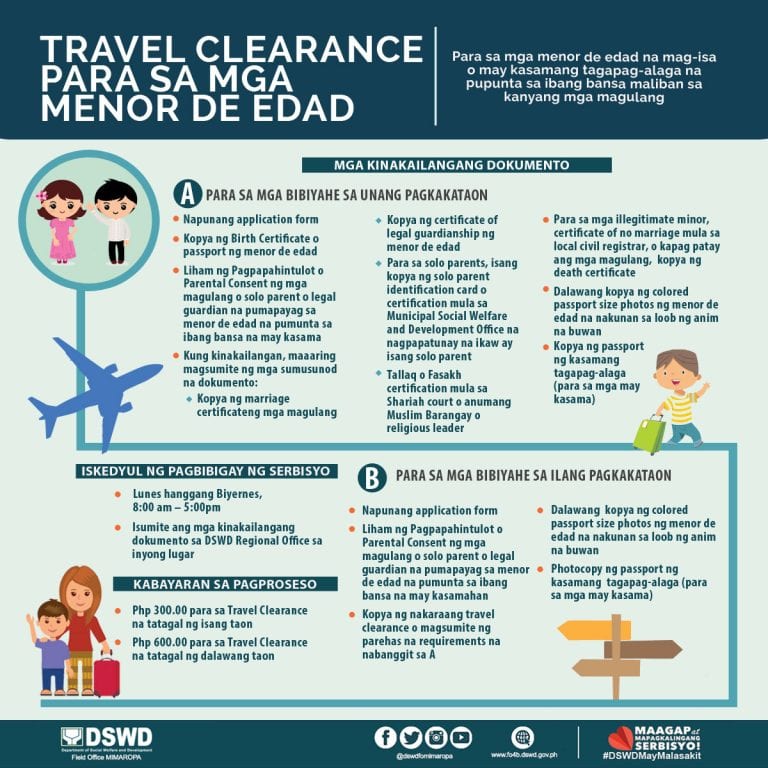
Step-by-step Guide to Applying for a Travel Clearance
The application process is relatively straightforward:
- Prepare the required documents - Ensure you have the complete set of documents, including the minor's birth certificate, notarized consent, proof of travel, valid IDs, and the processing fee.
- Visit a DSWD regional office - Travel Clearances are processed at DSWD's regional offices, not the central ones. The DSWD website lists these offices and provides their contact details.
- Submit the application - Submit the completed form and documents to the DSWD social worker, who will verify the information and check that everything is in order.
- Interview - In some cases, the social worker may interview the minor and the parents or guardians to verify the travel’s legitimacy and assess the minor's safety.
- Wait for processing - After submission, the application typically takes a few days to process, so applying at least two to three weeks before the planned travel is recommended.
- Claim the Travel Clearance - Once approved, the travel clearance will be issued. You may need to pick it up at the DSWD office, or in some cases, it may be mailed to you.
Validity and Expiry of Travel Clearancee
A Travel Clearance is usually valid for 60 days from the date of issuance, so be sure to apply in advance. If the minor's travel is delayed beyond this period, you may need to apply for a new clearance.
Tips for a Smooth Application
Start early
The process can take time, especially if there are missing documents or busy periods at the DSWD. It's best to apply well ahead of the travel date.
Stay updated on travel restrictions
Make sure to check the latest travel advisories, especially for international trips, as restrictions may change due to unforeseen circumstances such as pandemics.
Prioritize safety
Always ensure that the minor is well-prepared for the journey and has access to emergency contacts or help if needed.
By following the application process and submitting all required documents, parents and guardians can help facilitate a smooth and safe travel experience for their children.
For more information, visit the official website of the DSWD or contact the nearest DSWD office to get the latest requirements and guidelines.
Traveling with your baby for the first time? Click here for tips on safe trips by land and air.
More from sp

Lorem ipsum dolor sit amet, consectetur adipisicing elit, sed do eiusmod
Lorem ipsum dolor sit amet, consectetur adipisicing elit, sed do eiusmod
