
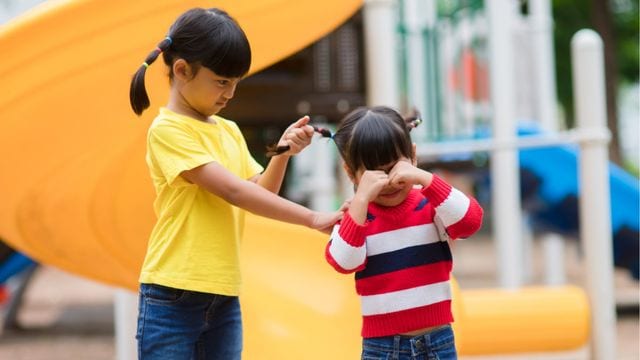
If you have two or more children, you know that sibling fights are a common part of daily life. No matter the age gap between your children, chances are you’re often playing referee to their squabbles, both big and small.
Dr. Siggie Cohen, Child Development Specialist with over 35 years of experience working with children and families, recently shared her insights on sibling fights on her Instagram account. Here’s what parents should know and do when their children fight.
The nature of sibling fights
Dr. Siggie begins by saying that sibling fights are normal: “Siblings fight. It’s what they do! And actually, it’s part of their sibling connection.” Acknowledging that sibling quarrels are normal shifts the perspective for parents, highlighting that our goal is not to totally eliminate their fights, but to understand its role in sibling relationships. Fighting among siblings can teach valuable life skills like communication, respect, and problem-solving.
What parents should do
Now that we know that fighting among siblings is normal, how should we handle it without losing our minds? Dr. Siggie offers a few tips:
1. Do not take sides
We have heard it time and again: Avoid taking sides when your kids fight. “Our job is not to eliminate fighting (also not possible). Our job is to teach them HOW to fight WELL, with communication, respect, problem-solving,” Dr. Siggie explains. This way, parents can prevent escalating sibling rivalry and instead promote a fair environment where all children feel heard and understood.
Dr. Siggie further emphasizes, “This doesn’t mean there are no boundaries, doesn’t mean anything goes and you’re not stepping in. Not at all. It means when you do step in, you are doing so to hear both (all) and guide both (all). EVEN if one is a baby. EVEN if one should ‘know better’ by now. EVEN if one is always the instigator (especially then!).”
2. Establish boundaries
Despite not taking sides, parents should still set clear boundaries. Parents should teach children that while disagreements are okay, there are acceptable and unacceptable ways to express their frustrations. Some statements that parents can try telling their children are:
“Yes, you want the toy. We are not grabbing, whining, or yelling. We talk. We ask, ‘Can I have a turn?’”
Or in Filipino: “Naiintindihan ko na gusto mo 'yung toy. Pero hindi tayo dapat nang-aagaw, nagrereklamo, o naninigaw. Magtanong, ‘Pwede bang mahiram?’”
Managing sibling conflicts constructively
Dr. Siggie also added a few more practical steps and even what to say to manage sibling conflicts effectively:
1. Listen to both sides
It’s important to let your children know and feel that you listen to and hear both or all of them, giving each child an opportunity to express their feelings and perspectives without interruption. This approach makes them feel valued and understood, reducing any feelings of favoritism and promoting fairness. Furthermore, listening to all of them also models the importance of communicating and listening to each other. You can express this by saying:
“I will hear you both. First you, then you. We will hear each other.”
Or in Filipino: “Papakinggan ko kayong lahat. Mauna ka, tapos ikaw naman. Kailangan natin pakinggan at intindihin ang isa’t isa.”
2. Encourage communication
Parents should teach their children to express their needs and frustration through words rather than actions. This way, we can help our children vocalize their thoughts and feelings clearly and respectfully. We can encourage them to use ‘I’ statements to express their feelings such as, “I feel sad when you take my toy without asking.” On the other hand, parents can encourage their child to communicate by saying:
“You can let him know. Go ahead, in your big voice. Tell him.”
Or in Filipino: “Pwede mong sabihin sa kanya ang nararamdaman mo.”
3. Model respectful behavior
We have always heard that children learn best by watching us. By modeling calm and respectful behavior, parents can teach their children how to handle conflicts maturely and respectfully. To do this, parents should ensure that they stay calm themselves, remind their children of any family rules about respectful behavior, and offer suggestions on how to express feelings without hitting or yelling. You can encourage your kids to be respectful by saying:
“You both are upset. It’s okay. You don’t always need to get along. Still, we do not hit, push. We use words. Talk.”
Or in Filipino: “Naiintindihan ko na pareho na kayong galit at okay lang 'yun. Hindi naman kailangan na palagi kayong bati. Pero, dapat hindi padin kayo nagkakasakitan. Mag-usap kayo.”
4. Avoid labels
Try to avoid labeling your children as much as possible. Calling them “victim” or “bully” can reinforce negative behaviors and create lasting emotional impacts. Instead, focus on addressing the behavior rather than assigning blame. You can do this by calling out their possibly “problematic” actions rather than the child, such as “Taking the toy without asking is not okay,” instead of “You’re being mean.” You can also encourage accountability and empathy among your kids by asking them how each one of them feels during the conflict, explaining to them the impact of their actions, and encouraging them to make amends. You can ensure that there are no labels among your children by saying:
“No one is a victim. No one is a bully.”
Or in Filipino: “Walang biktima dito, at wala ding bully.”
With Dr. Siggie’s strategies and tips, parents can guide their children toward healthier and more respectful ways of handling conflicts. These strategies not only help resolve immediate squabbles but also equip children with essential life skills that can benefit them in the long run.
View this post on Instagram
Read here to learn why punishing your toddler for hitting their sibling might not be a good idea.
What other parents are reading

Lorem ipsum dolor sit amet, consectetur adipisicing elit, sed do eiusmod
Lorem ipsum dolor sit amet, consectetur adipisicing elit, sed do eiusmod
