
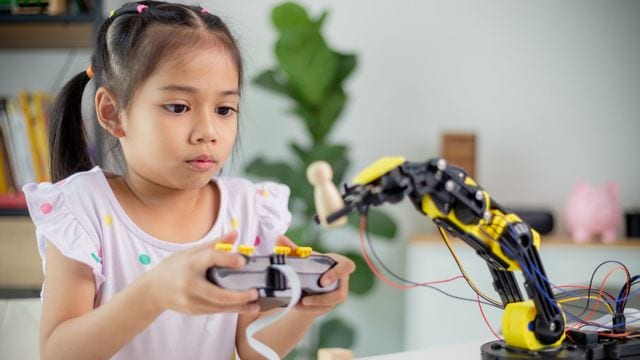
STEM was first coined in 2001 by the National Science Foundation and was thought to bind the fields of Science, Technology, Engineering and Math together under one term–to encourage proficiency across these interrelated subjects.
According to the Philippines Institute for Development Studies, “STEM education applies real world lessons to the classrooms so students can make the connections to the world they’re in. Countries with leading STEM graduates, also have helped shaped the world we all live in; the software we use for work, apps on our phones to communicate with each other and devices in our homes.”
It adds, “As the work places become automated, mobile internet further cementing a global workforce, the changes we have seen in the last few years, especially during the pandemic will not only continue, but hasten. Businesses looking to profit from new technology as well as countries looking to increase growth and attract investments will continue the emphasis on STEM related fields. As new technology enter(s) into our lives, there needs to be a strong transition from education to the workplace.”
The plight of Science and Math in the country
The Philippines’ state of basic education can be partially gauged by its rankings in the Programme for International Student Assessment (PISA), where the country ranked lowest among all participating nations in 2018, placing 78th out of 78. In 2022, the Philippines slightly improved but still ranked near the bottom, at 77th out of 81. In the said PISA, we ranked sixth from the last spot for Mathematics and an embarrassing third from the last spot for Science.
PISA evaluates 15-year-old students, enrolled in Grade 7 or above, in the areas of Mathematics, Science, and Reading across Organization for Economic Cooperation and Development (OECD) member and partner countries, offering insight into students' foundational knowledge and skills.
Last month, Education secretary Sonny Angara made public that a task force will be in charge of ensuring the improvement of Filipino students’ performance on PISA 2025.
Also read: This Pinay Mom, One of the World's Leading Environmental Scientists, Was Terrified of Math
Now as parents, how do we begin to cultivate our kids’ natural love for Science, Technology, and Math? How do we lay the foundation in raising STEM inclined kids? Where exactly should we begin?
Raising STEM-inclined kids
Kids have a natural curiosity for the world around them—if you’re a parent, chances are, you’ve navigated through the ‘why’ responses more than once. You’ve probably watched them deconstruct a doll or a robot, perhaps disassemble a toy car, and figure out how to put the pieces back together. They're curious how these things are made.
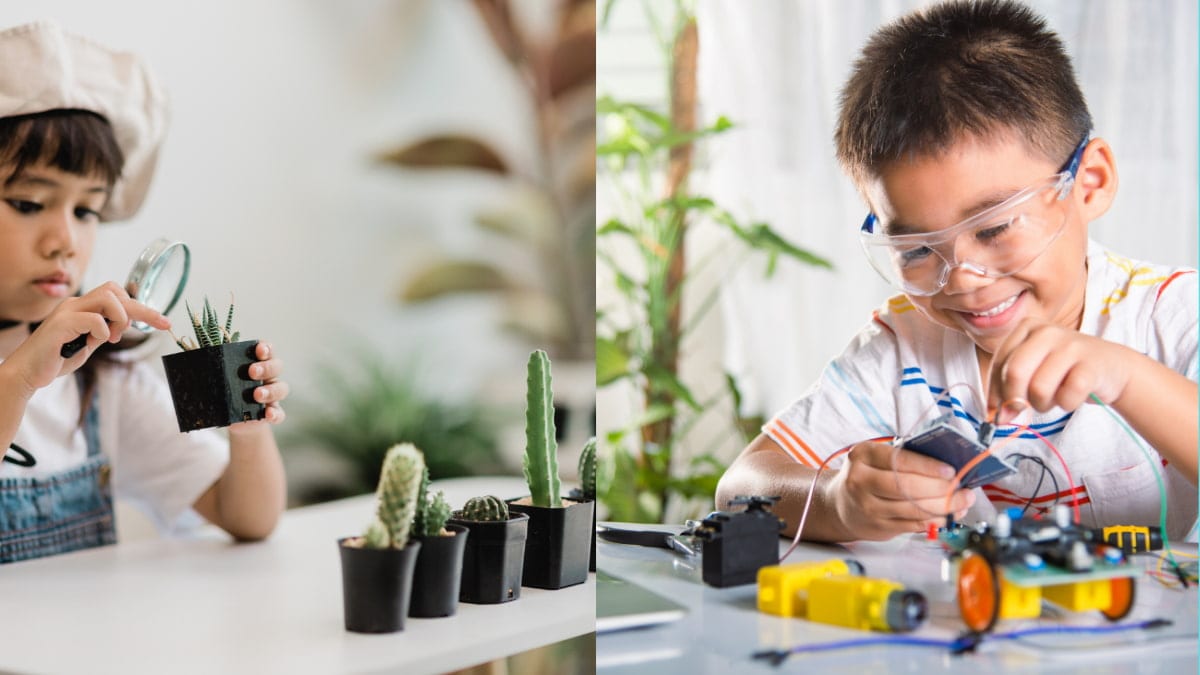
You possibly witnessed how they spend hours and hours building all sorts of things with Lego blocks and home furnishings. And if you look even closer, you'll understand that through such kind of activities, parents are beginning to foster their love for building and creating, as well as enhance their skills in observing, inferring, and problem-solving.
According to Great Lakes Science Center, an American Science center, there are five steps to encourage STEM interest in your child.
5 steps to encourage STEM interest
1. Be a positive role model.
The site says, “Make a conscious effort to avoid casting Science and Math as things that are 'too hard' or 'not for me.' Instead, focus on the fun of learning about something new as an adventure or a worthwhile investigation. It’s OK to admit you don’t know a factual answer to a science question, but make finding out about the answer something fun to do together.”
2. Encourage curiosity.
The site reminds us that, “sometimes as adults it’s hard to remember how even the simplest experiences for children can be truly eye-opening.” Kids are encouraged to remain curious to develop confidence in pursuing STEM fields in the future.
Related Read: This Barbie Can Offer Your Child a Rich STEM Learning Experience
3. Go outside.
The perfect way to ignite the love for learning and experimentation is to explore the outdoors. The stars, the plants, the birds and changing color of leaves, according to the site, can all spark wonder and exploration.
4. Visit a museum.
Visiting Science centers and museums help STEM come alive. Exhibits, hands-on exploration and experimentation can facilitate learning, problem-solving and concept illustration.
5. Find the STEM they already love.
The site explains, “Chances are your child already enjoys sports, LEGOs, gaming, baking or playing an instrument. A great way to stimulate interest in STEM is to show how it applies to an activity they already enjoy and encourage them to learn more about that relationship.”
Also Read: Want To Raise A Future Engineer Or Science Whiz? Try These 5 STEM Activities At Home
6 practical tips in raising STEM inclined kids
1. Introduce building and construction toys. Building toys develop spatial skills, basic engineering concepts, and patience. Let them experiment with different structures and problem-solve when they don’t go as planned: allow them to feel the struggle and frustration until they figure things out. Let them be uncomfortable, that's how they learn.
Ned Johnson, co-author of “What Do You Say? How To Talk with Kids to Build Motivation, Stress Tolerance, and a Happy Home,”reminds parents, “We all have the natural tendency to jump in and help our kids solve their problems. But what we really want for our kids is for them to learn to solve their own problems.”
2. Incorporate Math during play. Math doesn’t have to be about numbers on a page; it can be playful. Try counting games, pattern matching, shape sorting, or building towers with blocks. Everyday activities like sorting laundry by color or size also help build foundational math skills in a practical context.
3. Find time to experiment at home. Kids learn best when they can touch, see, and explore. Try simple, safe experiments like predicting which items would sink or float during bath time. In a huge tub or pail of water, they can put items and guess first which ones would float or sink. This is a perfect time to discuss density.
Or, you can also explore magnetism with different objects. Find out which surfaces the ref magnet would cling onto. These simple activities are engaging and can teach them basic scientific concepts in a memorable way. The internet is a gold mine for various experiments both of you can try at home.
4. Refrain from putting a gender stereotype on STEM-related fields. In the country, engineering is often thought of as a male-dominated discipline, and while it may be true, this should not limit your child’s curiosity or hinder their interest simply because of their gender. Girls can ace Math and Science, too.
Also Read: Grade 8 Girls Beat Boys in Test on Technology and Engineering Skills (Girls Can STEM!)
Another tip: Make kids understand that toys have no gender. Your little girls can create and play with cars and trucks while the little boys can design dolls and make them move. According to Professor Judith Blakemore of Indiana University, "If you want to develop children's physical, cognitive, academic, musical, and artistic skills, toys that are not strongly gender-typed are more likely to do this."
Most STEM toys (puzzle pieces, board games, building blocks, clay doh, shape sorter and art supplies to name a few) are labeled gender-neutral. But psychologist Dr. Elizabeth Lombardo makes it simple, "Toys are toys until we tell the child that it is for boys or girls."
5. Explore STEM toys or make DIY projects at home. Design a project with your child whether it is about robotics, puzzles, pulleys, makeshift fortress, stitching or even patchwork. Do a quick research of easy DIY projects that you and your child would be both interested in. If you’re not very keen on DIY projects, you can shop for STEM toys instead through Shopee or Lazada.
6. Enroll them in enrichment programs. If there's additional budget for supplemental tools and learning, encourage your child to enhance his/her knowledge and skills in STEM. Support your child's interest by expanding his/her horizon.
Enrichment programs and STEM kits, services, and classes
Nutty Scientists PH
Contact No. +63 917 775 8688 | +63 922 868 8688
Visit the website here.
Engineering For Kids Manila
Contact No.+63 2 9757170
Visit the website here.
Philippine Coding Camp
Contact No.+63 976 049 6633
Visit the website here.
Bricks 4 Kidz - Philippines
Contact No.+63977-875-5858
Visit the website here.
Want to know the story of a Filipina engineer who struggled in Math but now works at NASA? Read her story here.
More from sp

Lorem ipsum dolor sit amet, consectetur adipisicing elit, sed do eiusmod
Lorem ipsum dolor sit amet, consectetur adipisicing elit, sed do eiusmod
