
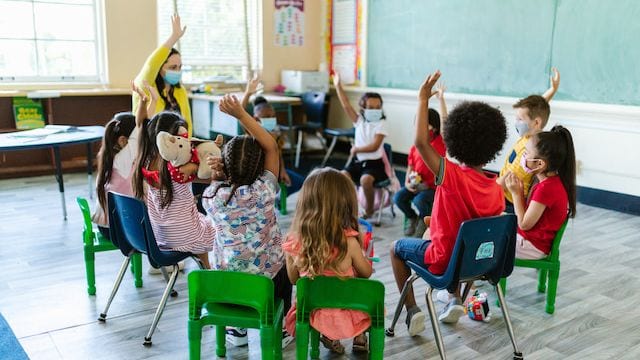
So we’ve heard them all: preschool, pre-K, nursery, toddler school, playschool. These terms have stirred the curiosity of some moms and dads on our Facebook group, Smart Parenting Village. What’s the difference? Are they all practically the same?
Maybe history has the answer. Let's get digging.
Brief history
In a UNESCO document on “Global history of Early Childhood Education and Care,” kindergartens and nurseries have long existed in the 19th century with the distinction of kindergarten is for educational purposes while the latter is for provision of care.
Fast forward to 1946, the end of the second world war, a memorandum submitted at a UNESCO organized conference on early childhood education stressed the importance of early childhood education and care programs to developing countries. Most countries used the term “kindergarten” to refer to these programs and some used this term to differentiate the older children in the bracket of “preschool aged-children”. Many used this term to describe all programs from birth to mandatory age for formal schooling. The usual age range in the program was between 3-5 or 6 years of age.
1968 UNESCO survey reported children in some countries, aged 1-3 were taken cared of in “nurseries” and in 1975, age 3 or 4 became the age of entry into preschool or pre-primary.
A year prior to this report, a 1974 survey revealed that “preschool” has now become a broader concept, with the premise that early childhood education begins at birth until the school entry age.
It acknowledged different labels used to early childhood education and care such as pre-primary school, preschool, kindergarten, nursery school, and the like.
The nursery school
Margaret McMillan and her sister, Rachel, returned to Scotland from the United States when their father died. They were tackling poverty as a result of Industrial Revolution and advocated for the “slum child.” In 1911, they opened their first Open-Air Nursery School. They called it “nursery school” to provide care and nurture aside from learning; their program was designed to recognize health problems prior to primary school.
Today’s nursery schools are mostly based on the basic principles of earlier nursery school which is to provide care while supporting the child’s emotional and social well-being in terms play, activities, discovery and experience.
Related: At What Age Should A Child Start Preschool? Don't Just Look At Age, Says This Educator
Early Childhood Care and Development (ECCD)
Early Years Act (EYA) of 2013 recognizes the age from 0-8 as the crucial stage of educational development. Ages 0-4 will be under the responsibility of Early Childhood Care and Development Council while ages 5-8 will be DepEd’s responsibility.
The goal of ECCD is to improve the quality of life of young children with the help of the parents and community. The ECCD system refers “to the full range of health, nutrition, early education and social services development programs that provide for the basic holistic needs of young children from age zero (0) to four (4) years; and to promote their optimum growth and development.”
Still according to (EYA), ECCD curriculum “shall focus on children’s total development and take into account age, individual and socio-cultural appropriateness. It shall promote the delivery of complementary and integrative services for health, nutrition, early childhood education, sanitation and cultural activities. It shall use the child’s first language as the medium of instruction.”
In the Philippines, state educational programs for early childhood education (popularly known as “daycare” or “nursery”) refers to ITED or Infant-Toddler Early Development Program (Age 0-2.11) and PreK (PreK 1 age 3-3.11 and PreK 2 age 4-4.11).
PreK programs align with DepEd Kindergarten themes for smooth transition to mandatory and compulsory Kindergarten education. Early childhood education centers are called “Child Development Centers.”
Related: Make These Your Top Considerations When Looking for A Preschool
Preschool vs nursery school
Now we’ve unearthed the history of where these terms come from, whilst used interchangeably at times, preschool is a broad terminology typically designed to prepare children for "academic readiness" for primary school. In many countries, preschools have education regulators (even licenses) and set curriculum. Preschools provide more structure than nurseries because preschools are often guided with learning philosophies like Montessori, Waldorf, or Reggio Emilia.
Nursery schools may be run by the state, the community, or even by the local church, where babies and children are provided with care and encouraged to engage in activities, games, and skill developing pursuits. In the United States, it is primarily a day care center where some may allow the school to be open as late as 08:00 in the evening to accomodate working parents and the school can provide full board meals or snacks, even nap time.
In the Philippines, private schools/institutions provide a guide to parents as to how to they approach the terminologies they use for their pre-primary school programs.
Bottom line: look at the child's readiness
Whether it’s called a preschool, a nursery school, toddler school, or playschool—what’s important is that as parents, we value the readiness of our child. Unesco tells us that “school readiness is linked to learning, school completion, later skill development, and acquisition of academic competencies and non-academic success.”
Every child is unique and each learns at his own pace; whatever guiding philosophy or school of thought we choose for our little ones, what matters is that we make their safety, happiness, and learning our utmost priority (and why not make it fun, too!).
What other parents are reading

Lorem ipsum dolor sit amet, consectetur adipisicing elit, sed do eiusmod
Lorem ipsum dolor sit amet, consectetur adipisicing elit, sed do eiusmod
