
My youngest daughter was asked to take an admission test twice by a traditional Catholic school we were considering for her and her Ate. The reason? She did not know her ABCs and numbers. This expectation caught me by surprise because, first, it was her first year as a nursery student in an official school, and second, we did not encounter such expectations when we enrolled her Ate in Nursery and Kinder at another traditional school. The admission officer told us at the time that she might feel discouraged since most of her classmates already knew their letters and numbers–at four years old. So, she retook the test. She was eventually accepted on the condition that she would take additional tutorial classes for the first few months to “catch up” with the other kids.
It seems that such expectations from traditional schools are fairly common, pressuring both children and parents to dive headfirst into early academic learning. More often than not, this also plays on parents’ competitive nature–their inherent desire for their kids to outperform others and meet the school’s standards.
Let kids be kids
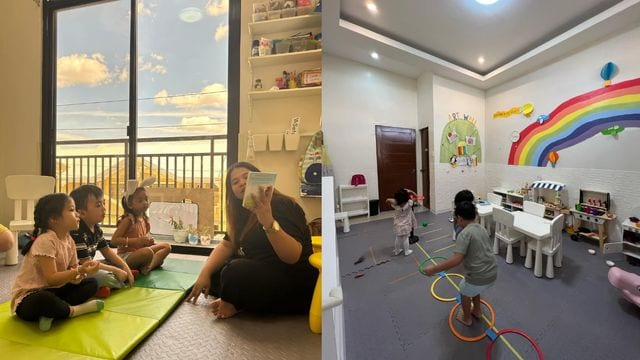
However, an educator wants to remind parents to let their kids be kids and not pressure them to learn the alphabet so early. Irah Maliwat, an educator and co-owner of a playschool and tutorial center, advocates for a different approach–one that prioritizes play and developmental appropriateness over early academic achievement. In her Facebook post, Irah shared a scene she regularly encounters at their play center:
“Madalas na eksena sa center:
Parent: Teacher, may anak po ako na 3 years old. I-enroll po sana namin sa Reading and Wriing class.
Me: Mommy, start po natin siya sa playgroup (And I would go on explaining the benefits of play-based classes)
Parent: Gusto ko po kasi na alam na niya ang alphabet at makapagbasa na siya para ready na pagpasok sa school next year.
And this actually breaks my heart. What’s sad is that mukhang tama sila ne need iprepare nga ang mga bata dahil para palang gyera sa school.”
School pressure on young kids and parents
As a playschool co-owner and educator, Irah regularly interacts with young children and their parents. In an interview with Smart Parenting, she shared her observations that school lessons and pacing for young kids tend to be fast and overwhelming. “Sometimes, the kids cry and refuse to study, and I’ve heard that they are even made to stand if they don’t answer questions correctly during recitations,” she said.
Irah admitted that she given such situations, she understands why parents want their kids to have an early start on their lessons, saying, “As a tutorial center serving students from various local schools, it’s disheartening to see that this issue isn’t limited to just one or two schools but is a widespread problem affecting the entire community.”
Irah emphasized that for young children, parents should focus on “fostering a love for learning through play and exploration, rather than pushing academic skills too soon.” She added, “We need to raise awareness and inform parents about the importance of not overlooking the fundamental aspects of learning.”
The long-term impact of academic pressure
Irah also highlighted how academic pressure can have long-term negative effects on children’s relationship with learning. She explained, “Pressure to perform academically at a young age can make children anxious and stressed about learning. This can lead to a fear of failure and make learning less enjoyable, which may decrease their motivation and interest in education over time.”
When Smart Parenting asked about her comment “parang gyera pala sa school,” she explained, “I feel that children are caught in a constant struggle at school, which has turned into a battlefield where they must defend themselves and fight to succeed. It no longer feels like a nurturing environment where they should be supported and taught.”
When it comes to exhaustion and school punishments, Irah advised her co-educators and parents to be aware of this, saying, “Children are straightforward and will openly express if they are tired or bored. Additionally, kids who are exhausted at school often become sensitive and may struggle with low self-esteem. Their unhappiness will be quite noticeable.”
Advocating for play-based learning
Irah advocates for play-based learning for young children, explaining, “Play-based learning benefits young children by promoting cognitive, social, and emotional growth through interactive, hands-on experiences. It enhances creativity, problem-solving, and critical thinking while encouraging a positive attitude toward learning. This method allows children to develop essential skills at their own pace, providing a strong foundation for future academic achievement in a relaxed setting.”
Play-based learning in schools allows children to enjoy going to school. According to Irah, this enjoyment “is a clear and positive sign that they are having a good time in their classes.” Moreover, “Play-based activities make it easier to engage them, as learning becomes a natural and enjoyable process,” she said.
Nurturing a love of learning
Irah clarifies that there’s nothing wrong with parents teaching or preparing their children for school. She explained, “I don’t mean that we shouldn’t teach our children at all. I strongly believe that early childhood is crucial for laying the foundation for life. However, I support age-appropriate learning through purposeful and intentional play.”
Irah also highlighted the importance of meaningful experiences during the developmental years, saying, “Meaningful experiences help children enjoy their childhood and learn effectively. There’s no contradiction between preparing them for the future and allowing them to enjoy their early years.”
For Irah, school administrators and teachers play a big role in children’s early school experiences, saying, “I strongly believe that schools should ensure that they have the right people in the right positions, and that they are properly equipped. This issue is more complex than it seems and can only be effectively addressed if authorities consider the child’s perspective, understanding their feelings and needs. It is crucial for educators and schools to have genuine care for children and their learning.”
It is also important to note that education should not be based solely on memorizing information. As Irah explained, “I firmly and unequivocally support education that is based on love and sincere concern. We need to deeply reconsider what education truly means. Is it merely about memorizing information and accumulating achievements? To me, it’s about gaining wisdom through these experiences. Wisdom, unlike mere intelligence, is what truly matters.”
And for parents like me who are concerned when school administrators tell them that their newbie-to-school preschooler needs to know her letters and numbers to keep up with other children, Irah offers this advice: “In reality, children will eventually learn to read, write, and do math. As adults, no one asks when we acquired these skills or what we knew at age three. There’s no need to rush or complicate things. Although society often imposes pressure, avoid passing that stress onto your children.”
Ultimately, Irah emphasized that parents should “let their kids be kids,” explaining, “It’s more important than ever to appreciate your children’s early years because this stage is temporary and won’t last forever… The focus is on valuing this time now, as it’s your chance to make the most of it. Beyond providing them with a joyful and meaningful childhood, remember that this is your only opportunity to be a parent to a young child. Your own time as a young parent is also limited.”
As for us, we decided to enroll our bunso in another school–one that accepted her without conditions and without her knowing her letters and numbers. And by the end of her nursery year, she knew them all. She didn’t feel left out, nor did she feel discouraged. I guess kids do learn at their own pace after all.
Read here to learn why parenting experts advocate for play-based learning.
What other parents are reading

Lorem ipsum dolor sit amet, consectetur adipisicing elit, sed do eiusmod
Lorem ipsum dolor sit amet, consectetur adipisicing elit, sed do eiusmod
