
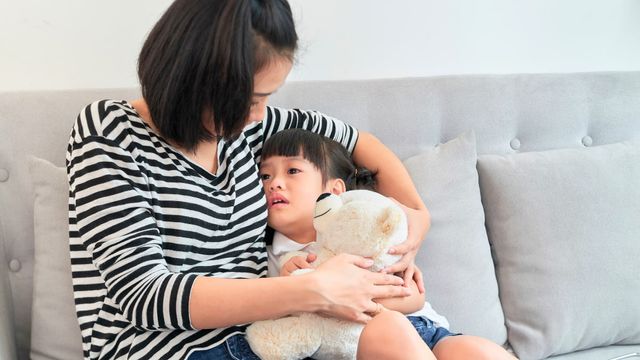
How many of you parents have struggled your way in and out of school drop-offs with your preschoolers? How did you deal with the whining, crying, kicking, and unwrapping clingy fingers off your legs and thighs?
How many of you have been stalked around the house that you couldn’t even get a bathroom break without an “audience”? How many of you have dealt with separation anxiety from your little ones?
What is separation anxiety?
An Australian website, Raising Children, defines separation anxiety as “children’s fear of being away from their parents or carers. Children with separation anxiety might cry or cling to their parents or carers when being separated from them.”
It is believed that separation anxiety is a common part of children’s development which can start around 6-7 months and reach its peak around 14-18 months.
Anxiety versus Trust
Child Development Specialist with 35 years of experience, Dr. Siggie Cohen, believes that the opposite of anxiety is not calm, but trust.
It is the feeling that you can rely on something, yourself, and others. She says that “an anxious child needs help building a sense of trust, especially in themselves. That inner sense of: “Yes, this is hard, this doesn’t feel good at all, but I also know that I will be ok (sic).”
Five tips on managing separation anxiety at school drop-offs
1. Plan and Practice
Plan a visit before school starts and practice brief separation.
Bring your child to the preschool and show him around with enthusiasm. Give the impression that school is not something to be afraid of. Show him where you’re supposed to drop him off, what he needs to do at drop off (like greeting the guards, teachers, and staff, or smiling at them if he is too shy to say "hi"), what time he will be picked up and where. This way, your preschooler will be more familiar and comfortable with his school surroundings. Then try to practice "dropping him off" and your "going away" subtly.
Suppose this is going to be the first time that you’ll be away from your child, practice brief separation. If you have a yaya, leave the child for an hour or two to run some errands, and make sure to let them know you’re leaving as well as when you’re back. If there is no other caregiver than you, practice stepping out of the room and leaving your child on his own, announcing your leaving and return.
Practicing being away from your child and returning helps ease separation fears.
2. Opt to bring a transitional object
Child psychology experts have “transitional object” as a term for items that bring people we love close to us even in their absence. They help children make an emotional transition from dependence to independence. So if the teacher allows it, your child can bring a little toy or plushie as a transitional object.
3. Quick goodbyes, no false promises
During separation, do not linger on saying goodbye as it creates confusion rather than confidence. They have to feel from you that this is all okay and that you will reunite in no time. Let them know that you are excited for them to have fun at school. Similarly, avoid making false promises like “I’ll just be outside the door” if you won’t because your child might end up looking back at the door, checking all the time if you are indeed there. Next thing you know, he might not want to go to school anymore after feeling betrayed.
If you know you won’t be back for a few hours, be truthful. Don’t make false promises that you’ll be there as soon as it’s time to go home. Remember that trust is the grounding feeling that combats anxiety.
4. Establish a drop-off routine
Routine or rituals create a safe space for our children. Routine helps them predict what happens next. You can create a secret code for saying goodbye or establish a ritual like “spiderman hug” or “unicorn kiss” or even simple high-fives, fist bumps, or i-love-you's will do. Rituals are comforting to children.
5. Make the break
Don’t give in to “one more minute Mommy” or a “little bit longer Daddy” at drop-offs. Stay upbeat and confident because the moment you give in to your child’s hesitation or show that you’re quite worried, too–it will not be easier for them to let go.
If the moment they start crying or begging and you tell them “it’s okay, I’ll stay,” that’s when you mislead them, and give the impression that if they cause trouble, you can stay indefinitely.
Read Also: Preparing for Preschool: Separation Anxiety and Choosing the Right Preschool
Three tips on managing separation anxiety and building trust at home
Not all children show anxiety at school, some of them express theirs at home. Kids tend to follow you around at home, even when you’d like to pee in peace. How do we reassure them then?
1. Highlight other senses.
Dr. Siggie on her Instagram post says that “your child is actually relying on seeing you that you are actually there.” She then recommends practicing engaging one of their other senses which they can also rely on.
In her example, one can use “hearing her” as proof that she is there even though the child could not see her. She adds, “Continue to play this game in close proximity, and then begin to expand the distance.”
2. Don’t sneak out of the room.
If you need to leave the room or you need to leave your child to a babysitter or other family member, avoid sneaking out. Let them know you’re leaving and let them see you exit. Sneaking out may fuel separation anxiety even more. Let them know where you’re going: “I’ll be in the kitchen and check the cake in the oven. I’ll be right back. Yaya will be right here with you.”
In addition, avoid criticizing their behavior by labeling them as “being such a baby” or “pasaway lang/nag-iinarte.”
3. Read them books.
You can read them books about separation fears and anxieties to help them know that they’re not alone. Reassure them that they will be fine on their own. Children can easily relate to stories and illustrations. You may check “Why do I have to go to school” from Lazada or “Llama Llama Misses Mama” from Shopee.
Read Also: Don’t Rush Through School Drop-Offs! 5 Ways To Help Ease Your Child's Separation Anxiety
Don’t fear regression
No matter how much we reassure our kids or how we follow our routine to a T, a school break, an illness, an injury, or a bad experience in the classroom can cause a major setback and you may feel you’re back to where you started.
Don’t fret dear parents, occasional regression may happen and is believed to be normal. Just go back to your strategies and remain upbeat.
Similarly, teachers are child experts–talk to them for context and ask for additional guidance.
More from sp

Lorem ipsum dolor sit amet, consectetur adipisicing elit, sed do eiusmod
Lorem ipsum dolor sit amet, consectetur adipisicing elit, sed do eiusmod
