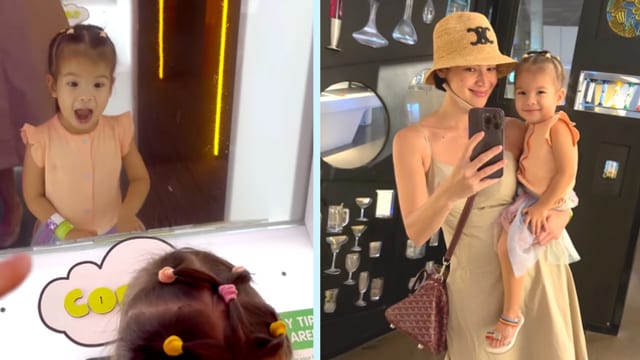
It may seem like just another mommy-daughter date for Anne Curtis and daughter Dahlia but as most educators and child experts might say, a family trip to the museum is great for child development.
On November 1, Anne shared an Instagram reel showing videos of her day at Mind Museum with Dahlia interacting with the planetarium displays. “Spent the best morning with this curious little kitten at the Mind Museum,” she captioned her post.
An article in Parent Toolkit by NBC News and Learn and published on Today.com says “Curiosity helps children be more observant and to think about things and try to figure them out.
It adds, “When children explore their curiosity, they expand their vocabulary as they use language to describe what they’re thinking, seeing, hearing, or experiencing. You can help your child’s growth by supporting her curiosity.”
Is a toddler too young to bring to a museum? Perhaps what they will learn on the day of the museum visit itself might not stick. But what the child gains through the activity in itself will help create in her a lifelong learner who will want to keep visiting museums even as she grows older.
“That’s why it’s important to get children coming in from when they are really young. Our research found that children and parents learn together when their curiosity is sparked by the same exhibits and they talk to each other about what they see,” says Associate Professor and Deputy Head of Research in the Department of Educational Studies at Macquarie University in Sydney, Australia, Sheila Degotardi.
2 simple ways to nurture your child’s curiosity
1. Take kids to zoos, parks, bike trails, the outdoors.
Preschoolers and toddlers are constantly learning about the world around them. When you are out, help them learn by naming the things she sees. If she is drawn to something in particular, stop, slow down, and discover it with them.
You may extend the learning by reading a book about it after your trip.
2. Make time for unstructured play.
“By providing your child with free time to play, you are allowing them to use and practice their curiosity and imagination, says the same article by Today.
Maurice Elias, director of the Rutgers Social-Emotional Learning Lab says in the article that parents must give their young child’s natural curiosity the benefit of the doubt whenever possible.
RELATED: Clumsiness, Attention Deficit Often Seen in Kids Who Rarely Play Outdoors
Unstructured play might not make sense to adults and they may not even use toys according to its intent. Remember: this is all part of their development. Try not to intervene as much as you can.
“There are also many factors that can get in the way of your child’s curiosity, like too much screen time or over-scheduling of activities. If you do not allow some time for unstructured play, you may be inhibiting your child’s imagination,” Today reports.
To gain inexpensive ideas on how to entertain your curious child, read this story.
What other parents are reading

Lorem ipsum dolor sit amet, consectetur adipisicing elit, sed do eiusmod
Lorem ipsum dolor sit amet, consectetur adipisicing elit, sed do eiusmod