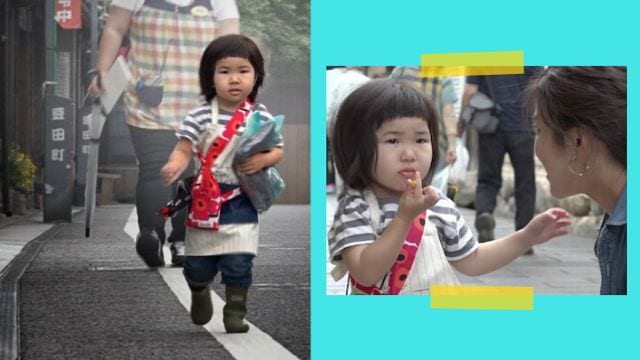
Would you ask your two year and nine-month-old toddler to buy you dinner ingredients you forgot you ran out of?
This is the question many parents are recently asking themselves since watching Old Enough, a Japanese reality show on Netflix. It’s a popular local show called Hajimete no Otsukai, or My First Errand that has been running for more than 25 years.
The show features short episodes featuring young Japanese children, some as young as two years old, sent by their parents to fulfill simple errands alone all on camera. The camera crew does not intervene but is trained to in cases of emergencies.
The first episode follows a young boy who was sent to the grocery to buy three items and had to cross a street. Over at our Smart Parenting Village, parents shared that they enjoyed watching the young kids practice independence and believed that the show is proof that kids are not too young to practice life skills.
Pwede sa Japan, but not in the Philippines
There were a few unanimous sentiments in the Facebook group, and the first is how impossible it would be to blindly copy the show’s premise because of safety issues.
SPV member Naja says, “Dito satin e mga gawaing bahay lang talaga dahil delikado ang lansangan natin. Walang maayos na sidewalks at hindi ino-honor ng ibang motorista ang mga tawiran. Isama mo pa mga kidnapper.
“At that age na 2 years old we can let them help na talaga sa ibang mga gawaing bahay,” she says about kids’ independence.
Joji Jugo-Velasco had similar sentiments as Naja, pointing out how learning errands at a young age is part of Japanese culture.

“Finished all the episodes in 2 days. This proves that our kids are amazing and can do simple chores kaya huwag natin lagi sasabihin na bata pa sila, hindi nila maiintindihan. This is possible in Japan because it’s a safe place,” she says.
Many articles online reviewing Old Enough support this fact. Forbes quoted a study by insurance company William Russell for its findings of Japan being one of the top five safest countries in the world.
Parents repeatedly commented that sending young kids out to run errands is possible in Japan, but not in the Philippines. Others even mentioned they would likely train their kids to do the same if they were living in Japan.
Hazel Joy Diloy says, “Ang cute kaya. I watched it even sa anime. And the first errand is super big deal sa kanila. It’s part of their culture.
She also educates and says academics is not the first lesson a child learns in the Japanese school system. “Tsaka kasi sa daycare nila hindi academics ang tinuturo but discipline, personal hygiene and house chores.”
Pwedeng turuan sa loob ng bahay
Parents of SPV were quick to agree that it’s not impossible for a child as young as two years old to be taught life skills, chores, and how to pick up after themselves.
Mhy Senedrin-Singh says “Hindi kailangan exactly na ganyan ang ipagawa pero reflect kung ano ba yung mga gawaing bahay na pwede silang tumulong; mga bagay na pwede nilang gawin na sila lang tulad ng kumain, kumuha at magsalin ng tubig, magmedyas, magsapatos, magtoothbrush, maglinis ng kalat, magpunas.”
READ MORE ARTICLES ON TEACHING KIDS TO DO CHORES:
- Your Toddler Is Not 'Too Young' To Do Chores: How To Start Teaching It
- Luto, Linis, At Turo: The Kramer Kids Are Great At Household Chores
Experts agree that introducing age-appropriate chores as young as two-years-old is beneficial for the child. Children who start doing chores early “are more likely to have good relationships, academic and career success,” reports NBC News.
Mhy adds that this Japanese parenting practice is similar to the Montessori method. “Freedom within limits yan especially for practical life skills.”
Deorina Joy Ranches says she’s been teaching her son to help at home since he turned five years old starting with washing dishes. Now at seven-years-old, he is able to fold laundry, can bathe himself, and helps her out at home.
“I believe if we restrain them to do things we think is not for kids, it oppresses their vision that they can do it and will be more inclined that ‘I can’t do it’ and then come up with reasons for their ‘limitations’.
She advises, “We just need to supervise as usual but when they grow up helping, they can be independent and stand up for themselves with maturity.”
Kalmia Mimosa jokes, “Kaya ng kids! Pero di kaya ng nanay. Lumalabas nga lang ng gate ng mag-isa natataranta ka na.”

What it’s like in Japan
Japanese-Filipina Meira Furuki-Chua, mom of one and human resource executive, confirms that teaching errands while they are young is the norm in Japanese families. In her perspective, it stems from the Japanese culture that values independence and a saying that teaches them not to be an inconvenience to society.
“We don’t like causing others an inconvenience, it’s really shunned. And a lot of shame comes from inconveniencing others. Parents train kids early on so as not to be an inconvenience in society,” she says.
She personally continues teaching independence to her own one-year-old, explaining that she teaches it not because she wants him to be independent of her but “it’s because I know he can do it. I want him to be empowered.”
Meira recently bought her son a learning tower, which is similar to a step ladder, in order for her son to wash his hands on his own. “It’s not because I don’t want to wash his hands, it’s because he can wash his own hands,” she says.
How can we raise independent kids?
SPV member Chek Cruz says “Sobrang dami kong natutunan sa kanila, they are very disciplined and polite.”
Hazel hopes that Filipino parents would learn from the culture too, “It would be great if kids in the Philippines will be taught that way din. More disciplined ang next generation. But precautions must be applied din siyempre since since di ganun ka-safe ang existing generation.”
Bloomberg explains that the reason Japanese parents can send their kids on errands is credited to their trust in society apart from their trust in the child. “By giving them this freedom, parents are placing significant trust not only in their kids, but in the whole community.”
It’s called ‘group reliance’, according to cultural anthropologist Dwayne Dixon. He tells Bloomberg, “[Japanese] kids learn early on that, ideally, any member of the community can be called on to serve or help others.”
Perhaps the question we can ask ourselves as parents, apart from how we can raise independent and self-sufficient kids is, how can our parenting help create a society we’re absolutely sure will help our children out when they need it?
It’s a tall order, but maybe that’s a value we can teach them along with independence so they can raise their kids in a safer society.
What other parents are reading

Lorem ipsum dolor sit amet, consectetur adipisicing elit, sed do eiusmod
Lorem ipsum dolor sit amet, consectetur adipisicing elit, sed do eiusmod