
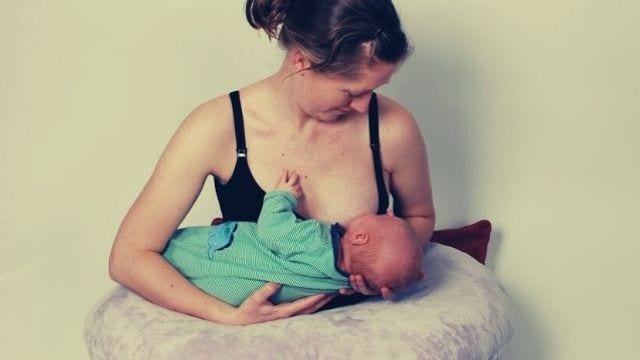
Moms know all too well how breastfeeding can be a challenge. We will try anything that can help make nursing easier, easing the pain, and having to sleep even just ten minutes more. One of these is a nursing pillow.
READ MORE STORIES ON SAFE SLEEP:
- Check Here if You’re Following Safe Sleep Practices for Your Baby
- Baby Sleep Safety: When Can My Baby Use a Pillow?
The U.S. Consumer Product Safety Commission (CPSC) warned parents never to let babies sleep on nursing pillows or other pillow-like products. The agency is currently investigating at least 28 infant deaths between 2012 and 2018 linked to nursing pillows.
How to use nursing pillows safely
Nursing pillows offer moms support when breastfeeding. Moms place the u-shaped pillow to hug their stomach and prop their baby on it as the little one feeds. This way, the mother’s arms have extra support.
It becomes a safety issue when you don’t transfer your baby to a safe sleep space after feeding or leave babies propped up on the nursing pillow as they sleep.
“When children are left on or near pillows, and the child rolls over, rolls off, or falls asleep,” the CPSC stressed. It becomes problematic because it can lead to blocked airflow and suffocation.
The American Academy of Pediatrics (AAP) also weighed in. “While nursing pillows may help moms and babies breastfeed more easily, they clearly represent a danger with regard to sleep,” Ben Hoffman, M.D., a pediatrician and chairman of the AAP’s Council on Injury, Violence, and Poison Prevention told Consumer Reports.
The CPSC is still investigating nursing pillows and its ties to the infant deaths. While it has not issued a warning or a recall for any specific make or brand, this serves as an early warning for those who use it. Moms can doze off while feeding their baby, too.
Always follow safe sleep guidelines
The takeaway is not to allow infants to sleep on nursing pillows or other pillow-like products. The same warning goes for letting babies sleep in car seats and not secured in a vehicle, in-bed sleepers, and using infant sleep products with inclined seats that are more than 10 degrees.
The AAP’s safe sleep guidelines are in place to keep your baby safe, so be sure to follow them. These include:
- Put infants younger than 6 months old to sleep alone and on their backs.
- Place baby’s crib in your bedroom, but avoid letting her sleep on your bed until they reach age 1. If co-sleeping is unavoidable, have your baby sleep in your room — not on your bed, but in his own crib — for at least 6 months. (Click here for co-sleeping safety tips.)
- Your baby’s safe sleep should be a safety-approved crib with a firm mattress and tight-fitting sheet.
- Your baby’s sleeping space should be clear of pillows, blankets, crib bumpers, stuffed toys, and other soft items.
READ MORE STORIES ON SAFE SLEEP:
- Check Here if You’re Following Safe Sleep Practices for Your Baby
- Baby Sleep Safety: When Can My Baby Use a Pillow?
For more information about safe sleep, click here.
What other parents are reading

Lorem ipsum dolor sit amet, consectetur adipisicing elit, sed do eiusmod
Lorem ipsum dolor sit amet, consectetur adipisicing elit, sed do eiusmod
