
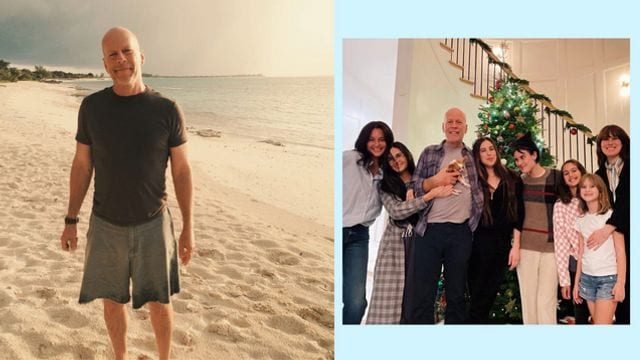
The family of Bruce Willis shared a devastating update on the retired actor's health condition.
The 67-year-old Die Hard star has been initially diagnosed with aphasia, a language disorder, early last year.
"As a family, we wanted to take this opportunity to thank you all for the outpouring of love and compassion for Bruce over the past ten months. Your generosity of spirit has been overwhelming, and we are tremendously grateful for it. For your kindness, and because we know you love Bruce as much as we do, we wanted to give you an update," his family's statement posted on the AFTD website on February 16 reads.
"Bruce’s condition has progressed and we now have a more specific diagnosis: frontotemporal dementia (known as FTD). Unfortunately, challenges with communication are just one symptom of the disease Bruce faces. While this is painful, it is a relief to finally have a clear diagnosis."
The statement was issued by his wife Emma Heming, ex-wife and fellow actor Demi Moore, and five daughters Rumer, Scout, Tallulah, Mabel, and Evelyn.
READ ALSO: Their Mom Has Dementia, And They Will Never Forget Her Advice: 'Don't Make Your Child Owe You'
What is frontotemporal dementia?
Frontotemporal dementia (FTD) refers to a group of disorders caused by progressive nerve cell damage in the frontal or temporal lobes of the brain. These are located in the areas behind your forehead, or the regions behind your ears, according to the Alzheimer's Association.
When these brain regions are damaged, it can cause changes and deterioration in the patient's behavior, personality, and movement, as well as difficulty in speaking and comprehension. FTD is different from Alzheimer's disease, when it comes to age of diagnosis and symptoms.
While the speed of decline varies from person to person, individuals with frontotemporal dementia exhibit muscle weakness and coordination problems. They also tend to experience muscle issues that can cause problems swallowing, chewing, moving, and controlling the bladder and/or bowels.
READ ALSO: Stroke, Tremors, Dementia, At Iba Pang Mga Uri Ng Sakit Sa Utak Na Dapat Malaman
A cruel disease with no treatments
"FTD is a cruel disease that many of us have never heard of and can strike anyone. For people under 60, FTD is the most common form of dementia, and because getting the diagnosis can take years, FTD is likely much more prevalent than we know. Today there are no treatments for the disease, a reality that we hope can change in the years ahead. As Bruce’s condition advances, we hope that any media attention can be focused on shining a light on this disease that needs far more awareness and research," they said.
According to AFTD, there is no cure, and no way to prevent the onset of this disorder. The average life expectancy of an individual with this condition is 7 to 13 years after the start of symptoms.
As to what causes it, there are no known risk factors except for a family history or a similar disorder.
A call to raise awareness on the disorder
Bruce's blended family came together at this difficult time to communicate one message: to bring this disorder to light so that more people will be informed and seek help.
"Bruce always believed in using his voice in the world to help others, and to raise awareness about important issues both publicly and privately. We know in our hearts that – if he could today -- he would want to respond by bringing global attention and a connectedness with those who are also dealing with this debilitating disease and how it impacts so many individuals and their families."
They continued, "Bruce has always found joy in life – and has helped everyone he knows to do the same. It has meant the world to see that sense of care echoed back to him and to all of us. We have been so moved by the love you have all shared for our dear husband, father, and friend during this difficult time. Your continued compassion, understanding, and respect will enable us to help Bruce live as full a life as possible."
Read how two daughters document their mom's dementia journey through TikTok, here.
What other parents are reading

Lorem ipsum dolor sit amet, consectetur adipisicing elit, sed do eiusmod
Lorem ipsum dolor sit amet, consectetur adipisicing elit, sed do eiusmod
