
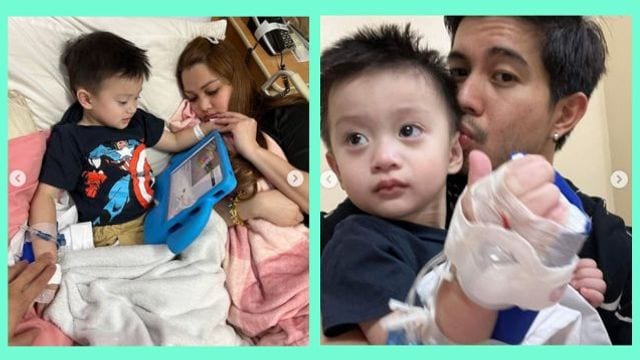
Rodjun Cruz recently took to Instagram to ask for "healing prayers" for his and his wife Dianne Medina unico hijo Joaquin, who's fallen ill with dengue.
"Our very brave boy," the actor captioned his post showing a pair of photos and videos of their sick but still cheerful son. "Love you anak! Asking for healing prayers for Baby Joaquin. dengue +"
Dengue cases on the rise
The number of dengue cases almost doubled (94 percent) in the first quarter of 2023 compared to the same period in 2022, according to a news report that quoted data from the Department of Health (DOH).
A total of 27,670 dengue cases (with 92 resulting to death) were recorded from January 1 to March 18, 2023 compared to 14,278 in the first quarter of 2022. Among the dengue cases in 2023.
Dengue is a disease transmitted by the bite of a mosquito. It affects all age groups, but babies and children are most vulnerable. Its primary symptom is sudden, recurring high fever.
To differentiate dengue fever from those of other ailments, notably flu or trangkaso, here are what you should take note of:
1. No apparent underlying cause (no colds, cough, etc.)
“We think of dengue fever if the child has high fever. Pabalik-balik 'yung lagnat na mataas every four to six hours,” said Dr. Carmina Delos Reyes, an infectious disease specialist and a fellow of the Philippine Pediatric Society.
Meaning, there's "no identifying source of infection." Dr. Delos Reyes explained further in her past interview with Smart Parenting: "So walang ubo. Hindi naglalabas ng plema. Hindi masakit ang pag-ihi — walang UTI [urinary tract infection]."
If you suspect your child has dengue fever, Dr. Delos Reyes's advice is to not wait for serious symptoms to appear before consulting a doctor.
2. After the fever goes away, new and alarming symptoms set it
Dr. Delos Reyes pointed out, “Kahit may gawin kayo o wala, mawawalan ng lagnat 'yung bata. That’s when the problem sets in.”
In fact, the first two days after having fever are the most crucial. This is according to Dr. Salvacion R. Gatchalian, the president of the Philippine Pediatric Society in her past interview with us.
Thus watch for these other dengue symptoms:
- Severe headache
- Pain around the eyes
- Rashes
- Bleeding of the gums and nose
- Severe abdominal pain
- Persistent vomiting
If your child has any of those symptoms, seek medical attention immediately. Babies, on the other hand, should be brought to the hospital earlier, when an acute high-grade fever sets it. This way, Dr. Faith Buenaventura-Alcazaren, a pediatrician, explained to a past interview with us, health care providers can begin to observe the baby’s fever pattern for two to three days.
How to prevent a dengue outbreak
The DOH pushes for its 4-S campaign against dengue:
1. Search and destroy mosquito-breeding sites
Make a thorough inspection of your house, inside and out. Look for breeding sites of mosquitoes, where there is stagnant water, and get rid of them.
2. Secure self-protection measures
Wear long pants and long sleeved shirts), if possible. Use a mosquito repellent, such as a spray, to discourage the mosquitoes from breeding.
3. Seek early consultation
If you or your child is experiencing dengue fever and other symptoms, consult a doctor right away.
4. Support fogging/spraying
Inform your barangay about hotspot areas, where dengue cases are rising in two consecutive weeks, and request for fogging or spraying services to prevent an outbreak.
Read here on how to protect your kids from dengue-causing mosquitoes.
What other parents are reading

Lorem ipsum dolor sit amet, consectetur adipisicing elit, sed do eiusmod
Lorem ipsum dolor sit amet, consectetur adipisicing elit, sed do eiusmod
