
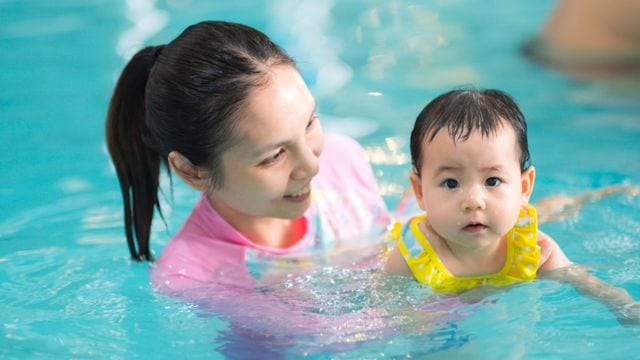
If you haven't enrolled your child in any learning or sports class this summer, consider enrolling them in swimming lessons instead.
Why swimming should be your child's first sport
An organization in the United States has been actively campaigning for swimming to be the first sport your child learns. On Facebook, National Drowning Prevention Alliance (NDPA) shared that drowning is the number one killer of toddlers in America. According to U.S. Centers for Disease Control and Prevention (CDC), more children ages 1-4 die from drowning than any other cause of death.
In the Philippines, 2019 data shows that 33 percent of drowning deaths are children age 0-4, more than half of which are males. Drowning, which is defined by Healthline as a form of death by suffocation, has been considered by experts as one of the important public health issues that are not often adequately addressed, as stated in a 2023 Inquirer report. Death occurs when lungs take in water and interferes with breathing.
With the hashtag #FirstSport, the campaign seeks to encourage parents and caregivers to make swimming and water competency a critical survival skill that all children should learn, before they learn basketball, soccer, and other sports.
The 5 Layers of Protection to Prevent Drowning
The American Academy of Pediatrics (AAP) reminds parents that swim lessons don't make your kids drown-proof. This is why on its website, the NDPA outlines five layers of protection that every parent and caregiver should be aware of to avoid drowning incidents.
1. Barriers and alarms
According to U.S. data, up to 70 percent of drownings among young children happen during non-swim times. This is why NDPA encourages families who have pools or any water features at home to use fences or physical barriers to restrict children from accessing pools as well as alarms for alerts.
2. Supervision
Some parents learned this the hard way; whether there is a pool around or not, never leave your kids unattended. This should be communicated to the caregivers too, in case the parents are not around. A lot of drowning incidents happen even when people are actively swimming. That's why NDPA reminds parents and caregivers to always be within arms' length of infants, toddlers, and children who lack water competency. Remember: floatation devices should not replace active supervision. Swimming near a lifeguard is always recommended.
3. Water competency
Learning how to swim is not really inherent or natural skill for everyone. Therefore, all adults and children should learn how to swim at some point in their lives. AAP recommends starting swimming lessons in children as early as age 1. NDPA advises that children ages 1-4 to take formal swimming lessons to minimize their risk of drowning by 88 percent.
"Water competency and swim lessons should be continuous, and not taken for just one season–skills need to be developed and maintained during the entire year," the organization emphasized.
Parents should look for swim programs with experienced and certified instructors for young children. Also, it's important to seek your pediatrician's clearance before enrolling your child in any swimming lessons.
4. Life jackets
When in or around natural bodies of water or riding a boat, both adults and children alike should wear life jackets that are appropriate for their size. These should be worn properly and at all times, as this can prevent unintentional drowning when other layers of protection are not in place.
Life jackets are not the same as floatation devices like arm bands, water toys, and should be worn before entering a body of water.
5. Emergency preparation
In case of a water-related emergency, it's important to know which emergency numbers to call. These hotline numbers should be saved in your phone and can be easily accessed at all times.
It is also essential for adults to learn how to perform cardiopulmonary resuscitation or CPR. NDPA recommends that at any pool party or group outing, at least one person should know CPR.
If a child is missing, always check the pool or other water bodies first. Every second counts when it comes to drowning incidents.
Read more about NDPA's campaign here.
Choosing the right swimsuit can save your child's life
Recently, a poster of swimsuit colors when submerged in the pool and lake made rounds on social media, shared by parents.
A mom in the Smart Parenting Village Facebook group shared a similar poster back in 2022.
.jpg)
Mommy Saskia Velasco then shared, "Hi Mommies! Pag pumipili ng swimsuit or rash guard for our kids be sure to consider the color:
- Blue or green shades are hard to see pag nasa water na
- Bright neon colors best and pinakamadali makita pag nasa water
- Bright neon color madali din makita sa crowd incase mahiwalay siya sa inyo
Photos [above] show anong itsura ng colors na yun pag under water and under water with bubbles."
She told Smart Parenting why she shared this kind of information with other parents: "I once witnessed one of my playmates drown (luckily, he was saved). That's why I decided when I have a kid, I want him/her to be equipped with everything to ensure that he will be safe whenever we go on outings."
Again, adhering to these swimsuit color guidelines is not enough. Enrolling your child to swimming lessons, plus constant adult supervision, is essential.
Remember the 3-year-old boy who drowned in a resort while celebrating his birthday? Read his story here.
More from sp

Lorem ipsum dolor sit amet, consectetur adipisicing elit, sed do eiusmod
Lorem ipsum dolor sit amet, consectetur adipisicing elit, sed do eiusmod
