
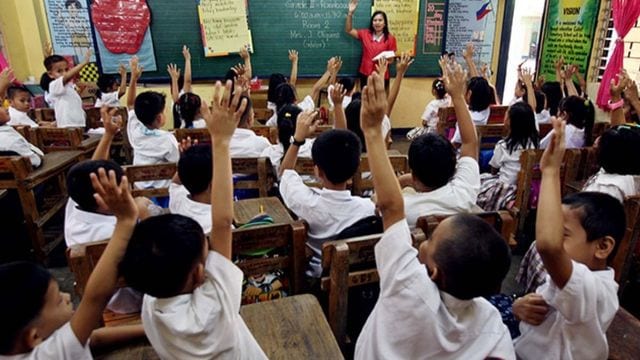
In a Malacañang press briefing on Tuesday, EDCOM 2 Executive Director Dr. Karol Mark Yee highlighted a 5.5-year learning gap among Filipino students, along with other pressing educational challenges.
The World Bank’s Human Capital Index estimates the Philippines' learning gap at 5.5 years, surpassing that of neighboring countries. This suggests that while Filipino students spend more time in school, their productivity lags behind their peers internationally.
Yee illustrated the issue with an example from his on-ground observations, noting that some Grade 8 students were still struggling with basic arithmetic, such as addition and subtraction. These foundational skills are essential but insufficient for the competencies expected at the Grade 9 level, which include quadratic equations, inequalities, and rational algebraic equations.
He said, "Mga batang pinapanood namin sa learning camp, hirap sila mag-subtract. Grade 8 students sila. Buong buwan inaral nila addition and subtraction, and they struggled to subtract."
"We asked them about multiplication and I gave examples... Sabi ko, 3 times 3, 0 times 0, 10 times 10. Hindi kaya. Pagpasok nila ng July 29, ang lessons nila is quadratic functions, algebra. How will you solve all of those concerns?" he added.
Yee concluded that tackling this issue, along with other educational crises such as the lack of basic resources, the impact of bullying on students' academic performance, and mismatched teacher training, will require DepEd’s collaboration with other agencies through a Cabinet Cluster.
ALSO READ: Alarming Bullying Rates In PH Schools Revealed In New Studies
Cabinet Cluster For Education
In the same press briefing, Education Secretary Sonny Angara confirmed that the President has approved the creation of a Cabinet Cluster for Education.
“In principle, he approves of it and would like us to fast-track some of the actions because he can see the urgency and it’s a very deep-seated problem,” the newly appointed DepEd secretary stated.
The Cabinet Cluster for Education was proposed by the Second Congressional Commission on Education (EDCOM 2), which is responsible for assessing and evaluating the Philippine education sector.
Dr. Karol Mark Yee emphasized that resolving the learning crisis is not solely DepEd’s responsibility.
“DepEd has to do its work in resolving the learning crisis, but it’s not something it can achieve on its own,” Yee stated.
While education agencies are making efforts, Yee highlighted the need to streamline programs, address gaps, and ensure continuity across all levels. This is where the Cabinet Cluster for Education comes in.
The Cabinet Cluster for Education will develop a 10-year National Education and Workforce Development Plan, ensuring that annual agency targets and budgets align with this plan. It will comprise the DepEd, the Commission on Higher Education (CHED), and the Technical Education and Skills Development Authority (TESDA).
Yee emphasized that the National Education and Workforce Development Plan is a “long-term” initiative designed to tackle challenges in the education sector.
“Kailangan tuloy-tuloy 'yung reforms. If they are interrupted, bagsak na naman tayo so mahalagang-mahalaga 'yung gagampanan ng Education Cluster,” he added.
Additionally, Angara noted that the cluster will act as a coordinating mechanism among agencies and will also involve collaboration with the Department of Labor and Employment (DOLE) and the Department of Budget and Management (DBM).
EDCOM 2 stated that establishing a new cluster would “strengthen” the governance structure of the education system and urgently address the country’s learning crisis.
Learn more about DepEd's tech-driven educational reforms by clicking this link.
More from sp

Lorem ipsum dolor sit amet, consectetur adipisicing elit, sed do eiusmod
Lorem ipsum dolor sit amet, consectetur adipisicing elit, sed do eiusmod
