
“The earlier infants, toddlers, and preschool children get exposure to daily movement and exercise, the better the likelihood of healthy development later in life.”
— Jane Clark, Ph.D., professor and chair, Department of Kinesiology, University of Michigan
Your children’s physical health depends on your ability as a parent to choose the right activities for them. Lack of physical activity makes children prone to illnesses such as coronary heart diseases, diabetes, obesity, and other chronic problems when they become adults. Provide toddlers with at least 30 minutes of adult-supervised movement activities, and preschoolers with 60 minutes of structured play.
TIME FOR PLAY!
Make the most of your kids’ intrinsic thirst for movement with our list of age-appropriate exercises. Exercising with your child not only develops his motor skills and self-confidence, but strengthens your parent-child bond as well. Have fun with your child and don’t be afraid to try out games that also challenge their social and cognitive abilities.
Games for Infants
0 to 18 months
What may seem simple and trivial activities are actually essential in supporting your infant’s motor development. Reaching and grasping toys and other objects, rolling over, crawling, and standing are only some of the motor exercises that boost your baby’s fitness.
1. Beach Ball Balance
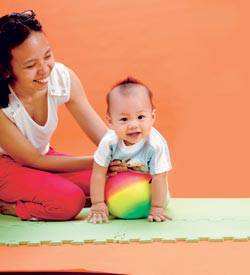
- Developmental stage: From birth to 3 months, your baby will begin to steadily hold his head up while lying on his stomach and to lift his head and shoulders more confidently.
- Place your baby tummy-down on a lightly deflated beach ball. Hold him securely as you rock him back and forth or side to side. Be sure to support your newborn’s head all the time. Sing and talk to your baby while you play. This will keep him focused while the gentle rhythm and pressure soothe his tummy. Allow for some rest in between.
- Physical gains: balance, upper body strength
Click here for more parent-baby activities.
[previous|page|next]
Read on for more parent-baby activities.
2. Puppet Play

- Developmental stage: While your baby’s vision may be the least developed of the 5 senses at birth, rich visual stimulation in the first 6 months enhances curiosity and attentiveness, as more brain circuitry is built for enhanced learning. Develop your baby’s skill in visual tracking, which will be useful when they’re playing sports in later years.
- Lay the baby facing up. Put on a finger or hand puppet and place it about 5 inches away from the baby’s face. Move it up and down or sideways. You will see how your child follows the object with his or her eyes.
- Physical gains: eye-hand coordination
3. The Pillow Course
- Developmental stage: By 10 to 12 months, your baby will be able to support his entire body weight on legs. He walks when his hands are held and enjoys cruising along furniture or sturdy objects. He can stand and crawl up steps. He has better balance when sitting and can shift positions without falling.
- Create a safe obstacle course in the living room with a simple zigzagging path of pillows, cushions, and big toys. Encourage your child to complete the course by crawling or walking along the path. Be sure to hold his hand as he begins the journey. Remove his shoes to help him keep his balance.
- Physical gains: gross motor skills, balance, coordination
4. Cushion Mountain
- Developmental stage: From 6 to 9 months and onward, your baby can sit independently, crawl, lean over and reach for objects while sitting, and even pull himself up to stand.
- Pile some cushions or throw pillows on the floor and show your baby how to clamber across them. Try placing a toy on top of the cushion to entice your baby to venture forth. Hide behind 1 cushion and encourage your baby to crawl across the others to find you.
- Physical gains: upper body strength, balance, bilateral coordination, gross motor skills
Photography by David Hanson Ong

Lorem ipsum dolor sit amet, consectetur adipisicing elit, sed do eiusmod
Lorem ipsum dolor sit amet, consectetur adipisicing elit, sed do eiusmod
