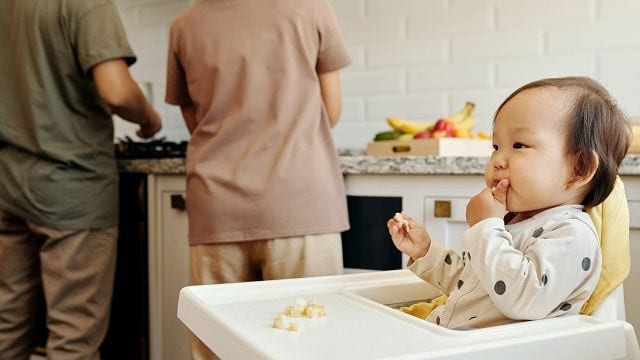
Your little one is ten months old! You should see your baby becoming more independent and confident. You might also have an idea of what your child’s personality is by now.
The 10th month is an exciting (and possibly exhausting) time for you! Your growing child is now keen to explore their surroundings and see just how much they can do.
What Developmental Milestones Should I Expect?
Around this time, it is all about exploring. Your baby has more muscle strength, coordination, and a growing curiosity about their surroundings. At this time, your little one is preparing for walking.
Physical Milestones
Most babies can crawl at around ten months. They can also stand up by pulling themselves up from a seated position. They can also squat or sit down while holding onto furniture. Lastly, they can roam by cruising or walking around while holding onto furniture or your hands.
Creating a fun obstacle course is an excellent way to encourage crawling and cruising. You can use pillows, empty boxes, and cushions to create paths. You can use their favorite toys as prizes at the end of the course!
However, if you are worried about your child getting into places they should not reach, you should baby-proof your house. Rearranging furniture or installing baby gates will help keep your little one safe while exploring.
RELATED: Wow! Philmar Alipayo Takes 10-Month-Old Daughter Lilo Surfing
Your child’s arm and hand movements are also more refined at ten months. They can hold an object in one hand (like a rattle) while using the other hand for another thing. They may also start clapping and waving bye-bye.
Lastly, your child’s fingers are more dextrous at ten months. They can now pick things up using the “pincer grip,” which is the thumb and pointer finger.
Communication Milestones
At ten months, your baby understands the basics of communication—although they still cannot use phrases and sentences. But your child now understands simple words like “no” or “more.”
Your child may also start mimicking the sounds of the words you make. Babbling is typical for babies at this age, and some might even utter their first word.
You can encourage your child’s communication skills by including gestures in your speech. For example, try pointing at the object while saying its name. You can also mimic the motion while saying the action, such as saying “drink” or “bottle” while bringing your cupped hand toward your mouth.
Cognitive Milestones
Remember when your baby loved playing peek-a-boo? During your child’s earlier months, they thought that a person or an object that disappeared in front of them was no longer there.
But at ten months, your child has a more developed understanding of object permanence. This means your baby knows the rattle still exists even after you have hidden it under a pillow.
However, your ten-month-old baby’s separation anxiety is still high, so they may cry for you when you leave the room.
Your baby may also likely explore playing with their toys differently. You may see them hitting, banging, or throwing their toys to see what happens.
My Baby Isn’t Walking Yet! Should I Get a Walker?
While it is true that some 10-month-old babies start walking around this month, ten months is not the deadline for walking. It is normal for children to start walking at around 12-13 months of age.
RELATED: Karen delos Reyes' Proud Mom Moment: Baby Walking at 10 Months
You must be eager to see your precious child start walking, and we understand! But, it is not advisable to use a baby walker. According to a 2021 research published in the Turkish Archives of Pediatrics, babies who used baby walkers had lower trunk balance and motor development scores than babies who did not.
Instead, you can help your child practice walking by letting them cruise along and across the furniture in the room. You can also try assisted walking: stand behind your child and hold their arms in yours. Pull them up, then guide their steps by gently pulling one arm forward. They will rotate their hips to step, and their feet will naturally follow.
READ ALSO: Andador o Walker? Alin Nga Ba ang Mas Ligtas?
Above all else, the best way to help your child’s development is to be with them. Pediatrician, child health specialist, and Smart Parenting expert Dr. Joey Cuayo-Estanislao says that playing and interacting with your precious baby is the best way to teach them their fundamental skills. “Give them loving, caring attention,” adds Dr. Cuayo-Estanislao. “Allow them to explore their bodies and their environment in baby-safe spaces.”
Check out these play activities that you can do with your 10-month-old baby, here.
What other parents are reading

Lorem ipsum dolor sit amet, consectetur adipisicing elit, sed do eiusmod
Lorem ipsum dolor sit amet, consectetur adipisicing elit, sed do eiusmod