
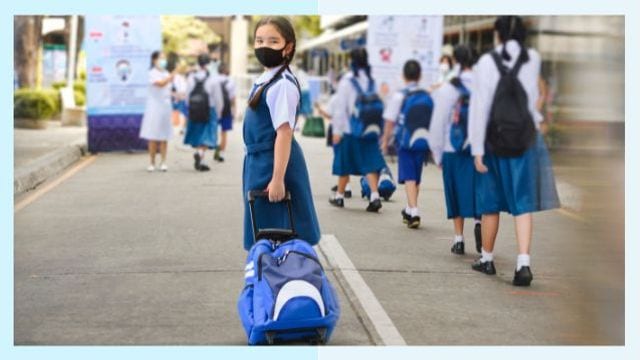
While transferring schools is mostly attributed to family's allotted budget for education, there are other reasons behind the academic move: relocation, parents switching careers, personal preference, state-of-the-art school facilities and equipment, teaching methodologies and philosophies, as well as the pride to become fruits of esteemed academic institutions.
Read Also: Public Vs Private Schools In The Philippines: Parents Share Pros, Cons, And What To Focus On
So what do we need to know in transferring private schools?
Here’s your basic guide to private school transfer:
1. Conduct personal research.
Research your area for potential private schools. Aside from the location, you may want to consider factors such as academic programs, or if they have special programs or extracurricular activities, student-teacher ratio, applicable fees, rooms and buildings, as well as school or student reputation.
If you are a parent looking for Special Education learning resource centers, you may also want to check if the school facility is PWD-friendly including those centers that provide assisted mechanisms such as audio-assisted technology like Braille and what specific interventions are being offered for your child with disability.
2. Check eligibility and documentary requirements
Check the eligibility requirements for transferring schools. These requirements may vary depending on the policies of the local education authority and the school itself. Most private schools require a certificate of character rating. This is equivalent to good moral standing or a letter of recommendation. Duly completed application/enrollment form and SF 9 (progress report card) will also be required. SF 10 (permanent record) will be sent by the originating school to the receiving school.
Even vaccination records may also be requested by the receiving school. So plan ahead and inquire with your school in mind in order to keep track of the requirements.
Read Also: Moving To The Capital? Here's A List Of Private Schools In Manila
What are DepEd's documentary requirements?
Eligibility standards and documentary requirements according to Department of Education’s Basic Education Enrollment Policy (DepEd Order No. 03, s 2018) are listed below:
Kinder
Eligibility: Children aged 5 years old by August 31 of the school year.
Requirement: Birth Certificate issued by Philippine Statistics Office (PSA)
Grade 1
Eligibility: Children who have completed Kindergarten in DepEd accredited schools
Requirements: Birth Certificate issued by Philippine Statistics Office (PSA) and Kindergarten Certificate of Completion
For children who are six years old and above who have not completed Kindergarten, an Early Childhood Care and Development assessment may be conducted. A PSA birth certificate is also required.
Children who have completed Kindergarten from a non-DepEd accredited learning center or are homeschooled, must undergo a validating test administered by the Bureau of Education Assessment through Philippine Educational Placement Test (PEPT) or Philippine Validating Test (PVT). A PSA birth certificate is also required.
Grade 7
Eligibility: Learners who have completed a DepEd-accredited Grade 6 program are eligible to enroll for Grade 7.
Requirements: Grade 6 SF9 Learner's Progress Report Card
Applicants must have passed the PEPT or Accreditation and Equivalency Test. Learner’s PSA Birth Certificate, Results of the Philippine Educational Placement Test or A & ETest.
Grade 11
Eligibility: Grade 10 completer
Requirements: Grade 10 SF9 Learner's Progress Report Card, PSA Birth Certificate; Results of PEPT or A & ETest
Transferees
Minimum requirements for school transfer are SF 9 and 10 (formerly known as forms 138 and 137). These are two basic school records that show the learner’s academic and co-curricular standing. If SF 9 is not yet available, a letter certifying the last grade level completed must be signed by the school registrar.
In the absence of a PSA birth certificate, the parent or guardian must submit a birth certificate (late registration) from the local civil registrar documenting the name of the child, name of the parents, date of birth, and sex.
Additionally, an assessment may be conducted in the following circumstances:
- Learners from non-formal and informal education programs
- Learners who have incomplete or no record of formal schooling
- Learners with back subjects
- Learners who need grade level standards assessment
- Learners who are overage for their grade levels
Related Read: Ultimate Guide To Transferring Elementary Schools: Here's What You Need To Know
3. Check special case requirements
DepEd also highlights special case requirements in the following situations:
Learners from Philippine Schools abroad
- Birth Certificate or equivalent legal document
- Latest report card or any equivalent academic record
- Accepting school has the discretion to determine the appropriate grade level in which to place the learner
- PEPT certificate of rating
- Permanent transcript of records from originating school
Learners from Foreign Schools abroad
- Birth Certificate or equivalent legal document
- Latest report card or any equivalent academic record
- Accepting school has the discretion to determine the appropriate grade level in which to place the learner
- PEPT certificate of rating
- Permanent transcript of records from originating school
Learners from non-DepEd accredited schools
- PEPT Certificate
- PSA Birth Certificate (or local civil registrar or barangay certification)
Learners who have been out of school for a long time or Balik-Aral learner
- SF 9 of the last school year attended or PEPT certificate of rating
- PSA Birth Certificate (or local civil registrar or barangay certification)
Accreditation and Equivalency (A & E) Test Passer - Elementary
- A & E Elementary level certificate of rating
- PSA Birth Certificate (or local civil registrar or barangay certification)
Accreditation and Equivalency (A & E) Test Passer who qualified for Grade 11
- A & E scondary level certificate of rating
- PSA Birth Certificate (or local civil registrar or barangay certification)
Displaced learners due to on-going war, armed conflict, or very recent disasters/calamities
- Any proof of identity as directed by the Central office, SF 9 or results of PEPT or A & E, if applicable
4. Prepare for the transition.
Transferring to a new environment is a huge deal for our children. Just as change is difficult for us adults, the same goes with our children. There is a whole array of emotions to deal with: anxiety, fear of the unknown, and plain discomfort when things shy away from predictability and routine.
It is important to plan ahead in terms of allotting budget for school and transportation, getting familiarized with school policies and facilities, and knowing what to do in case of emergencies.
A visit to the school is highly recommended to inspect the facilities and common areas. Observing the dynamics of students and teacher can also impact your choice. Moreover, free trial classes can also aid your decision and lock in the transfer.
5. Complete the application, ensure official enrollment, and attend orientation.
Make sure to follow up with the new school that all transfer paperwork, especially in special case scenarios, has been processed. Pay the applicable fees for tuition, books, and uniform. Confirm that you are officially enrolled in the classes. Attend parents' orientation and keep communication lines open with school officials for any additional requirement that may be needed in the transition process. Seek support from teachers and school personnel for your child who is in the adjustment phase.
3 tips to help prepare your child for the transition
Set expectations
If your child used to study in a public school, chances are, he/she would deal with some changes. From facilities alone, ceiling or wall fans are now probably replaced with air conditioning units. The student-teacher ratio might also be different, especially for public schools with a high number of enrollees. Expect more focus on learning and understanding with fewer classmates. School culture and policies will tend to differ as well.
Ultimately, it is important to let your child realize “why” the change has to happen. Letting your child know what to expect is also an opportunity to teach your child about flexibility, self-reliance, and adaptability to change.
Maintain a positive outlook
If we allow our children to focus on what they lack (old friends, old neighborhood, previous school), they might lose motivation as they adjust to this new phase. But if we train them to look into the positive sides of change like “a fresh start,” new friends and acquaintances, new activities to try, and perhaps another opportunity to become a better learner, then we might actually be unlocking an important lesson on growth and perspective.
Strength comes in the ability to start over.
Also Read: Private Vs. Public School For Your Child: Here's What Teachers Say
Show them support
Entering into an adjustment period can be daunting for a child, especially if he’s been accustomed to a particular school culture before the transfer. Because children typically thrive on routine, parents’ support is important in this stage where a lot of learning and unlearning happens. We should show them that they are not alone in this adjustment period and that things will get better with time.
More from sp

Lorem ipsum dolor sit amet, consectetur adipisicing elit, sed do eiusmod
Lorem ipsum dolor sit amet, consectetur adipisicing elit, sed do eiusmod
