
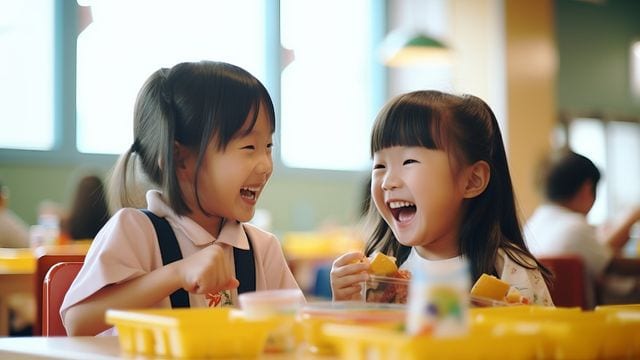
Preschool years are considered transformational years where children begin to learn how to detach themselves from being fully dependent on their caregiver to have their first taste of independence. They begin to explore the world around them and start to become self-sufficient in terms of trying to feed on their own, washing their own hands, using the toilet independently, putting on their shoes and even striking up conversations in the hope of making friends. This is a period of autonomy and initiative, according to psychologist Erik Erikson and his theory on psychosocial development.
4 areas of child development
There are four major areas of early child development namely social, emotional, physical, and cognitive.
Social
This area is where one gains knowledge and skills to interact with people. Social skills are mostly learned by experience with peers and what children see from adults.
Emotional
This refers to one’s emotional response to events. Children who develop strong emotional skills can express feelings of joy, love, sadness, anger, frustration, and gratitude. This is where children begin to practice self-control and learn how to self-regulate.
Physical
These are physical changes that occur, including physical maturity of the body and physical coordination of muscles including muscle control.
Cognitive
This is the area of language, problem-solving, ability to reason, ability to organize ideas, and physical brain growth.
Preschool years: autonomy and initiative
Autonomy
Erikson’s theory says that during stages 2 and 3 of psychosocial development, children enter into autonomy and initiative stages where they begin to become more mobile and move freely, with confidence and some sense of self-control. It is also a time when play is at the center and children learn to interact with peers, plan and initiate activities, as well as accomplish tasks, and overcome challenges. It is believed that, when these skills are not developed or supported, children may feel shame, doubt, and guilt. For example, if children are overly controlled or criticized, they lose confidence in themselves, and harbor feelings of self-doubt and lack initiative. But if the caregiver shows support for the child’s first steps to self-reliance, that child is believed to take initiative, formulate and execute plans, and learn to think for themselves.
Initiative
Vigor in action and asserting initiatives may also come up as being “aggressive” and asking too many “trivial” questions could appear as a nuisance. If a parent punishes a child for this behavior, the child may feel the “guilt” and this can inhibit his creativity and even slow the child’s interaction with others. But if the caregiver provides a safe space for the child to explore freely and make mistakes in the process, this is believed to nurture the child’s initiative and problem-solving skills. It will also boost confidence and resilience.
READ ALSO: New Study Reveals: Full-Day Preschool Is More Beneficial For Kids
Strategies for social development
So in this stage of exploration and quest for independence, how do we support our preschoolers in developing their social skills? How do you avoid making them feel shame, doubt, and guilt?
Peer Support Teachers developed strategies and tools in introducing social and emotional skills in preschool–a program supported by the UK, Unicef and Ministry of Labor and Social Policy. We can learn a thing or two from these strategies.
1. Self acceptance
As parents, it is vital to show our children how to love themselves for who they are. They should learn how to respect themselves to show respect and love to others. One technique is to give them a mirror, let them look at themselves, and show them how unique they are and at the same time appreciate how other people are different from them.
As young as they are, children should know that they must protect themselves, their joy and their peace by not allowing other people to hurt them. We are our best friend.
Let them tell themselves in the mirror, “I love you and I will always protect you.”
2. Self-awareness
Children will have a strong sense of self if they can recognize their emotions. Self-awareness in the early years of life helps them develop strong emotional abilities. Help them put a name to what they’re feeling: is it anger, is it joy, is it frustration, is it excitement? Not only do they recognize their own emotions, but they will also learn to recognize others’ too and develop empathy.
3. Self-regulation
When a child is aware of what they feel, they will understand their emotions. As parents, we can help them self-regulate to express themselves in an acceptable form of behavior. When children are upset, restless, or even when they are too excited and elated, their emotions could go overboard and they cannot focus. Teach your child how to relax and calm down by focusing on their breathing and doing some breathing exercises.
And in times that they are too upset, hug them and make them feel the space is a safe one.
4. Manage stress and conflict situations.
A child in play will almost always have conflict situations–but a child being himself, they are quick to move past one. However, conflicts can bring about stress and make them deal with emotions that are not easy to deal with at the given time. As parents, we can prepare them for conflict situations and help them think for themselves or practice problem-solving by giving them hypothetical conflict situations in form of storytelling and involving them in the plot.
5. Express gratitude and respect.
Repeating affirmative words and words of happiness help children relax their brain and become ready to learn a new activity. Additionally, as parents, let us show them the value of saying “sorry” and “thank you” more often.
Read Also: Out Of Ideas? Here Are 15 Preschool Activities You Can Do At Home With Materials You Already Have
Other ways to support your child’s social development
Improve communication skills
Encourage conversations during playtime and do role-plays with your child.
Learn to share and take turns
Use group activities to encourage sharing, such as group art projects and teach your child how to wait for his/her turn.
Make friends
Build friendships by arranging playdates to promote social interaction.
READ ALSO: 'Mahiyain, Walang Kaibigan?' 5 Tips For Parents To Help Their Preschoolers Make Friends
Enhance listening skills
Read them stories and have a mini-discussion about what was read. Play games that involve listening and following instructions. Teach them how to listen when someone is talking.
Positive reinforcement
Praise and acknowledge positive behavior. Give rewards if you deem fit.
Foundational skills
Social development in preschoolers is a vital aspect of their overall growth. During the preschool years, children are developing holistic foundational social skills that will serve as the basis for future interactions and relationships. It is important that as parents, we provide them the support they need and the love and care they deserve.
More from sp

Lorem ipsum dolor sit amet, consectetur adipisicing elit, sed do eiusmod
Lorem ipsum dolor sit amet, consectetur adipisicing elit, sed do eiusmod
