
"Turuan mo na magsulat ng pangalan."
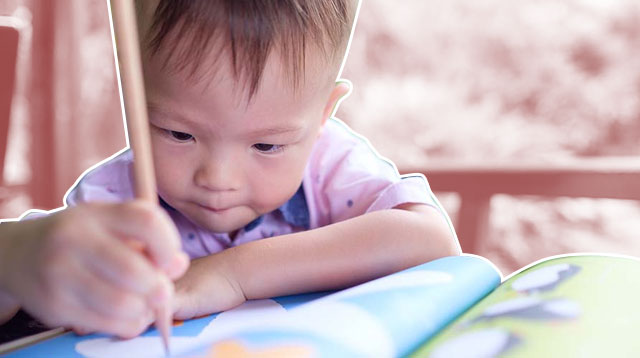
So your little one holds a pencil for the first time, then struggles. You hold their fingers together, guide them to trace the dotted diagonal lines on the worksheet you recently bought, and then the pencil slips right through, and you start from the top, and the pencil still slips from those tiny fingers--repeats one more time, this time your grip is firmer, but now your child's exhausted and you're frustrated. It should have been a nice bonding moment, you know.
Truth is, writing is a complicated skill and it isn't as simple as giving a pencil and guiding your child to trace the dotted lines, diagonal lines, circle, semi-circle, and all that curved lines and zigzags.
According to Kid Sense, there are fundamental skills children need to develop before they're able to write. These are called pre-writing skills. These skills are essential for the child to fully develop the ability to hold a pencil and efficiently use it. To name a few building blocks of writing readiness from the site, there's hand-eye coordination, hand and finger strength, visual perception, object manipulation, hand dominance, and bilateral integration (using two hands together with one hand leading).
Pre-writing is a gentle introduction to handwriting. It’s about slowly enhancing fine motor skills, becoming familiarized to the use of pencil, expanding the child's interest and concentration, typically through play, and introducing the simple lines needed to eventually form letters.
Simply put, the focus is not on pencil and paper but on fine motor skills and visual-motor skills (ability for the brain to understand and communicate from the eyes to the hands).
Why are pre-writing skills important?
Your Therapy Source sums it up in three:
- Early fine motor writing skills are an important school readiness skill.
- Writing by hand in the early years helps to support the development of reading skills.
- Kindergartner’s visual-motor integration skills predict achievement in Reading, Math, Writing and Spelling.
Hence, with such skills in mind, we've compiled sample activities that can help improve your child's writing readiness skills!
READ ALSO: Hone Your Child's Fine Motor Skills! 7 Best Toys for Squeezing, Stretching and Exploring
Pre-writing skills activities
Play doh activities
Playing the dough enhances hand strength and fine motor skills. Roll the dough into balls or snakes; use a pin roller or cookie cutter or toy knives to cut the dough into smaller pieces. You can also roll the dough to form big and small letters.
.jpg)
Use of scissors
Scissors can improve hand control, hand and finger strength, and hand-eye coordination. If cutting paper is a bit advanced for your little one, they can cut play doh or drinking straw instead.
Glitter glue tracing
Write a letter on a clean sheet of paper and let the child squeeze droplets of glitter glue (or colored glue) to trace the letter. You can also do the same for lines. Meanwhile, if a glitter glue is not available, you can also use a squeeze bottle and fill it with refined sugar as substitute.
.jpg)
Use of tongs to pick up objects
You can give a pair of tongs to your little kid and pick up dried leaves or small toys to practice their pincer grasp.
Q-Tips painting
Another way to enhance their pincer grasp is through the use of q-tips or cotton swabs. They can dip it on watercolor or any form of non-toxic paint and create their own masterpiece. You can also download and print free printables that they can trace or fill with color.
.jpg)
Use of clothespin
Instead of pointing to which picture is different, you can use clothespins to ask your child and show the answer. This is another good way to practice pincer grasp and finger strength.
.jpg)
Threading and lacing
Print colorful pictures of animals or flowers or vehicles (absolutely your choice) and cut them, leaving a half inch space around the picture as a margin. Punch holes along the margin and let your child use a shoe lace or a yarn to fill in the holes. Another option is beading. You can place the beads into a ribbon or a yarn and create a necklace or bracelet of your choice!
Use of dropper
Another means of enhancing the pincer grasp, is through the use of a dropper. You can use medicine droppers to transfer colored water from one container to another. You can use food coloring to color your water.
.jpg)
Sensory writing
One can fill a sheet pan with flour, sand, or cornmeal (even shaving cream!) and use photos of letters as guide to write and copy the letter using fingers.
.jpg)
PHOTO BY teaching mama
Construction
Building with Duplo, Lego, Mobilo or other construction toys will help develop fine motor skills, hand and eye coordination and even bilateral integration. Eventually you can also use these blocks to create letters.
Straight lines sensory bin
You can fill a box or a tub of objects that are straight in form like pencils, chopsticks, pens, barbeque sticks, etc. and use these items to make vertical lines.
Pop the bubble wrap
Excess bubble wrap from your online shopping spree? You can recycle it by writing a letter on the bubble wrap, a huge one, using a colored marker and let your child pop as they go. This aids letter recognition and exercises their fingers, too.
Buttons up!
Fill a bowl with colorful butons and instead of using markers to trace lines and curves and zigzags--let your child trace the lines by lining up buttons instead. This is good activity to develop fine motor skills.
Finger painting and drawing
Another way to enhance fine motor skills and finger strength is through finger painting. There are lots of washable paint in the market now so you can schedule a nice painting session with your kid using only fingers!
.jpg)
You can also use washable markers and draw on the walls. Drawing is such a spot-on for your little ones. You can also utilize clean up time as a fun bonding moment with your child!
Other simple ways to develop pre-writing skills
Practice hand strength by scrunching paper or doing every day activities that require finger strength such as opening containers and jars. One can also exercise with fingers through action songs like Itsy Bitsy Spider. Your kid can also tear paper, fold paper, and solve wooden puzzles to enhance fine motor skills. You can also use a masking tape and let your child tear the tape by hand to create letter forms and stick to a flat surface.
Remember to praise and encourage your children especially if they find the activities challenging or difficult.
What happens if my preschooler is not developmentally ready to write using a pencil?
OT Toolbox writes:
Immature grasp
Inability to form diagonal lines
Forms letters from bottom to top
Forms letter segmentally and inappropriately
Weak grasp on the writing utensil
Inconsistent hand use
Weak pinch and base of support on the pinky side of the hand
Poor posture
Inattention
Difficulty identifying letters and copying complete parts
Sources: Teaching Mama, Growing Hands on Kids, We are Teachers
What other parents are reading

Lorem ipsum dolor sit amet, consectetur adipisicing elit, sed do eiusmod
Lorem ipsum dolor sit amet, consectetur adipisicing elit, sed do eiusmod