
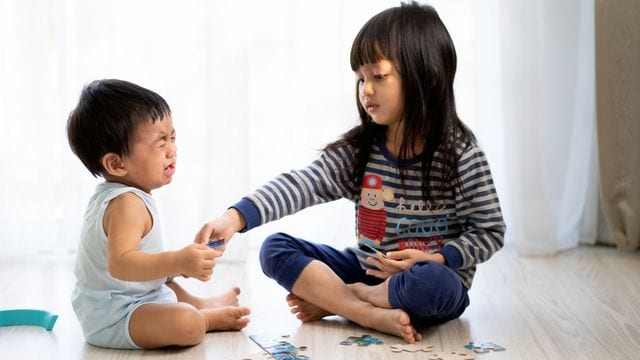
Is your child taking on the role of emotional regulator during family conflicts? While some level of responsibility fosters maturity, this might indicate parentification, which can have long-term negative effects.
Parentification is a term that has gained attention in recent years, describing a situation where a child takes on adult responsibilities, acting as a caregiver for a parent or sibling. Psychologists refer to destructive parentification as a form of emotional abuse or neglect. In these cases, a child is compelled to prioritize the needs of others over their own, often at the expense of their emotional and developmental well-being.
ALSO READ: Raising Siblings Without Rivalry, Is It Possible?
What Is Destructive Parentification?
Destructive parentification occurs when children are forced into caregiving roles that exceed their developmental capacity. Unlike occasional chores or helping out, destructive parentification fundamentally disrupts a child's ability to experience a normal childhood. This can manifest in two subtypes:
- Instrumental Parentification: When children are tasked with practical duties, such as cooking, cleaning, getting groceries, or managing household finances.
- Emotional Parentification: When children provide emotional support to parents or siblings, listening to their problems or acting as a mediator in family conflicts.
In families experiencing destructive parentification, the children don't have a reliable adult to turn to. They’re left to shoulder the emotional and practical burdens of the household, unknowingly becoming the caretaker in a space where they should be cared for.
The Emotional Toll on Children
Being thrust into a caregiving role robs children of the opportunity to explore their own emotions and needs. Researchers increasingly find that destructive parentification not only disrupts a child's development, but also leaves deep emotional scars that linger into adulthood.
A 2012 study by the Columbia University found that when a child's early experiences at home revolve around meeting everyone else's needs, they may feel unseen. This lack of acknowledgment of their individuality can result in chronic self-esteem issues, anxiety, a pervasive sense of unworthiness, and other negative outcomes.
A parentified child often learns that self-reliance is safer than trusting others. This adaptation can manifest as difficulty forming close relationships or relying on others for support. Such individuals may find themselves compulsively caretaking in adult relationships, prioritizing the needs of others while neglecting their own.
Sibling Dynamics in Parentified Families
While much of literature focuses on parental neglect, there is less examination of how this neglect forces children to parent one another. In abusive or neglectful family environments, parentified siblings often develop symbiotic relationships to fill the void left by absent or unreliable caregivers.
Dr. Lisa M. Hooper, a leading researcher on parentification, highlighted its often codependent nature in an interview: "I think that it's important to recognize that a lot of parentification is codependent... Perhaps one sibling does the dishes, cleans the house, and takes care of the mom who is sick or drunk, while another sibling provides emotional support by listening to problems or offering comfort."
This dynamic can mirror relationships like that of Wendy and the Lost Boys in Peter Pan, where one sibling assumes the "parent" role while others rely on them for stability. However, while these relationships may foster closeness, they can also lead to long-term challenges in sibling dynamics, including resentment, guilt, and difficulty setting boundaries.
Interestingly, there is virtually no empirical research examining how parentification impacts sibling relationships over time or how these dynamics affect future relationships. Scholars agree that understanding sibling roles in abusive family environments remains an underexplored area of study.
Resilience and Strength: The Other Side of Parentification
Despite its negative outcomes, parentification can also cultivate resilience and self-efficacy in individuals who have experienced it. Dr. Hooper suggests that many parentified children develop a remarkable capacity for problem-solving, independence, and empathy.
These skills, while born out of necessity, can become assets in adulthood. Parentified individuals often excel in leadership roles, caregiving professions, and situations that require adaptability and emotional intelligence.
Still, it’s important to note that these strengths often come at a high emotional cost. Without support and intervention, the toll of destructive parentification can overshadow these benefits, leaving individuals grappling with unresolved trauma and unhealthy patterns in relationships.
Breaking the Cycle
Awareness and intervention are critical for addressing the effects of parentification and supporting affected individuals. For children currently experiencing parentification, access to supportive adults, counseling, and community programs can provide relief and guidance.
For adults who grew up parentified, therapy can help unpack the lingering effects of their childhood roles. Recognizing and addressing compulsive caretaking tendencies, setting boundaries, and reconnecting with one’s own needs are key steps toward healing.
Parentification, particularly in its destructive form, is a reminder of the profound impact family dynamics have on a child’s development. By shedding light on this issue, we can work toward breaking the cycle of emotional neglect and ensuring that children have the opportunity to thrive in age-appropriate roles.
While the scars of parentification may run deep, the resilience of those who experienced it reminds us of the human capacity for growth and healing. With greater awareness, research, and support, we can help individuals reclaim their sense of self and build healthier relationships moving forward.
Click here for tips on how you can create a stronger sibling bond among your children.
More from sp

Lorem ipsum dolor sit amet, consectetur adipisicing elit, sed do eiusmod
Lorem ipsum dolor sit amet, consectetur adipisicing elit, sed do eiusmod
