
Welcome to Real Parenting, a space where parents can share the joys, pain, and the mess of parenthood. Want to get something off your chest? Share your parenting journey? Email us at smartparenting@summitmedia.com.ph with the subject “Real Parenting.” Click here to read more ‘Real Parenting’ stories.
A Twitter screenshot on spanking and abuse gained much traction and discussions at Smart Parenting Village (SPV), which quoted Dr. Stacey Patton, author, journalist, and child advocate saying: “Parents who hit their kids always say: ‘There’s a difference between spanking and abuse.’
But a child’s brain doesn’t pause while being hit and think, ‘This is just a spanking so don’t produce cortisol. Deactivate the fight or flight response system to avoid brain damage.”
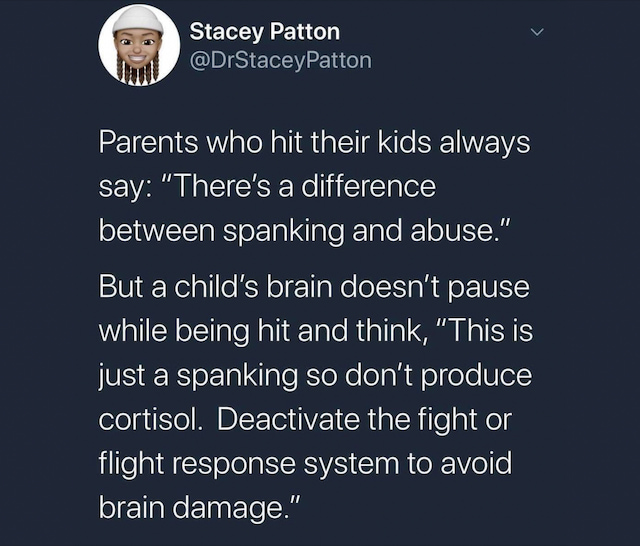
It was shared by Keith Bustamante, dad of a toddler and process analyst. There was no caption to his post nor was there any on the original post that was shared, but parents shared their thoughts and practices at home.
‘Okay naman ako’
A number of parents were quick to point out that they grew up being spanked by their parents and they “turned out fine” or “okay naman ako”.
Mommy R* says she grew up, like most Filipinos, being spanked. And she could easily distinguish even as a child what was “too much and when I was being disciplined.
“Kids aren’t naive. Not saying palo nalang tayo nang palo ha. But understanding our limits. If you can talk to your kids without resorting to palo then that should be the best, however I also don’t want my kid to grown up undisciplined.”
RELATED: Pagdating Sa Pagdidisiplina, May Iba Pa Nga Bang Pwedeng Pumalo Sa Anak Natin?
Spanking or pamamalo as a form of discipline is a well-established practice. Many young Filipino parents today, as evidenced by the SPV thread, were raised with the reasoning, “I love you that’s why I discipline you”.
However, Keith presented this idea to think about: The question of spanking is not a question of love. Because parents love their children.
Rather, the question of whether to spank or not can be viewed from a scientific perspective. Is there scientific evidence that spanking children will lead to disciplined adults?
The negative effects of spanking
American Psychological Association (APA) published a 2012 feature that states that recent research–meaning the past 50 years–has shown that “spanking and other forms of physical discipline pose serious risks to children, but many parents aren’t hearing the message.”
Psychology professor and principal investigator for the Child Violence and Trauma Laboratory at the University of Michigan Sandra Graham-Bermann, PhD said in the feature that “It’s a very controversial area even though the research is extremely telling and very clear and consistent about the negative effects on children.”
Here are some of the effects studies have shown:
- increased aggression
- antisocial behavior
- physical injury
- mental health problems for children
Recent data is consistently showing that spanking does more harm than good. So why do parents miss out on the science?
Perhaps because it is difficult to challenge the many years of child-rearing passed down by generations even if the data and the experts are clear.
RELATED: 'Spanking Actually Makes Children's Behavior Worse, Not Better'
The same APA feature quotes Alan Kazdin, PhD, Yale University psychology professor and director of the Yale Parenting Center and Child Conduct Clinic saying that spanking does not work.
“You cannot punish out the behaviors you do not want,” he said. “There is no need for corporal punishment based on the research. We are not giving up an effective technique. We are saying this is a horrible thing that does not work.”
‘I used to believe in spanking’
This is the point dad Keith brings up in his post: If an adult were to hit another adult because the latter made a mistake, it would be called an assault. “But suddenly violence done by an adult to a child, a child with a developing brain unlike an adult’s, we call it ‘discipline’ or ‘love’?”
He adds, “I used to believe in spanking, even slight spanking. I was spanked too a lot when I was young. But it doesn’t mean that we are always right just because we are parents. We can be wrong.
RELATED: I'm Not A Gentle Parent, Am I Bad?
“We do our best, yes. But if our best is wrong and harmful, we’re not really doing our best. There’s always right and wrong. We just have to be brave to accept that our beliefs are wrong.”
Keith explains that previous generations of parents did not have the advantage of science which today’s generation of parents can use to their advantage.
Spanking and brain development
A more recent article on Usable Knowledge, a digital publication based at Harvard Graduate School of Education, published in April 2021 says spanking impacts a child’s brain response which can lead to lasting consequences.
“We know that spanking is not effective and can be harmful for children’s development and increases the chance of mental health issues. With these new findings, we also know it can have potential impact on brain development, changing biology, and leading to lasting consequences,” says researcher Jorge Cuartas, PhD candidate.
RELATED: 'Hindi Kailangan Sumigaw O Mamalo': Mom Shares How To Remain Calm During Child's Meltdowns
What is surprising from the study Cuartas talks about is how spanking “elicits a similar response in children’s brains to more threatening experiences like sexual abuse.”
Cuartas says, “Preschool and school age children—and even adults—[who have been] spanked are more likely to develop anxiety and depression disorders or have more difficulties engaging positively in schools and skills of regulation, which we know are necessary to be successful in educational settings.”
What can parents do?
Both APA and Usable Knowledge articles recommend similar steps to parents who want to opt out of spanking. Here are some things to start with:
1. Recognize that spanking is an ineffective tool of discipline.
2. Learn and practice non-violent parenting techniques.
3. Remain calm during a child’s tantrum or emotional meltdown.
Lead researcher on physical punishment at the University of Texas Elizabeth Gershoff, PhD says to APA that “Part of the problem is good discipline isn’t quick or easy. Even the best of us parents don’t always have that kind of patience.”
RELATED: How Iya Villania And Drew Arellano Apply a Gentle Parenting Approach To Their Boys
But as Keith says in his SPV post for those who are trying, “Sa mga cycle-breakers, practitioners of gentle and attachment parenting, I know it’s challenging. Konting lang tayo e. And we are surrounded by a culture nourished by and through centuries of violence.
“I’m a parent of a two year old, probably a nobody, but just so you’d know you’re not alone in this, as a parent and a human being, you have my love and respect.”
*Names have been withheld at their request.
What other parents are reading

Lorem ipsum dolor sit amet, consectetur adipisicing elit, sed do eiusmod
Lorem ipsum dolor sit amet, consectetur adipisicing elit, sed do eiusmod
