
In a study conducted on global prevalence, trend, and projection of myopia in children, they found out that 1 in every 3 children is nearsighted. It anticipates that by year 2050, the global incidence of myopia will exceed 740 million cases.
Meanwhile, according to a UP Manila 2022 article, Dr. Leo Cubillian, ophthalmologist and director of the UP Manila National Institutes of Health’s Philippine Eye Research Institute (PERI), estimates that around two million Filipinos are visually impaired.
Additionally, in a research conducted by PERI (according to a UP Forum article), it is estimated that, “in a class of 40 Filipino children, around four would have vision problems.” The article adds, “Three might have errors of refraction (EORs)—blurred vision and inability to focus. This usually manifests as myopia or nearsightedness, where things are clearer up close and more blurred farther away.”
Myopia, according to the International Myopia Institute, is “A refractive error in which rays of light entering the eye parallel to the optic axis are brought to a focus in front of the retina when ocular accommodation is relaxed. This usually results from the eyeball being too long from front to back, but can be caused by an overly curved cornea and/or a lens with increased optical power. It also is called nearsightedness.”
There is no cure for this eye condition–but correction and treatment through lenses and surgeries provide hope for better vision.
Key findings about myopia
1. Vision problems accelerated post lockdown. According to the said study on global prevalence of myopia in children, it was during the global COVID lockdowns, when millions were confined indoors for extended periods, when children's and teenagers' eyesight suffered.
"Emerging evidence suggests a potential association between the pandemic and accelerated vision deterioration among young adults," the researchers note.The study also suggests that girls and young women could experience higher rates of vision decline compared to boys and young men, as they tend to spend less time outdoors both at school and home as they age.
2. Highest rates are in Asia. In a BBC article, it states that 85% of children in Japan and 73% in South Korea are short-sighted with more than 40% affected in China and Russia. The article also notes that children in Asia, like Singapore and Hongkong, start their education as early as age two. “This means they are spending more time focusing on books and screens with their eyes during their early years, which strains the eye muscles and can lead to myopia,” the article says.
3. Genes can also be blamed. In an emotional post of Colourette CEO and founder, Nina Ellaine, she shared that she used to scold her kids watching too close to the tv. Later on, she found out that they have vision problems and that they needed glasses. The post garnered thousands of comments from netizens sharing their own experiences with kids having eye problems, unsolicited advice on gadget use, and acknowledgment that “mom guilt” is real. One netizen asked what the cause of it was, to which Nina Ellaine replied with, “It’s genetic! It’s the physical characteristics of their eye(s) that made them nearsighted.”
According to the American Academy of Ophthalmology (AAO), “Nearsightedness happens when the eye grows too long from front to back. As a result, people with myopia have good near vision but poor distance vision.”
Untreated myopia can increase refractive error, potentially cause cataract, glaucoma, blindness, and vision impairment due to myopic macular degeneration (MMD) and myopia retinopathy, as well as increased needs to manage myopia-related complications
- International Myopia Institute
4. There is a National Vision Screening Program (NVSP). NVSP is an early diagnostic initiative for young children. This law, also known as Republic Act 11358, mandates the screening of kindergarten pupils to identify eye problems and treat them as early as 3-5 years old. In coordination with the Department of Health and PERI, the Department of Education shall administer the vision screening program to all public kindergarten pupils using a Vision Screening Kit which includes charts with symbols or numbers, occluders, and transparent response key. The act encourages private schools to adopt their own system of vision screening for kindergarten pupils enrolled in their respective institutions.
5. 90% of visual impairment cases in high school students are caused by myopia. Dr. Cubillan presented the results of the 2018 Philippine Eye Disease Study that showed that 9% of kindergarten kids are affected with visual impairments. The said figure doubles when they reach adolescence; as 16% of high school students are found to have a visual impairment and 90% of these cases are myopia.
6. Recent studies highlight the lack of exposure to natural light as a potential risk factor. Although genetics is often cited as the primary cause of the rising rates of myopia, recent studies suggest that limited exposure to natural light is also a significant risk factor. Community lockdowns, which kept children indoors and reliant on computers and digital devices for long periods of home learning, deprived their eyes of natural light, contributing to the increase in vision problems.
Susanne Medeiros, in her article for AAO, Prescription for Keeping Children Out of Glasses: Sunshine, notes that “one idea is that sunlight increases dopamine levels in the eye, which controls the growth rate of the eye. Another theory suggests that shorter viewing distances may promote abnormal growth of the eye. Think of long periods of intense near work, whether in front of (a) computer screen or a book, without breaks.”
7. Untreated myopia can lead to other devastating vision problems. Potential consequences according to the International Myopia Institute for untreated myopia are as follows: increase in uncorrected refractive error, cataract and glaucoma, blindness and vision impairment due to myopic macular degeneration (MMD) and myopia retinopathy in adulthood, and increased needs for refractive and specialist services to manage myopia-related complications.
As parents, what can we do to protect our child's eyes?
Spot the signs.
If your children are squinting while watching the tv or reading a distant signage, if they are holding their gadgets too close to the face, or if they have poor performance at school–chances are, they are having trouble making sense of the letters and words they’re seeing, whether on the blackboard, tv, or mobile phone. The Mayo Clinic also notes the following signs: having headaches, seeming to not be aware of distant objects, frequent blinking, and rubbing the eyes often.
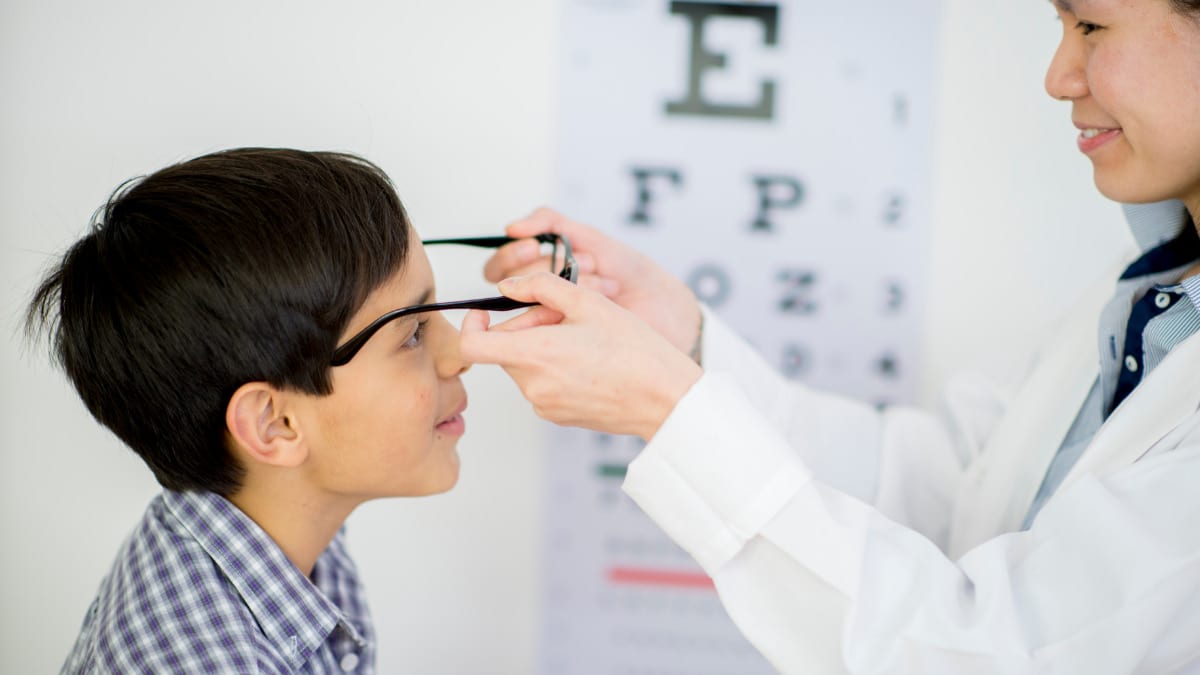
Have their eyes checked.
Dr. Lorna Abad, former chair of the UP-PGH Department of Pediatrics, emphasizes that from birth, both doctors and parents should be aware of potential eye and vision issues in children. Parents should be vigilant to detect key warning signs such as how the child responds to colorful objects, their viewing distance from screens, tilting the head or looking sideways when focusing on something, and their performance in school. “Healthy brain function needs healthy eyesight,” according to Dr. Abad.
Myopia progression may slow down with early detection and intervention.
Limit screen time.
“Children under five must spend less time sitting watching screens,” according to WHO. Here are WHO's screen time recommendations by age:
- Infant (less than 1 year of age): Screen time is not recommended.
- 1-2 years of age: No screen time for a 1-year-old. No more than an hour for 2-year-olds, with less time preferred.
- 3 to 4 years old: No more than one hour.
Moreover, according to AOO, “Although excessive screen time is not solely an "eye problem," its effects are readily apparent during a comprehensive eye examination through observation of pupil size and assessment of accommodative function.”
Spend time under the sun.
Although genetics is primarily blamed for the sharp increase in myopia, recent studies suggest that insufficient exposure to natural light is also a contributing risk factor. WHO advises to “include spending at least 90 minutes outdoors during daylight hours.”
Early intervention is crucial
In our busy day-to-day lives, we might not be aware that our kids are having problems with their vision. For all we know, they might not be aware of it as well.
My child was diagnosed with myopia at age 10. She had no vision issues the previous year so she thought that maybe it was the school's television to be blamed for her inability to see the PowerPoint presentation clearly. She had to go near the presentation to make sense of it. When she finally got the corrective lenses, that’s when she realized that it wasn’t the tv, it was her vision that was making it difficult for her to see and understand the lesson.
Untreated myopia has mortifying consequences, so even if your child isn’t expressing any visual concerns, “as early as birth”(as Dr. Abad puts it), consider having them scheduled for regular eye check-ups.
Waiting too long may aggravate vision problems. Find more about it here.
More from sp

Lorem ipsum dolor sit amet, consectetur adipisicing elit, sed do eiusmod
Lorem ipsum dolor sit amet, consectetur adipisicing elit, sed do eiusmod
