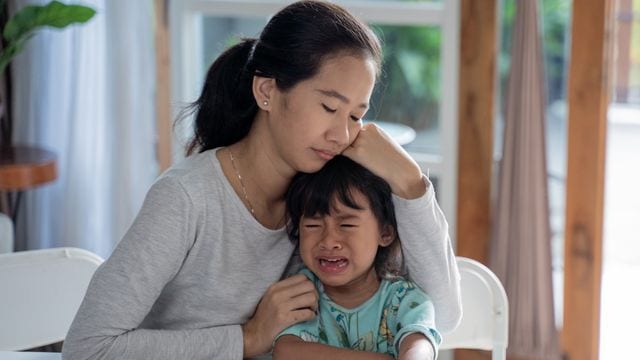
So your child forgot his assignment.
And your immediate reaction is, "Don’t worry baby, I’ll have it delivered to you." Or, "You're scared to buy water, honey? Let Mommy do it. Just stay right here." "Somebody made you upset at school? Who? Let me talk to that kid–Mommy will make that kid stop."
How many of us have been in the same situation? Been there, guilty. A couple of times, actually. I'm not saying it's entirely wrong, but if we've made it a habit to shield our children from discomfort, an expert thinks we might be missing the opportunity to teach our kids about discomfort and the value that comes with it.
We’ve become too eager to find a fix for our children—we’ve forgotten how capable they are. We’ve managed to figure out coping strategies in their behalf by being 'their' coping strategy. I know, I know, I hear you. Kids are uncomfortable and when we see that they are, we are, too. And our unwritten oath to protect our kids from harm has motioned us to find the solution to every difficulty they encounter. The problem is, we’re not fixers—we are parents—and as parents, we must educate them on how to navigate through negative emotions, feel them, name them, and reassure them that feeling uncomfortable is okay.
And that they need to feel uncomfortable.
“If we’re always trying to “rescue” our kids from discomfort, they won’t learn how to tolerate distress. Resilience comes from the ability to tolerate uncomfortable feelings and keep going when things get tough." —Dr. Becky Kennedy, American clinical psychologist
Why do kids need to be uncomfortable?
Dr. Becky Kennedy, an American clinical psychologist and founder of ‘Good Inside’ (a learning resource for parents who want to become the parents they want to be), talks about why we need to teach our kids to sit with these uncomfortable feelings in an Instagram post. "Discomfort is a sign I'm doing something new, not something wrong. We all tend to misinterpret discomfort."
View this post on Instagram
Dr. Becky was named “The Millennial Parenting Whisperer” by TIME magazine. In that post, this mother of three asks in the caption, "Are you like most of us who have the urge to go into “fixing” mode? Where you want to take away their sadness or distract them from their jealousy or solve their frustration?"
Related Read: Let Him Feel His Feelings: 4 Reasons Why Boys Should Learn To Express Their Emotions
She follows it with, “If we’re always trying to “rescue” our kids from discomfort, they won’t learn how to tolerate distress. Resilience comes from the ability to tolerate uncomfortable feelings and keep going when things get tough. And... our kids can’t learn to tolerate the feelings that we don’t tolerate in them.”
6 Negative feelings children need to feel
Children need to experience and navigate a range of negative feelings as these are essential for their emotional development as well as resilience. The American Psychological Association (APA) defines resilience as "the process and outcome of successfully adapting to difficult or challenging life experiences."
Also Read: 'Let's Put A Name To Your Feeling': Phrases To Help Your Child's Emotional Development
Here are 6 key negative emotions kids should learn to feel and process:
1. Disappointment
Hunter Clarke-Fields, author of 'Raising Good Humans' says, “We hate to see our kids disappointed. And it would be really amazing if we could just take that feeling away and make everything perfect.” He follows it up with, “But we do our children a disservice when we try to protect them from all the uncomfortable feelings... It’s healthy for kids—with the loving support of their parents—to go through uncomfortable feelings and realize how they can handle it.”
National Geographic Kids states that disappointment happens when reality doesn’t live up to expectations, and the feeling can manifest in various ways. When kids get disappointed, NatGeo Kids advises parents to be honest (be true even when the news you're about to break is potentially disappointing), label the feelings, understand and accept them, model self-regulation, and practice soothing techniques.
Also Read: 'Sabi Ng Husband Ko, Masyado Ko Daw Na-Baby Ang 11 Y.O. Namin: Paano Ituro Ang Independence?
2. Frustration
Frustration often arises when children face challenges or obstacles. APA tells us to teach our children how to calm down, help them learn words for their emotions, consistently deliver and explain consequences, and if aggressive behavior persists, parents can seek professional help.
"They need to be sad, and angry, and afraid. And they need the space to actually feel these feelings when they come up before rushing forward onto something that seems better, because doing so makes these feelings seem bad." —Jen Underwood, coach
3. Anger
Anger is a powerful emotion that, when managed healthily, can teach children self-regulation and how to assert their needs or boundaries without aggression.
The Child Mind Institute explains that it’s common for children who struggle to manage their emotions to lose control and express their distress in extreme ways, such as yelling, cursing, throwing objects, or even hitting and biting. These outbursts can be overwhelming and stressful for both the child and the caregiver. Often, after calming down, children may feel remorse for their actions.
To address this, it's crucial to understand that such behavior is a form of communication. A child lashing out is typically overwhelmed and lacks the skills to express their emotions more constructively. While parents might sometimes interpret these behaviors as manipulative, because we want them to simply stop, we give what they want and end the aggression.
However, angry outbursts are more often signs of a child unable to cope with their feelings. Child Mind Institute tells us parents to stay calm, don't give up, and help them practice problem-solving skills, "...when you shout, you have less chance of reaching them. Instead, you will only be making them more aggressive and defiant."
4. Sadness
According to an article titled, "Why We Should Let Our Kids Be Sad," "(children) also need to cry, and yell, and whimper. They need to be sad, and angry, and afraid. And they need the space to feel these feelings when they come up before rushing forward onto something that seems better, because doing so makes these feelings seem bad."
It adds, "That’s one of life’s biggest secrets. Sadness, anger, and fear always feel like they will swallow you whole if you go into them, but once you do, they release. They move through you, usually within a few minutes. And if you can feel them with someone else, the process brings you closer. It is the real balm to all our wounds. Feeling our feelings fully, in the presence of others, is, as it turns out, all the soothing that we ever really need."
5. Fear
According to Kids Health, it's natural for children to occasionally feel fear or worry, as these emotions can encourage caution in unfamiliar or potentially risky situations. New, loud, large, or unusual things might initially seem intimidating to them.
Also Read: This Anti-Anxiety Technique Can Help Calm Your Child if He Is Having a Meltdown
According to the site, schedules and routines give them a sense of predictability and could potentially ease worry. Additionally, we don't remove the things that scare them but we help them set expectations. For example, if your child fears going to the dentist, we don't skip the dentist appointment–we let them know what to expect instead, (will it be painful or will there be use of anesthesia?) and what's next in our plan (shall we get an ice cream after tooth extraction?).
6. Rejection
According to Teens Health, a site that offers support and doctor-reviewed advice on health, emotions, and life, "People who become too afraid of rejection might hold back from going after something they want. Sure, they avoid rejection, but they're also 100% guaranteed to miss out on what they want but won't try for."
If that's the case, why do our kids need to feel rejection?
It's an opportunity for our kids to work on themselves. Rejection offers an opportunity to reflect and assess areas for potential growth. The site believes that it’s perfectly normal to evaluate whether improvements are needed or if expectations were set higher than current abilities. If skills fell short, this could be the perfect chance to refine them.
While rejection can feel like a harsh wake-up call, approaching it with the right mindset through our words, we can guide our kids toward opportunities that align more closely with their skills and strengths.
We're uncomfy too, but that's fine
Allowing children to feel these emotions in a supportive environment equips them with the tools to handle life's inevitable adversities. Parents play a key role by modeling healthy responses and not being too quick to rescue children from the pit—let’s give them a chance to figure out what’s going on and how to get out of the mishaps on their own.
I once read that as parents, we are raising our kids to make good decisions by allowing them to make decisions and not choosing what we decide for them. We are raising them to eventually not need us because the truth is, the time when we won’t be around to help them, even if we wanted to, will come.
Is there a right time to ask kids about their feelings? Find out here.
More from sp

Lorem ipsum dolor sit amet, consectetur adipisicing elit, sed do eiusmod
Lorem ipsum dolor sit amet, consectetur adipisicing elit, sed do eiusmod