
Editor’s note: Quotes were edited for clarity.
The new year often brings a renewed sense of purpose–of hope and many second chances.
For most parents, this includes the desire to improve their parenting skills and child-rearing strategies. From navigating tantrums to managing screen time, to being consistently mindful and less indulgent, the daily demands of raising a child can leave parents feeling overwhelmed, frustrated, and exhausted.
But it doesn't have to be this way. Baby steps, shall we?
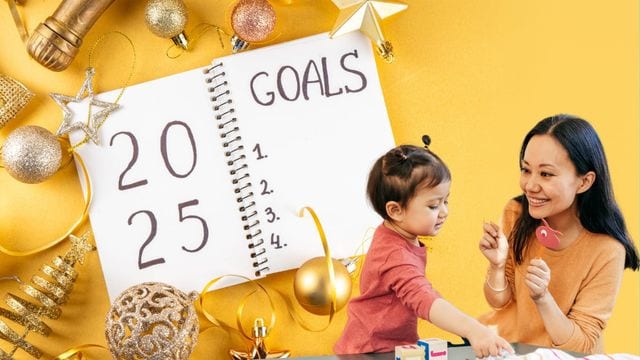
2025 presents a fresh opportunity to set meaningful resolutions that can strengthen family bonds, re-introduce self-love, enhance child development, and create a more positive and fulfilling home environment.
Also Read: Pinay Family Counselor Says There's a 'Healthier Form of Sacrifice' When Loving Our Kids
We've rounded up parenting resolutions (backed by studies and experts) that aim to provide a real difference in your family's life. We also included personal resolutions of parents from the Smart Parenting Village, a community of more than 108,000 moms and dads navigating the parenting journey.
Here are New Year's resolutions for parents that are worth giving a try:
1. Commit to self-care.
Commit to at least 15 minutes of self-care daily. According to Mental Health America, self-care is “proven to reduce stress and anxiety levels while increasing self-compassion.” This could include exercising, reading, napping, taking a break on social media, enjoying a cup of hot drink, indulging in a relaxing bath, or simply spending time alone or in nature.
Dr. Laura Markham, clinical psychologist and author of "Peaceful Parent, Happy Kids," emphasizes the importance of parental self-care. "You can't pour from an empty cup," she says.
2. Listen more, react less.
Dr. Michele Borba, an educational psychologist, talks about “knowing how to listen and to make yourself be understood opens doors to new relationships and enriches countless experiences. Effective communication skills enhance our children’s success in school by making it easier to gain knowledge and understand other people’s views. We also know that learning how to listen does not happen by chance. You are your child’s best communication instructor."
Mhy Magallanes, a member of the village, aims not to sweat the small stuff next year. She says, "Hindi na muna magya-yap over simple things. Hate ng teenagers ko ang yapping, instead daw na mag-yap ako, pakinggan ko raw muna sila para magkaintindihan kami."
Another villager, Patt Lagpad, hopes, "Siguro yung maging less reactive parent. I tried once maging less reactive, I saw how she responded. Before kasi natataranta ako agad kapag for example may gamit siya na nakuha na either makakasakit sa kanya or what, I tend to freak out like hahabulin ko s'ya and mapapasigaw, lalo siyang tatakbo papunta sa room at inuulit niya ng patago. But when I tried to follow her ng dahan-dahan, curious lang pala siya sa bagay. I let her talk kung bakit n'ya kinuha, then tsaka ko inexplain na yung bagay na yun might hurt her and she shouldn't get it again. Ayun, di na nya inulit.
Our kids are just naturally curious. Sometimes, they just need someone na makikinig sa kanila at magpapaliwanag ng mahinahon."
3. Learn to self-regulate.
A study shows that “Regulatory deficits make parents more likely to respond to children’s misbehavior in reactive and harsh ways, which in turn puts children at risk for maladjustment in the form of emotion dysregulation and behavior problems…Parents with poorer self-regulation have more difficulty responding constructively to challenging child behavior.”
Sofia Claire Orsos wants to practice self-regulation for the next year. She says, “As, much (as) possible, control my anger to my daughter na maintindihan ko siya bilang bata at di siya masigawan. Aalisin ko ‘yung makakasakit na salita at ‘pag may mali ako hihingi ako ng dispensa.”
4. Travel more.
Parenting coach and expert Mansi Zaveri says, "There’s just so much that kids (and we) learn from a travel experience that no classroom can ever teach us. Ever since my kids were infants and toddlers, I have not compromised on travel and I'm happy I did that. It did come with its share of challenges, but what doesn’t? The biggest lesson for kids is to enjoy the experience, and to revel in the joy of discovering new things, new places and new people.”
By traveling more, Zaveri explains that we are teaching and learning (along with our kids) other people’s culture and values, as well as how to blend with the locals, how to use life skills, and how to transform moments into memories.
Also Read: Traveling Is Good for Your Child's Brain and Can Make Her Better in School: Educators
Bebe Ramallosa, another member of the village, swears to have more travels with her kids next year. She writes, “I want them to enjoy many things I didn’t when I was their age.”
5. Try to be more present than simply being visible.
Dr. Dan Siegel, clinical professor of psychiatry and founding co-director of the Mindful Awareness Research Center at UCLA, emphasizes the importance of being present and mindful in our interactions with children.
Dr. Siegel’s book (co-authored with Dr. Tina Payne Bryson), “The Power of Showing Up,” tackles the significance of the quality of presence we provide our children.
Accordingly, among the predictors for how any child turns out—in terms of happiness, academic success, leadership skills, and meaningful relationships—is whether at least one adult in their life has consistently shown up for them.
Also Read: Dear Parent, Your Presence Does Not Mean You're 'Present'
6. Connect with other parents.
Parenting can be isolating. In 2025, in case you haven’t yet, you can start connecting with other parents through local parent groups or playdates. If you are the type who does not want to connect on a personal level you can join online parenting groups and forums.
Also Read: Playdate Is a Great Parenting Tool for Your Toddler's Development
Connecting with other parents provides support and valuable insights while we navigate through the uncharted waters of parenting. Having one child or two does not make one parent an expert as every child is different. There will be times when we will still feel lost and confused— connecting with other parents even on virtual platforms will help us feel seen, heard, or understood.
The Smart Parenting Village, for example, is a safe space to ask questions, seek insights, or just to let out some steam when parenting becomes overwhelming. Sometimes we need not only sound, practical advice but also empathy and a sense of community, knowing that we are not alone.
Join the conversation at the Smart Parenting Village, and follow the Smart Parenting Facebook page.
Parenting is not a competition
In case you've forgotten, allow me to remind you that parenting is a journey, not a race.
Be patient with yourself and your child. Celebrate yourself and your successes, and if things get complicated, don't be afraid to adjust your resolutions as needed.
Start small and gradually incorporate strategies into your daily routines, whether these are small talks with your kids, self-care, meditation or reaching out to parenting forums. Know that by making conscious choices, big and small, and prioritizing your family's well-being (while also minding your own), you can create a positive and lasting impact on your children's lives.
What's the trick to keep your resolutions? Find out here!
More from sp

Lorem ipsum dolor sit amet, consectetur adipisicing elit, sed do eiusmod
Lorem ipsum dolor sit amet, consectetur adipisicing elit, sed do eiusmod
