
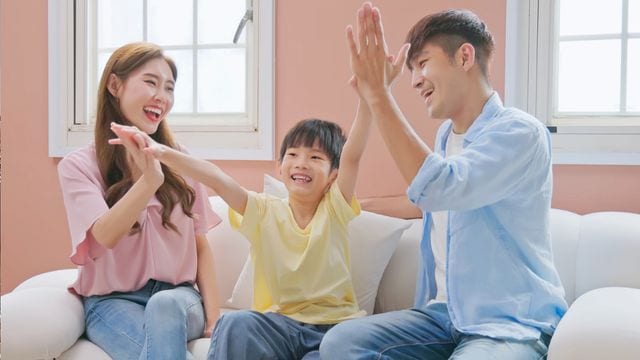
Parenting is an important, personal journey. Parents come from different families and backgrounds, and the difference often impacts how we parent our children. While differences in opinion is common for any household, it can ignite a struggle on how to raise our children best. For a two-parent setup, even if such dynamic can sometimes enrich a family, by fostering a more open, well-rounded approach, it can also lead to disagreements and tension especially if one parent feels that his authority (and ego) is being stepped on.
Common disagreements among parents include family traditions, use of money, chores and cleanliness, consistency, screen time and technology use, diet and nutrition, time management, and commitment to academics versus extracurriculars–not to forget the ways and means to discipline a child.
When these conflicts are left unaddressed, they can impact the family environment and leave the child confused whose orders to follow or obey.
Ever heard of the strategy, ‘Tap In, Tap out?’
In an Instagram post, child psychologists, Dr. Erin Avirett and Dr. Jordana Mortimer, name a parenting strategy called, ‘Tap In, Tap Out’.
The idea is reminiscent of ‘good cop, bad cop’ parenting strategy but this time, parents have a united front. This means when one parent becomes overly upset or frustrated while trying to respond to a child's behavior, the calm parent will come, gently ‘tap in,’ while the upset parent quietly ‘taps out’ and walks away from the heated situation, leaving the other parent in charge of maintaining a calm environment.
Few key principles of this strategy
- Parents should agree on a non-verbal signal that children don’t know about. For example, a gentle tap on the shoulder or a touch to your partner’s back.
- Parents should both agree that if they receive the non-verbal signal, they will not take it against their partner nor take it personally.
- The parent who is ‘tapping in’ should maintain a calm attitude. Otherwise, the entire strategy fails to meet its purpose if that parent becomes upset as well.
It's normal to be angry, what’s the big deal?
When parents get overly upset, they tend to feel out of control and at times, in an attempt to desperately regain control, they become overwhelmed, enough to yell, scream, threaten, or talk too much and utter words they don’t even mean. According to clinical psychologist and life coach, Dr. Melanie Greenberg, parents can sometimes commit the worst mistakes when talking to kids.
Worst mistakes when communicating with children
Talking too much. In the outburst of emotions, we might fall into the trap of spewing words out of disappointment or disgust.
According to Dr. Greenberg, “When parents go on and on, kids tune them out. Researchers have shown that the human brain can keep only four “chunks” of information or unique ideas in short-term (active) memory at once. This amounts to about 30 seconds (or 1 or 2 sentences) of speaking.”
Nagging. Dr. Greenberg reminds that, “Many parents feel out of control and thus try desperately to control the situation by nagging or criticizing. The problem with nagging, however, is that you are actually training kids to ignore you.”
Using guilt and shame to get compliance. “One of the biggest lessons one learns as a parent is that young kids don’t naturally have empathy and consideration for your needs. They develop empathy slowly as they mature, by experiencing your empathy for them. That’s why the expectation that young kids walk in your shoes and see things from your point of view may not be reasonable. The failure to do so does not mean they are a bad or uncaring kid. They are just being a kid,” Dr. Greenberg explains.
Using guilt and shame to elicit empathy will make the kids feel they’re not good enough or something’s wrong with him. She reminds parents, “Label the behavior as unacceptable, but the kid is still lovable.”
Not listening. How many of us have been in a situation where we are so angry that when a child wants to air his side of the story, we are so quick to shoot his reasons down? Dr. Greenberg tells us, “We would all like to teach our kids to respect other people. The best way to do this is by modeling respectful and caring behavior in our own interactions.”
That’s why a calm parent has to take over the situation before the matter escalates to a much bigger concern, without undermining the authority of the other parent–like any power team should.
Why should parents learn how to regulate emotions?
Regulating our emotions plays a central role in allowing us to parent in the way we aspire to. It's all too easy to let our emotions take over and lead us down an unhelpful path. The difficult task of managing our feelings so that we can respond to our child with love and patience, instead of reacting with frustration, is essential to effective parenting.
According to the Children's Health Council, the way we regulate our emotions significantly impacts our children and we've listed them below:
Benefits of regulating own emotions
- Children learn emotional regulation from us.
- The emotional safety we create for our children is exactly what allows them to heal, grow and thrive.
- When we provide a calm “holding environment” for our children, they feel safe enough to experience their emotions.
- When children respect us and feel understood by us, they’re more likely to want to follow our lead.
- Children are sensitive barometers of our moods and tensions. When we work on our own issues, we find that our child’s behavior changes — even without our directly addressing it.
- When we respond differently, so does our child.
Parenting is team effort
Whether you’re the parent who ‘taps in or taps out,’ it is vital that you trust each other enough that when you let the other parent handle the situation, you surrender the platform to your partner. You already know how losing control in front of the kids makes them feel unsafe and confused. After all, your partner is not your competition.
Parenting as a team involves working together, agreeing on a consistent approach, making joint decisions, and offering mutual support. When parents view themselves as a team, children feel secure and develop a strong sense of self-worth. Teamwork teaches kids valuable lessons about respectful communication and building healthy relationships, which are crucial for their emotional growth. In the end, the team’s goal is not to know who the best parent is, but for couples to know how to parent together in the best ways possible.
What if there’s more to arguing that could debunk the idea that it is all negative and detrimental? Read here.
More from sp

Lorem ipsum dolor sit amet, consectetur adipisicing elit, sed do eiusmod
Lorem ipsum dolor sit amet, consectetur adipisicing elit, sed do eiusmod
