This is the second of two exclusive essays that Lissa has written for Smart Parenting since the life-changing incident of losing her husband, artist Kidlat De Guia. Read Part 1, 'After Spain': A Story of Grief And Love, here.
“Everyone has a 100% chance of dying,” said certified life doula and grief counselor Charity Marohombsar in her workshop on the grief process. We all know we are going to die, but no one teaches you how to grieve.
Three weeks prior to this workshop, I had lost one of my best friends -- writer and intuitive healer, Tata Mapa. Little did I know that exactly a week later, I would lose my husband, soulmate, and partner for life, Kidlat de Guia.
Even when your world feels like it is crumbling around you, if you have the spiritual eyes to see, you will sense how you are always cradled by the Divine. A few months before Kidlat passed I had completed my training as a Self Love Solution teacher with the Atma Prema Wellbeing Group. I was putting into practice all the concepts I had learned and was teaching my students. Giving myself deep self-care put me in an optimal state. I was healthy, well-rested, happy. Also, practicing what I preached made self-love and self-care habitual. I didn’t have to think about it, it was a muscle I strengthened.
But attending the grief workshop added a few concepts that I clung to when the tidal wave that was Kidlat’s death washed over my entire life and swept away the world as I knew it. I can still hear Charity’s gentle, compassionate voice in my head:
“There is no right or wrong way to grieve. There are no ‘stages of grief.’ Grief has no timeline. It’s okay not to be okay. Grief is a sign of how deeply you loved.”
The Gift of Allowing
I encountered the idea of allowing when I became a parent for the first time nine years ago. I came across Janet Lansbury’s respectful parenting blog on Facebook. She encouraged parents to acknowledge their children’s emotions while reinforcing boundaries. If my son was upset that we had to leave a play area to go home, I would say, “You’re angry and sad that we have to leave. If I were you, I would feel sad and angry too. If you have to cry, that’s okay. But we still have to go.” Acknowledging my children’s feelings had this magical effect of diffusing the situation, and the tears would dry up almost immediately. I realized that children simply have a need to be seen.
I encountered this idea again while undergoing my teacher training. One of the pillars of self-love is Allowing: allow joy, allow pain, allow grief, allow all—for it is only by allowing the spectrum of human emotion that we experience our full humanity. Allowing also means that we trust that life is working out in our favor, that we allow ourselves to ask for and receive help.
Losing Kidlat tuned my life into a masterclass in allowing.
RELATED: 'Kung Malungkot Ka, Maging Malungkot Ka': Moms Who Lost A Child Share How They Cope
“It’s Okay Not To Be Okay”
When we received the overseas call that changed our lives forever, all I wanted to do was collapse. But as my children started to cry, I gathered them up in my arms and said, “Mommy’s here. You can cry and scream, it’s okay. I am holding you.” I don’t know where my calm and strength came from. But I also knew that it would be detrimental if I did not allow myself to do the same.
I asked my parents to take my children for almost a week, so they could be with their cousins who happened to be visiting Baguio for a month. I spent the mornings with them, but by lunch time I would drive back home to be alone. I allowed myself to cry and scream and punch pillows. When I was spent, I could finally go out and help out with the wake which we had set up across from our house, a temporary wake since we were still waiting for Kidlat’s ashes to come home from Madrid.
One of the pillars of self-love is Allowing: allow joy, allow pain, allow grief, allow all—for it is only by allowing the spectrum of human emotion that we experience our full humanity.
RELATED: Grief Coach Cathy Sanchez Babao Shares How To Find Purpose In Grief
Giving myself that time to feel and express my feelings gave me the wherewithal to do whatever else I had to do: talk to visitors, discuss funeral arrangements, even continue doing my work as a voice over artist. “You are so strong,” many people told me, though I really didn’t know why. I decided that I would redefine strength for myself, that rather than it meaning stoicism in the face of adversity, it is actually the ability to embrace your authentic self at any given moment. My vulnerability—my ability to be my authentic self—became my strength.

I would return to my children at around 10 pm at night, and listen to them as they cried for their father. From deep within me emanated a calmness whose provenance I couldn’t quite pinpoint. As was my practice all these years, I told them, “It’s okay to be sad, and it’s okay to cry when you’re sad.” I taught them to speak with their “Taty” in their hearts, and to listen quietly for a response.
Now, six months later, I find myself breaking down every now and again. Seven-year-old Amihan tells me in a calm, reassuring voice, “Mommy, it’s okay not to be okay.” And I feel so much comfort in hearing that.
There Are No Stages of Grief
Yes, there are emotions associated with grief: denial, anger, depression, bargaining, acceptance. But to say that there are stages implies that grief is a linear process, which it isn’t. Indeed, there have been days when I have felt all those feelings and more in the span of a single day. I joked to a friend that I feel my life is a reality TV show called “Watch Lissa Go Through 100 Feelings in a Single Day!” I am slowly learning not to judge myself. There are some days when all I do is grimace when I remember Kidlat is gone. But there are days or moments when anything can set off a flood of tears.
Grief has no timeline.
I once messaged Charity, “Is it okay that I still cry when I pour Kidlat his morning coffee?” Of course it’s okay, she answered. Pouring his morning coffee is my ritual of remembrance and honoring the place he has in my life and in my heart. And it might happen that even though years have passed, I will get the whiff of a scent, or see something that reminds me of him, and tears will come unbidden. Grief has no timeline.
RELATED: Mom Had Her Baby For 55 Days. Four Years Later, A Shirt Brings A Wave Of Emotion
Grief Is Just Love With No Place To Go
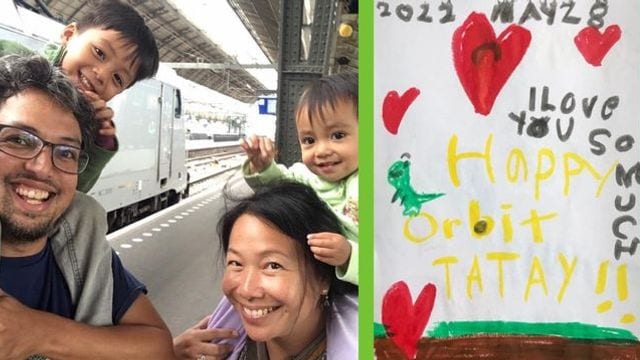
I asked Self Love Solution teacher for kids Lei Sta. Maria (who works together with co-teacher Charity) to help my children through this grief process. In one session, Lei helped them identify the things that give them joy, so that when they are not feeling so good, they can reach for that. With songs and art activities, she has taught them that emotions are okay and how to identify and express them. They have drawn what they love and miss about their Taty, and the results are both funny and touching. What is important is that they know that it’s okay to express how they feel, both verbally and artistically.

Teachers Lei and Charity also taught them that hugs are medicine. We have always been a hugging family, but now the children are even more quick to ask for a hug—as well as to offer me one. When they see me cry, they immediately envelop me in a group hug. And the amazing thing is that we can feel Kidlat hugging us too. I tell them that we can transform our yearning by learning to love one another better.

When the kids tell me they miss their Taty, I tell them I miss him too. Then I ask them, “If Taty were here, what would you like to say to him? What would you do if he were here right now?” I tell them to close their eyes and send love to their Taty because even if he’s not physically here, he is still present in our lives.
RELATED: This Artist Creates Ethereal Portraits Of Stillborn Babies
We also have a table in our room that is devoted to Kidlat’s memory. They make drawings for him and put it on the table as an offering. Or Kalinaw writes letters that simply say, “I love you. I miss you so so much.”
As my children and I go through our grief journey together, it is helpful to know that there is no right or wrong way to grieve. Grief is a sign that we love and are loved so deeply. Through our acts of love for Kidlat and our gestures of love for one another, we continue to grow as a family.
Lissa Romero de Guia is an author, certified Self Love Solution teacher and theta healer, and voice over artist. She lives in Baguio with her children Kalinaw and Amihan. For more information on the Self Love Solution Program or to purchase her book, visit www.atmaprema.global.
What other parents are reading

Lorem ipsum dolor sit amet, consectetur adipisicing elit, sed do eiusmod
Lorem ipsum dolor sit amet, consectetur adipisicing elit, sed do eiusmod