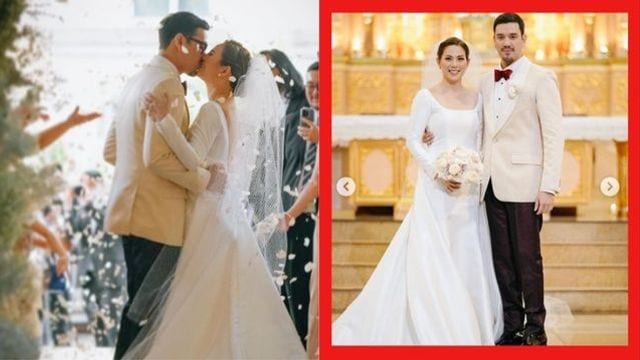
Luane Dy and Carlo Gonzalez tied the knot in a Catholic wedding ceremony just last February 8, 2023, or a little over three years after they got married in civil rites on November 28, 2019.
The couple, who have a son named Jose Christiano and born on April 30, 2020), exchanged I dos at the Shrine of Saint Therese of the Child Jesus in Pasay City.

"Our bond will be much stronger," said Carlo and Luane in their interview with their home TV network GMA-7, "dahil 'yon na ang go-signal ni Lord. Parang after ng lahat ng hindi natuloy because of the pandemic, with God's blessing...In God's perfect time"
Just like Luane and Carlo, many couples in our Smart Parenting Village online community who had been married in civil rites also aspire to have a church wedding. For starters, those couples ask if the wedding ceremony should only take place in a church.
The answer is yes, the wedding should take place in a parish church or at a chapel allowed to perform the Sacrament of Matrimony.
Here's what the Code of Canon Law of the Catholic Church says: "Marriages are to be celebrated in a parish where either of the contracting parties has a domicile, quasidomicile, or month long residence or, if it concerns transients, in the parish where they actually reside. With the permission of the proper ordinary or proper pastor, marriages can be celebrated elsewhere."

Planning a church wedding?
You will need these requirements to get married in a Catholic church:
1. Baptismal (binyag) and confirmation (kumpil) certificates.
If you or your partner no longer have your copies, you can ask your respective local parishes. In case no records show any proof that you were baptized even when you are sure that you had, the next best step is to request for a replacement copy of your baptismal certificate.
When requesting for the certificates, make sure they have the annotation "FOR MARRIAGE PURPOSES" and a validity of six months until the wedding date.
2. Marriage license
Whether you are having a church or a civil wedding, you have to satisfy certain requirements before you can tie the knot in the Philippines (read here how). There are exemptions, though (read here).
3. Canonical interview
In some churches, like the Santissimo Rosario Parish located inside the University of Santo Tomas (UST) campus, the canonical interview is scheduled after completion and submission of all the requirements. So make sure you inquire how it works in the parish church of your wedding venue, and then secure a schedule with the priest or his assistant.
4. Pre-marriage seminar
This is also called a marriage dialogue in some parishes. Check out the schedule in your church wedding's venue, and make sure to allot time for it. If you or your partner is abroad, you can inquire about obtaining a certificate of attendance to the pre-marriage seminar.
5. Marriage banns
Banns of marriage or wedding is a public legal notice posted in a church to announce an impending marriage. The purpose is for persons aware of any impediment to the marriage can make their objection known before the wedding takes place.
6. Wedding/marriage permit
You and your partner will make this request from your respective parishes if neither of you belong to the church where your wedding will take place.
7. Certificate of No Marriage (CENOMAR)
You need a CENOMAR issued two months before the wedding date. For the step-by-step guide, read here.)
8. List of principal sponsors
You will need to submit at least one pair of ninong and ninang along with their home addresses.
Do take note that parish churches may add one or two more requirements, such going on a confession or the Sacrament of Penance or a photocopy of diploma if you are a graduate of UST.
Read here for civil wedding requirements.
What other parents are reading

Lorem ipsum dolor sit amet, consectetur adipisicing elit, sed do eiusmod
Lorem ipsum dolor sit amet, consectetur adipisicing elit, sed do eiusmod