

We recently discussed in detail in an article why Filipino families desperately need a guide to digital parenting. With our children being born as digital natives, there is a pressing need to navigate this new world with them instead of resisting it.
It turns out, we are not alone in this journey. Even celebrity parents like Isabelle Daza-Semblat share similar struggles in harnessing technology and artificial intelligence (AI) for good, specifically for their children's development.
In an exclusive interview with Smart Parenting, the mom of three opened up about her dilemma in raising multi-cultural children, particularly when it comes to their language and communication.
"You know it's challenging. I obviously have to get support. I ask our helpers to speak to him [Baltie] in purely Tagalog and to all my kids in Tagalog. My husband speaks to him only in French, and then at school he learns Mandarin," she shared during the Promil Gold Gifted Talks event on July 11.
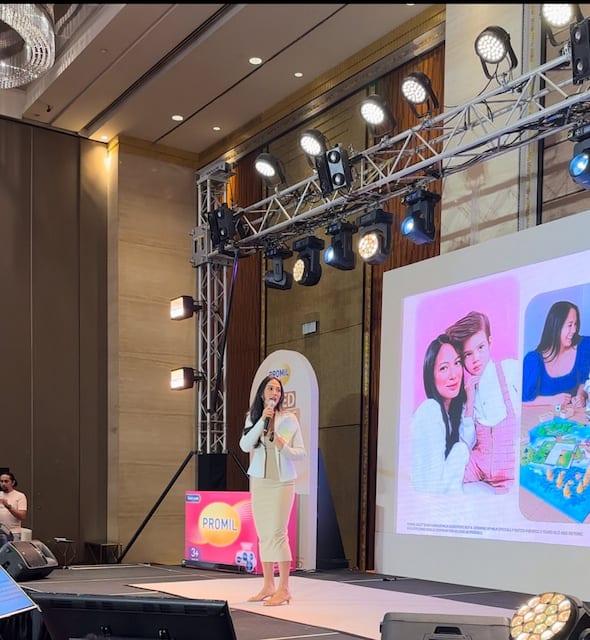
Isabelle Daza-Semblat shared how her firstborn son Baltie can speak four languages: Mandarin, French, Filipino, and English at the Promil Gold Gifted Talks.
Isabelle Daza on using AI and tech to teach language skills to kids
Being as hands-on a parent as possible to her three children, Baltie, Valentin, and Esmeralda, Isabelle is well-aware of the mobile applications she exposes her children to.
"We have a program called Khan Academy that my husband and my son do together. It's important that a parent is there watching because it's guided and much more engaging and safe when a parent is present," she shared.
"I try to walk the talk because children don't do what you say. They do what you do." —Isabelle Daza-Semblat
"So last week, for example, they were coloring a tree with a bear. And Baltie colored the bear red. My husband said, 'Why is it red? That's not Santa Claus.' So he changed it."
"I don't want to villainize tech and AI because it is the future. It's what we're going through. So I think it's important in moderation and that we guide them," she emphasized.
Aside from Khan Academy, she lets her kids use the app, Simply Piano, and her husband Adrien lets them use an app where they can learn French songs and spelling.
Isabelle Daza says 'it's very difficult' to model proper gadget use
As a podcaster and influencer, Isabelle gets candid about balancing physical activities and gadget use with her kids at home, "Well, I try to do 90% physical activities and then very, very little screen time. But it's very difficult because when our children see us that we're on the phone, they ask, 'Why are you on the phone?'
"So it's an effort for parents to make to put your phone in another room, hide it in the closet, and really be present. I try to walk the talk because children don't do what you say. They do what you do."
Isabelle shared that if ever she lets them have screen time, she prefers they watch it on the television instead of a mobile phone. "It's something that they can't touch, and it's a treat for them. I think it's important for them to also learn on TV and have that kind of cartoons. It's a break."
She continued, proper gadget use starts with the parents, "It's hard. It's hard maging parent, grabe. As millennial parents, we are learning how to balance screen time and also having the outdoors and play where they can just be kids."
How parents can support kid's language development
Isabelle offered advice for parents on supporting their child's language development, "What I learned becoming a parent is kids don't necessarily lie. They just tell you how they feel. If they're jealous, they say, 'I don't want him to have that. It's not fair.' If they're angry, they'll express that they're angry. If children are sad, they show you right away. It's not like us adults na where we're just hiding our emotions," she explained.
"To link it with child development, I think it's important for us parents to listen. Our children are very honest with how they feel and what they want. They are always communicating those things to us. Just being a listener because listening is so underrated," Isabelle added.
She also emphasized the importance of encouraging our children to practice activities that help widen their vocabulary, "So that they are really able to articulate and express how they feel. And it's important for children to be heard."
Educator affirms guided gadget use is important
Pre-school educator and school owner, Teacher Rosanne C. Araneta affirms that parents should guide their children when using AI. She recommends harnessing AI with a routine, "I will go as basic as possible just so the kids are not behind on tech and the future," she said.
"Just to allow them to be able to use their fingers so that they can type. They need muscle control there."
To encourage children to learn spelling, Teacher Rosanne recommends simple, offline games and games that educate through repetition. She discourages parents to let their kids play online games which may lead to dangerous interactions with strangers.
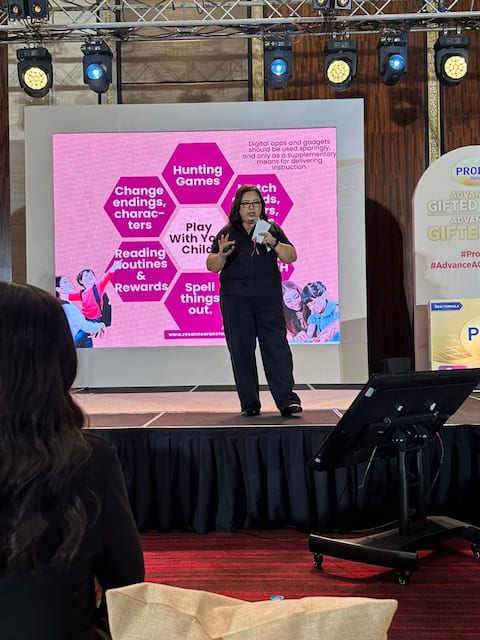
Preschool teacher and school owner Rosanne Araneta emphasizes the importance of interactive play vs digital apps and gadgets at the Promil Gold Gifted Talks.
Teacher Rosanne also cautions parents about praising their children or employing a reward system. She insists parents should validate their kids' effort, whether they succeed or fail on a particular task.
"And it's okay to fail because that's where you can measure where you went wrong. You can tweak it, you can fix the problem. But if they're afraid to fail, and if you don't allow them to fail, they'll hide things, they'll not want to do anything, and you won't know how to fix the problem because you can't see the problem," she explained.
She stressed, it's okay to let our kids try, make mistakes, and learn from their mistakes.
"So parents, just let your kids try first without your help. If they need help, then support. But don't do things for them, don't hover, don't be a helicopter parent, because the kids can. It breaks down the confidence of the child as well when they're not allowed to try. And if they fail, then validate effort."
"Never praise. Praise is empty. But if you can look at what the child did, right or wrong, they feel heard, then there is presence. That's what I want all parents to be, present. And then they'll know what to do because they see the problem," she said.
Read how a mom used daily routines to minimize screen time use for her son here.
More from sp

Lorem ipsum dolor sit amet, consectetur adipisicing elit, sed do eiusmod
Lorem ipsum dolor sit amet, consectetur adipisicing elit, sed do eiusmod
