
As a parent, you can only guess your baby's wants, so you dress them as you like and feed them what you know is healthy. You likely follow the discretion of a health professional or other moms, especially when it comes to your baby's diet. Still, some things can go awry as you build your child's diet, as every baby is different.
To help you feel at ease during this phase of your baby's life, Smart Parenting has consulted with a certified pediatrician and a nutritionist-dietitian to create a simple plan for introducing solid foods to your baby.
ALSO READ: Is Your Baby Ready To Start Solids? These 3 Items Are All You Need
When should you introduce solids to your baby?
Although most health organizations recommend breastmilk as the foundation of a baby's diet for the first year, they differ on when to introduce solids.
For instance, the World Health Organization (WHO) advises introducing solid foods at six months, while the American Academy of Allergy, Asthma, and Immunology (AAAAI) recommends starting solids between four to six months.
Either way, it is essential for babies to start no later than six months as breastmilk alone does not meet their nutritional needs at that point. Note that starting before four months is also not recommended because their digestive systems are not mature enough to handle solid foods, and it may even increase their risk of obesity.
It is also crucial to consider their developmental readiness. If you are a new mom, ask yourself these questions:
1. Can your baby sit up with or without support and hold their head up?
2. Can they open their mouth to take a bite of food, close their lips around the food, and swallow some of it?
3. Do they show interest in eating?
"Parents are encouraged to introduce solids at the appropriate time to ensure their babies’ nutritional needs are met and to promote healthy eating habits," said Ms. May Ann D. Gironella, a registered nutritionist-dietician and Senior Science Research Specialist at the Food and Nutrition Research Institute (FNRI).
How should you introduce solids to your baby?
"Parents should feed their babies slowly and patiently, encouraging them to eat without force-feeding. Engaging with your baby by talking to them, maintaining eye contact, and minimizing distractions during feeding can create a positive eating environment," advised Geronilla.
According to FNRI, at six months, you can introduce mashed single food items such as lugaw, boiled sweet potato, and squash mixed with breastmilk. Other options include pureed fruits and vegetables.
As the baby becomes accustomed to these foods, gradually introduce mixtures of mashed items, adjusting to a thicker consistency and increasing variety like kalabasa-banana puree, munggo with sweet potato, and lugaw with egg and carrots. Around eight months old, babies can start eating "finger foods" or small pieces of soft foods. By twelve months, they can eat the same meals as the rest of the family, but be careful of foods that could be a choking hazard.
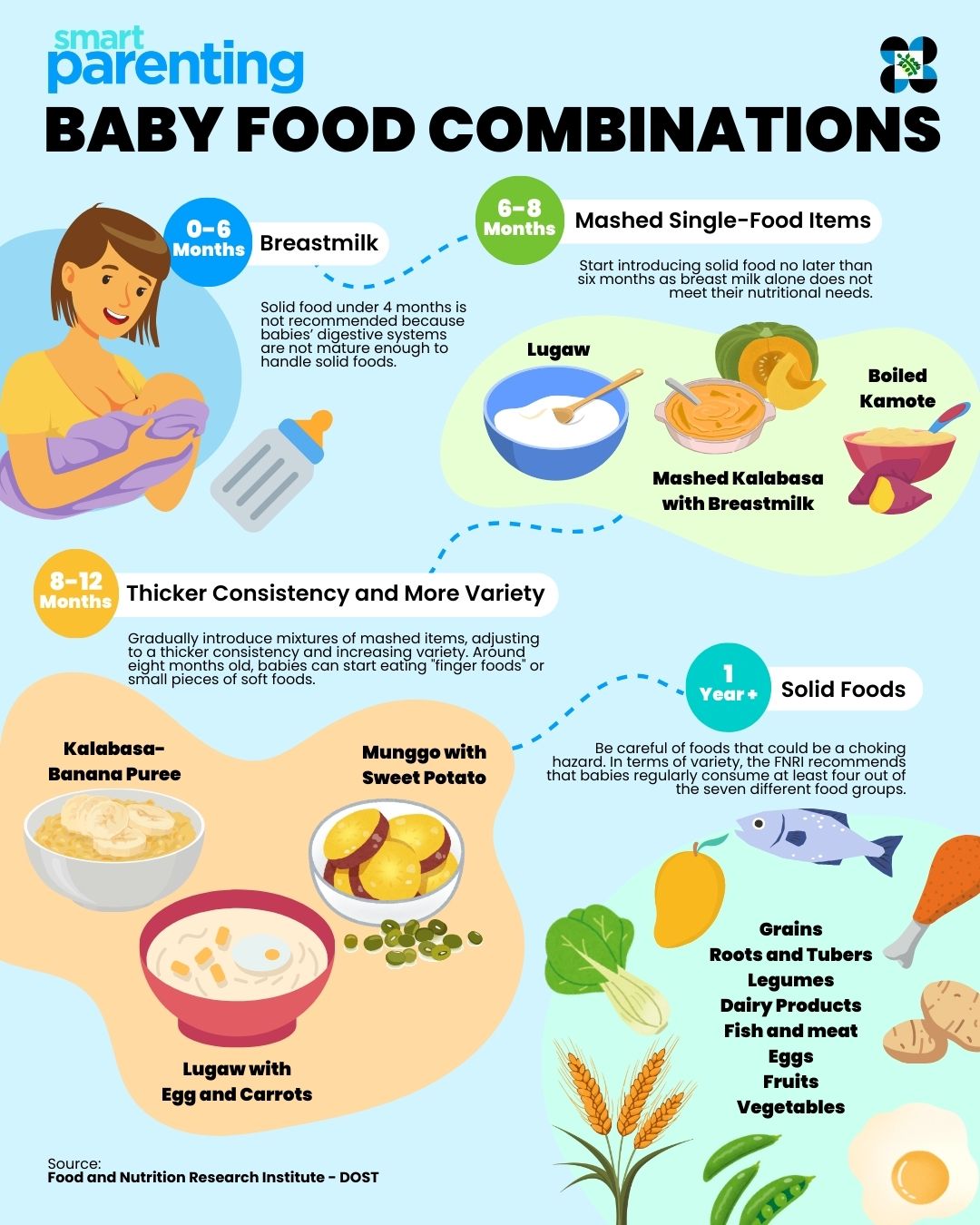
In terms of variety, the FNRI recommends that babies regularly consume at least four out of the seven different food groups (grains, roots and tubers, legumes, dairy products, fish and meat, eggs, fruits, and vegetables) to complement breastmilk.
Feeding babies nutrient-dense foods ensures they receive iron, zinc, and calcium. Iron is notably essential for breastfed babies as, after six months, they need more iron than breastmilk provides.
How To Watch Out for Allergies
If your baby shows no interest in a new food, try reintroducing it later. Wait two to three days before introducing another food so you can observe any allergic reaction that may occur and identify the culprit.
However, if your baby has diagnosed allergy or if you have a family history of food allergies, like eczema, asthma, or hay fever, you must be extra careful when introducing food.
Allergic reactions typically occur quickly, within a few minutes of being exposed to an allergen. See the list of indicators of food allergies in babies below, according to the National Health Service in the United Kingdom:
- Sneezing
- A runny or blocked nose
- Red, itchy, watery eyes
- Wheezing and coughing
- A red, itchy rash
- Worsening of asthma or eczema symptoms.
While most allergic reactions are mild, in some cases, a severe and potentially life-threatening reaction known as anaphylaxis or anaphylactic shock can occur. Anaphylaxis is a medical emergency and requires immediate treatment.
If your baby is at low risk for allergies, you may introduce peanut products and other solids whenever you prefer. There is insufficient evidence to recommend a specific time frame for introducing other common allergens such as dairy, eggs, or wheat. There is also no evidence that delaying their exposure to those foods beyond four to six months is beneficial, says the American Academy of Pediatrics (AAP).
What is the right amount of food for your baby?
It can be challenging to determine the precise amount of breast milk a baby consumes or to decide how many complementary foods to introduce.
Geronilla suggests that parents start by offering two to three tablespoons of solid foods while also keeping in mind the principles of responsive feeding. This method promotes allowing the child to eat according to their hunger and fullness cues, which supports the development of self-regulation in eating.
How often should you feed your baby in a day?
Start baby on 2-3 tablespoons per meal, two meals daily. From here, you can gradually increase the amount of food per meal to about 125 mL per serving, and work your way to 3 meals per day (125 mL of food per serving) for babies 6-8 months old, with one to two nutritious snacks, advised Dr. Joey Cuayo-Estanislao, general pediatrician and child health specialist, also a member of Smart Parenting's Board of Experts.
The WHO recommends that babies six to eight months receive complementary foods two to three times a day, increasing to three to four times daily for babies aged nine to 24 months, while continuing to breastfeed and following the principles of responsive feeding.
"Parents should also familiarize themselves with and establish a routine for the appropriate times to feed their babies," emphasized Geronilla.
Preparing nutritious baby food
Making baby food at home is easy, and generally, as long as the food is pureed or cut into small pieces, it will be safe for your baby. Special equipment is not also required. If you do not own a food processor or blender, you can always use a trusty fork or potato masher to puree soft foods like bananas and sweet potatoes. For older babies, you can chop and mash fully cooked chicken or fish into chewable pieces.
Making purees
Puree your chosen fruit, vegetable, or meat until it reaches the right consistency for your child's stage of eating. Ensure that there are no stray peels.
To store, spoon the pureed food into ice cube trays, cover with plastic wrap, and freeze. Once the cubes are frozen, transfer them to ziplock bags or another food storage container, and label with the type of food and the date prepared.
When serving, remove the desired number of cubes and thaw them. Baby food can be served cool, at room temperature, or slightly warmed, but always test the temperature first to avoid burning your baby's mouth.
Baby-led Weaning vs. Traditional Weaning (Tamang KAIN)
Baby-led weaning is a method of complementary feeding where babies are encouraged to feed themselves from the get-go with finger foods, versus starting them with spoon-fed purées or mashed food, as mothers do in traditional weaning (Tamang KAIN) or complementary feeding.
Traditional weaning tends to be less messy since it is parent or caregiver-assisted, whereas BLW often results in more mess as babies handle the food themselves. Additionally, BLW carries a risk of choking, necessitating close supervision.
According to Doc Joey, complementary feeding remains the method of feeding that pediatric societies encourage parents to follow, although many parents, due to its increasing popularity in social media, have also been interested in trying baby-led weaning.
Advocates for baby-led weaning claim that this method encourages more enjoyment of food, lowers food fussiness and refusal, and improves the child's ability to regulate their food intake. They also say it encourages the baby’s independence and allows the baby to practice their gross, fine, and oral motor skills.
"In terms of research and evidence, though, we still do not have many good data regarding the benefits of baby-led weaning and the outcomes of children who are fed this way. Hopefully, in the future, we will have more evidence to better inform us in making decisions in the manner of feeding baby, especially if a family is interested in exploring BLW," clarified Doc Joey.
SP's resident pediatrician added, "More than anything, it is important to talk to your pediatrician about how to feed your baby, your intentions on what method you would like to explore, and to talk to them about the risks and benefits of either method. It is also important to be informed about what first-aid skills it would be best for the baby’s caregivers to know."
"Parents opting for BLW should ensure they have a thorough understanding of the approach and how to implement it safely," reminded Geronilla.
When asked which one is the better method, Geronilla believed that deciding between traditional weaning and BLW depends on various factors, like your baby's developmental readiness, your family's lifestyle, and your comfort level with each approach.
"You may want the combined method, starting with purees and gradually introducing finger foods, allowing the baby to self-feed while still providing spoon-fed items," she suggested.
However, the nutritionist-dietician also clarfied that "there is no one-size-fits-all answer, as these methods can lead to healthy eating habits and proper nutrition for your baby."
She added, "consider your baby’s preferences whether they show interest in spoon-feeding or self-feeding; your familiarity with and capability to implement each method, and your lifestyle. Ensure that whichever approach you choose, your baby receives adequate nutrition and that safe feeding practices are followed."
ALSO READ: 3 Simple But Key Things Pinoy Parents Often Neglect When Starting Baby on Solids
Baby Food Combinations of Philippine or Local Fruits and Veggies
Generally, there is a good variety of fruits, vegetables, grains, and proteins available to us locally. But many Filipino families prefer to start their babies on our local root crops due to their ease of preparation and year-round availability.
In terms of combinations, once your doctor has given you the green light to move on from single-ingredient foods, many favorite options include mixing fruits, such as papaya, with root crops like sweet potatoes, and incorporating green leafy vegetables like kang kong, mustasa, pechay, and spinach.
"It is nice to try different combinations of foods to introduce your baby to a variety of tastes and textures, as well as to enhance the nutritional value of their meals," said Doc Joey,
The recipes provided by DOST-FNRI below are designed for one serving, considering the amount, texture, variety of ingredients, and recommended nutrient intake for infants according to their age group. Breastmilk may be added to achieve the desired consistency.
Recipes for 6-8 Months
For infants aged six to eight months, simple recipes with minimal food items and simple preparations, such as boiling and steaming, are introduced. These recipes consist of mashed foods to achieve a thick consistency.
KALABASA-BANANA PUREE
Ingredients:
- 1/3 cup Kalabasa, fruit, steamed, mashed
- 1/2 pc Banana, saba, steamed, mashed
- 1/2 tsp Cooking oil, fortified
Instruction:
In a bowl, combine kalabasa, banana, and oil. Blend well.
MASHED KAMOTE AND SAYOTE WITH SALMON
Ingredients:
- 2 Tbsps Sayote, cubed, steamed, mashed
- 1/4 cup Kamote, yellow, cubed, steamed mashed
- 1/4 mbs Salmon, native, steamed, flaked
- 1/2 tsp Cooking oil, fortified
Instruction:
In a bowl, combine sayote, kamote, salmon, and oil. Blend well.
MUNGGO WITH KAMOTE
Ingredients:
- ¾ cup Water 1 tsp Munggo, dried, green, labo
- 2 Tbsps Kamote, yellow, cubed
- ½ tsp Cooking oil, fortified
Instruction:
In a pot, combine water, munggo, and kamote. Cover and bring to a boil. Cook for 30 minutes. Do not drain water. In a bowl, mash munggo until smooth. Add oil and blend well.
MASHED POTATO WITH BANGUS
Ingredients:
- 1/4 mbs Bangus, deboned, steamed, flaked
- 1/3 cup Potato, cubed, steamed, mashed
- 1/2 tsp Cooking oil, fortified
Instruction:
In a bowl, combine bangus, potato, and oil. Blend well.
KAMOTE-LIVER PUREE
Ingredients:
- 1/2 tsp Cooking oil, fortified
- 1 tsp Pork liver, chopped finely
- 1/3 cup Kamote, orange, steamed, mashed
Instruction:
In a pan, heat oil. Saute liver and kamote for three minutes. Transfer ingredients in a blender. Blend thoroughly until smooth.
RICE-KAMOTE TOPS PUREE
Ingredients:
- 1/2 tsp Cooking oil, fortified
- 1 tsp Chicken breast, ground
- 1/4 cup Kamote tops, green, chopped
- 2 Tbsps Rice, soft-cooked
- 2 Tbsps Water, hot
Instruction:
In a pan, heat oil. Saute chicken and kamote tops for five minutes. Transfer ingredients in a blender. Add rice and water. Blend thoroughly until smooth.
RICE- GREEN BEANS PUREE
Ingredients:
- 1/2 tsp Cooking oil, fortified
- 1 tsp Pork, kasim, ground
- 1/3 cup Green beans, sliced thinly
- 2 Tbsps Rice, soft-cooked
- 2 Tbsps Water, hot
Instruction:
In a pan, heat oil. Saute pork and green beans for five minutes. Transfer ingredients in a blender. Add rice and water. Blend thoroughly until smooth.
RICE WITH EGG AND CARROTS
Ingredients:
- 2 Tbsps Rice, soft-cooked
- 1 Tbsp Carrot, steamed, mashed
- 1/4 pc Egg, chicken, boiled, chopped
- 2 Tbsps Water, hot
- 1/2 tsp Cooking oil, fortified oil
Instruction:
In a bowl, combine cooked rice, carrot, egg, water, and oil. Using a spoon, mash the ingredients together and blend well.
RICE WITH EGG AND TOFU
Ingredients:
- 1/2 tsp Cooking oil, fortified
- 1/4 mbs Tofu, mashed
- 2 Tbsps Rice, soft-cooked
- 1/4 cup Water
- 1/4 pc Egg, chicken, boiled, chopped
Instruction:
In a pan, heat oil. Saute tofu and rice for five minutes. Add water and boiled egg. Cover and cook for three minutes.
RICE WITH KALABASA
Ingredients:
- 2 Tbsps Rice, soft-cooked
- 1 Tbsp Kalabasa, fruit, steamed, mashed
- 2 Tbsps Water, hot
- 1/2 tsp Cooking oil, fortified
Instruction:
In a bowl, combine cooked rice, kalabasa, water and oil. Using a spoon, mash the ingredients together and blend well.
KALABASA-YOGHURT PUREE
Ingredients:
- 1/2 cup Kalabasa, fruit, steamed, mashed
- 2 Tbsps Yoghurt
- 1/2 tsp Cooking oil, fortified
Instruction:
In a bowl, combine kalabasa, yoghurt, and oil. Blend well.
Recipes for 9-12 Months
For infants aged nine to twelve months, recipes include additional food items and employ extra cooking methods, such as sautéing and pan-frying, to produce a lumpy texture.
BANANA-SQUASH PANCAKE
- 2 Tbsps Kalabasa, fruit, steamed, mashed
- 1/2 pc Banana, lakatan, mashed
- 1 tsp All-purpose flour
- 1/2 pc Egg, chicken, beaten
- 1/2 tsp Cooking oil, fortified
- 1/2 tsp Cooking oil, fortified, for frying In a bowl, combine mashed kalabasa, banana, flour, egg, and oil. Blend well.
Instruction:
In a pan, brush oil. Pour 1/3 cup of the batter. Cook until bubbles appear, then turn to cook the other side.
SINABAWANG GULAY WITH SALMON
Ingredients:
- 1/2tsp Cooking oil, fortified
- 1 Tbsp Kamote, yellow, cubed
- 1 Tbsp Sayote, cubed
- 1/4 cup Water
- 1/2 mbs Salmon, native
Instruction:
In a pan, heat oil. Saute kamote and sayote. Add water. Bring to a boil. Add salmon. Cover and simmer for five minutes. Serve with 1/4 cup of rice.
GINISANG MUNGGO WITH KAMOTE
Ingredients:
- 1 cup Water
- 2 tsps Munggo, dried, green, labo
- ½ tsp Cooking oil, fortified
- 1 Tbsp Kamote, yellow, chopped
Instruction:
In a pot, combine water and munggo. Cover and bring to a boil. Cook for 30 minutes. Do not drain water. In a pan, heat oil. Saute kamote and munggo.
MASHED POTATO WITH SPINACH AND BANGUS
Ingredients:
- 1/2 tsp Cooking oil, fortified
- 1/2 mbs Bangus, deboned, sliced
- 1 Tbsp Spinach, chopped
- 1/2 cup Potato, sliced, steamed, mashed
Instruction:
In a pan, heat oil. Saute bangus and spinach. Remove from heat. In a bowl, combine cooked bangus and mashed potato. Blend well.
MASHED KAMOTE WITH LIVER
Ingredients:
- 1/2 tsp Cooking oil, fortified
- 2 tsp Pork, liver, chopped finely
- 1/4 cup Kamote, orange, steamed, mashed
Instruction:
In a pan, heat oil. Saute liver for three minutes. Remove from heat. In a bowl, combine cooked liver and mashed kamote. Blend well.
KAMOTE TOPS PESTO PASTA
Ingredients:
- 1/2 cup Water
- 1 Tbsp Kamote tops, green, chopped
- 1/2 tsp Cooking oil, fortified
- 1 Tbsp Pasta water
- 1/4 cup Pasta, fusilli, cooked In a blender, combine kamote tops, water and oil. Blend until smooth.
Instruction:
In a pan, add the pesto sauce and pasta water. Cover and simmer for three minutes. Add the cooked pasta and toss for three minutes.
SAUTEED PORK AND GREEN BEANS
Ingredients:
- 1/2 tsp Cooking oil, fortified
- 2 tsps Pork, kasim, ground
- 1 Tbsp Water
- 3 Tbsps Green beans, sliced thinly
- 3 Tbsps Green beans, sliced thinly
Instruction:
In a pan, heat oil. Saute pork for five minutes. Add water and green beans. Cover and simmer for three minutes. Serve with 1/4 cup of rice.
EGG DROP SOUP
Ingredients:
- 1/4 cup Water
- 1/2 pc Egg, chicken, beaten
- 1 Tbsp Patola, sliced
- 1/4 tsp Spring onions, chopped
- 1/2 tsp Cooking oil, fortified
Instruction:
In a pot, heat oil. Saute the patola. Add water and bring to a boil. Slowly add the egg and stir. Add spring onions. Cover and simmer for two minutes. Serve with 1/4 cup of rice.
PAN-FRIED TOFU & EGG
Ingredients:
- 1/2 tsp Cooking oil, fortified
- 1/2 pc Tofu, sliced
- 1/4 pc Egg, chicken, boiled
Instruction:
In a pan, heat oil. Pan-fry tofu until it turns brown on all sides. Slice into small cubes. Serve with boiled egg on the side. Serve with ¼ cup of rice.
VEGGIE RICE WITH BANGUS
Ingredients:
- 1/4 cup Rice, soft-cooked
- 2 Tbsps Kalabasa, fruit, steamed, mashed
- 1 Tbsp Patola, sliced, steamed
- 1 Tbsp Bangus, deboned, steamed, flaked
- 2 Tbsps Water
- 1/2 tsp Cooking oil, fortified
Instruction:
In a bowl, combine cooked rice, kalabasa, patola, bangus, water and oil. Blend well.
STIR-FRIED CHICKEN VEGGIES
Ingredients:
- 1 tsp Cooking oil, fortified
- 2 tsps Chicken, breast, ground
- 2 Tbsps Kalabasa, fruit, chopped
- 1 tsp Kulitis, chopped
Instruction:
In a pan, heat oil. Saute chicken, kalabasa and kulitis. Cover and cook for three minutes. Serve with 1/4 cup of rice.
Food that babies should avoid
Certain foods pose risks to infants and should be avoided to prevent choking, allergic reactions, and other health issues.
Honey, though natural, is a prime example of a food that babies under one year should not consume. It can contain clostridium botulinum spores, which can cause infant botulism, a serious form of food poisoning. Babies' digestive systems are not mature enough to handle these spores.
Similarly, cow's milk is not suitable for infants under one year because it lacks essential nutrients that babies need, such as iron and vitamin C, and can be difficult for their digestive systems to process.
Salt and sugar should also be limited in a baby's diet. High sodium levels can strain an infant's immature kidneys, while excessive sugar can lead to a preference for sweet foods, dental problems, and unhealthy weight gain.
It's crucial to avoid food that are choking hazards such as nuts, whole grapes, popcorn, and chunks of hard fruits or vegetables. These should only be introduced when a child is older and can chew thoroughly.
Parents should also steer clear of unpasteurized cheeses and other dairy products, as they can contain harmful bacteria like listeria, which is particularly dangerous for infants. Caffeine and chocolate should be avoided too, since caffeine can interfere with a baby's sleep and lead to irritability.
Processed and junk foods are detrimental due to their high levels of unhealthy fats, sugars, and additives. These foods offer little nutritional value and can set the stage for poor eating habits later in life. Artificial colors, flavors, and preservatives should also be kept away from babies, as their long-term effects on a developing body are still not fully understood.
Additionally, introducing eggs and peanuts should be done carefully and in consultation with a pediatrician, especially if there's a family history of allergies. Gradually introducing these foods and monitoring for any adverse reactions is crucial to ensuring a safe dietary expansion.
Guide to baby's liquids
Ensuring your baby gets the right liquids is crucial for their health and development. Here’s a guide to what liquids are appropriate at different stages of your baby's first year:
Birth to 6 Months
Breastmilk
This is the best option for most babies. It contains all the necessary nutrients and antibodies.
Formula
If breastfeeding isn't possible, iron-fortified infant formula is the recommended alternative.
6 to 12 Months
Continue Breastmilk or Formula
These should still be the primary source of nutrition.
Introduction of Small Amounts of Water
You can start offering small sips of water, especially when starting solid foods.
Avoid Juices
Even natural juices are not recommended as they can contribute to tooth decay and unnecessary calorie intake.
After 12 Months
Whole Cow’s Milk
You can start introducing whole cow’s milk as a main drink, but breastmilk or formula can still be continued if preferred.
Water
Continue offering water regularly to keep your baby hydrated.
Limit Juice
If you choose to give juice, ensure it is 100% fruit juice and limit it to no more than 4 ounces per day. It’s better to offer whole fruits instead.
Reminders
-
Always consult with your pediatrician before making significant changes to your baby’s diet.
-
Monitor your baby’s hydration, especially during hot weather or illness.
-
Never leave your baby unattended while they are drinking to avoid choking hazards.
More from sp

Lorem ipsum dolor sit amet, consectetur adipisicing elit, sed do eiusmod
Lorem ipsum dolor sit amet, consectetur adipisicing elit, sed do eiusmod
