

There is no shortage of headlines to scare parents about the ill effects of screen time. Here at Smart Parenting, reports on the dangers of Roblox, online predators, and new studies on child anger increasing due to tablet use are popular reads. Based on our data, these stories are read and shared well yet much like content on health or financial freedom, it can seem as though that’s all it is: consumed content.
Every weekend, I see the same family scenes: parents take their families out while their young child sits listlessly on a stroller while watching on a phone or tablet. Sometimes, it’s an extended family dining at a restaurant and the youngest member is made to sit still on a high chair with a screen as a hack.
While we don’t assume that every single Filipino parent reads our articles, it is safer to assume that similar headlines from publications worldwide have found their way into the parents’ screen. The question that remains is if screen time for children below two years old is so harmful, why can’t parents stop allowing our kids to use it?
Millennial parents raising gen alpha—digital natives raising digital natives
Comparing raising kids in this age to the `90s or `80s when today’s young parents were kids is in vain because any millennial parent will tell you: times are different. That is why it’s easy for our generation to shrug off similar comments online: ‘Noong panahon ko, wala naman ganiyan.’ You hit the nail on the head: That was your time, this is ours. And many things have changed since.
Lack of access to paid child care, various work setups, and longer commutes to work are norms for today’s generation of young Filipino parents, a contrast to our own childhood years when household help was within reach for middle class families, parents hardly worked when they arrived home from the office, and the family’s daily travel time was reasonable.
For single mom and community manager Crystal Navarro, screen time for her daughter is necessary in order to do her work during work-from-home (WFH) days. “Kailangan ko busy kaming dalawa so I can work,” she explains. Crystal and her daughter live on their own, without the help of Crystal’s family. This was their daily setup before her daughter was old enough to start school.
For Cyril and Tiff Valdez, who have one school-aged son, screen time before their child turned two was reserved to coincide with their important meetings. “We allow our child screen time to learn things we cannot teach, like the alphabet, countries, and different animals, due to work or time constraints. We eliminated contents that are overstimulating like Cocomelon and Blippi,” they said.
“Because our child was born during the pandemic and my wife and I both work from home, we only allow him screen time when we have important meetings and to do deep work,” said Cyril, who works for a fast-moving consumer goods (FMCG) Australian company. “At times, we do feel guilty but because we’ve learned how to navigate things around our home, we can moderate his screen time.”

Being unable to afford household help is a major factor for the Valdez's efforts at finding ways to be able to work, finish household chores, and even squeeze in some down time for themselves. “On the practical side of things, we cannot afford to hire a helper for now and we value preserving our culture at home so we are still hesitant to hire help. But we’re open, maybe in the future,” said Cyril.
For Riyalyn Pasimio, a freelancing mom of one and Smart Parenting contributing writer, she made sure to set proper boundaries with her child's screen time use. "When our daughter was two years old and younger, we had strict rules: no watching on a mobile phone or a table—TV only, and within a safe distance. We chose the shows, and not more than 30 minutes in one sitting," she said.
Her reality as a freelancer and their family's default primary caregiver afforded her the freedom to provide her daughter high quality stimulation, essential to child development. "We have no yaya, my husband works full time, and it was the pandemic. There were a lot of times that I would feel guilty and would freak out if I thought there was too much screen time."
'How can the average Filipino parent solve being "time-poor" when a two-hour commute per way to work is acceptable? How can parents whose work environments expect their employees to be reachable at all times due to digital connectivity stop being "time-poor"?
Pasimio, like the Valdezes, chose to make the activity work for their family. She would strategically use screen time in order to accomplish daily chores and responsibilities such as cleaning, cooking their family's meals, and sometimes, to bathe in peace. "There is something valuable or productive done in exchange of the 30 minute screen time," she said.
The guilt over screen time use, just like the knowledge of screen time's lack of benefits for kids below two, is a fact for parents.
"Time-poor" parents
In 2022, a survey by KK Women’s and Children’s Hospital in Singapore released the result that children (ages three to seven) in Singapore get excessive screen time. It is said that the lifestyle patterns of “typical urbanites” reflect these results.
“Time-poor parents are not putting sufficient emphasis on activities for children and relying heavily on electronic devices for the children's activities and even child minding. COVID-19 [pandemic] has worsened the situation,” said KKH consultant Dr. Benny Loo in the same article.
"Time-poor". How can the average Filipino parent solve being time-poor when a two-hour commute per way to work is acceptable? How can parents whose work environments expect their employees to be reachable at all times due to digital connectivity stop being "time-poor"?
'If we are to accept the challenge of ensuring that our children use digital devices responsibly, we must also admit that our own screen addiction may be the reason we evade creating better boundaries for our kids' screen time.'
Distracted parenting
Smart Parenting reported on "distracted parenting”, defined by Michigan State University as ‘parental overuse of hand-held technology, particularly cellphone and tablets, in the presence of children’ in 2018. The Atlantic reported on its dangers the same year and the year before, The New York Times wrote about parents’ guilt behind it.
What we may still miss out on as time-poor parents–or maybe even gloss over–is that a young child notices when she is not given an adult’s full attention. “Children are acutely aware of their parents’ divided attention. They may not understand the complexities of adult responsibilities and the digital world, but they do recognize when they feel unseen or unheard,” writes Carolanne Bamford-Beattie in this 2024 article.
Creating meaningful connections is a baby’s business, especially in the first two years of their life. Babies learn from their interactions with an adult, starting with making eye contact around six to eight weeks old. It’s these daily interactions that are foundational in a baby's development that become a cause for concern when parents assume babies are “too young to notice” that they are multitasking.
I agree with American writer Anya Kamenetz’s essay on Time entitled ‘I Use My Phone Will I Breastfeed. I Am Not a Bad Mother’, shaming parents is not the way to get us to rethink our use of smartphones around our children. Especially not when the systems around us, including what performing in the workplace looks like, what our salaries can afford us, and the expectations of being part of the sandwich generation works against what should be our primary role: parents.
But systemic problems should not be a reason to give in completely. If we are to accept the challenge of ensuring that our children use digital devices responsibly, we must also admit that our own screen addiction may be the reason we evade creating better boundaries for our kids' screen time.
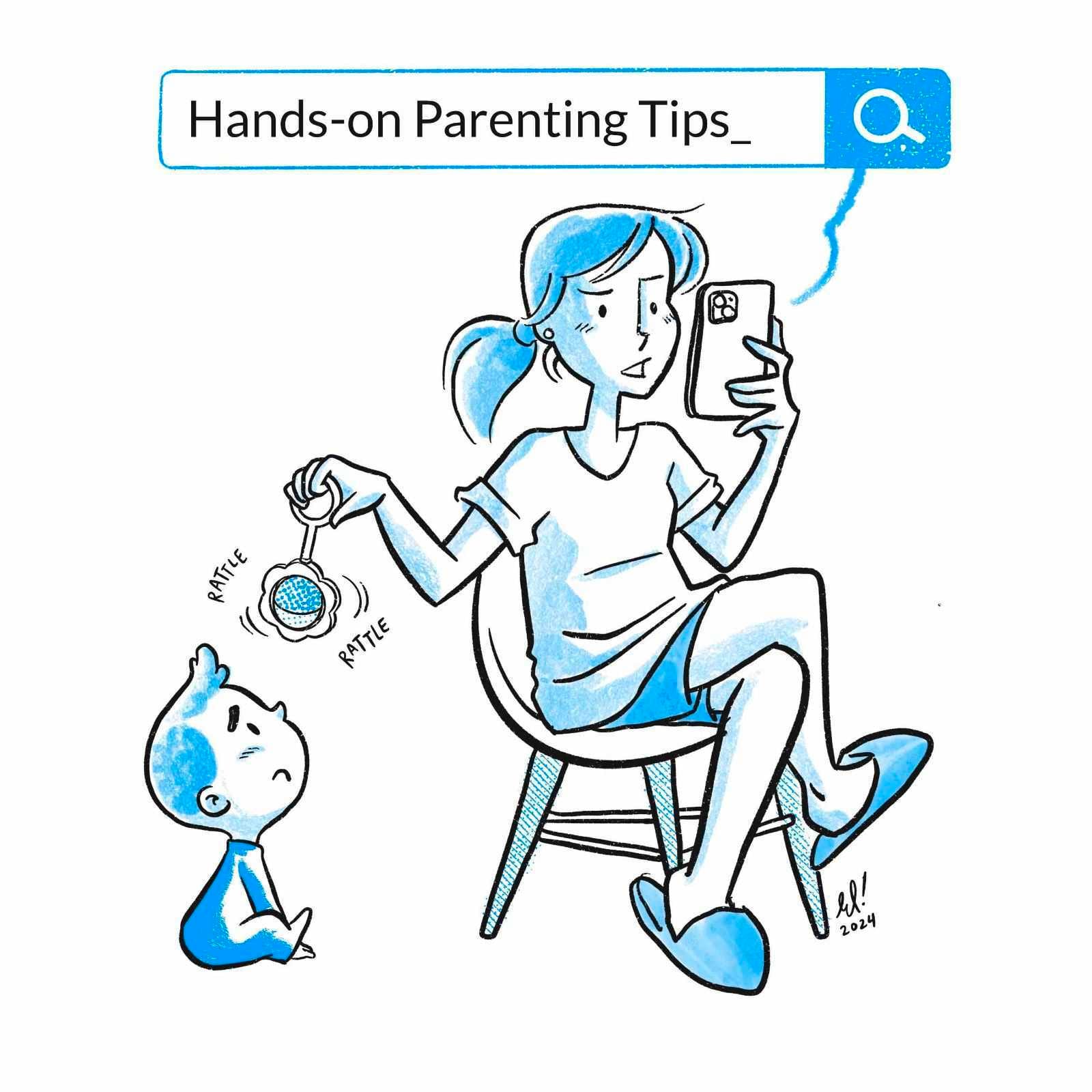
Realistic tips for managing your young child's screen time
If you've read tips about screen time management in the past, give this list a chance. It's not just a list of do's and don'ts, it is, more importantly, one that reframes the task of the parent.
1. Stop using screen time and gadgets to calm a child down or to get a child to follow you.
It would be convenient if children below two years old would sit inside the stroller while the family goes malling rather than running around, disturbing others, or even possibly getting hurt but it’s only convenient for us, parents. We must admit that it is convenient for our tired selves. And if a weekly habit of going out with the family, stroller in tow, entails making a baby sit inside a stroller using screen time, it’s time to rethink how to spend time together as a family out of the home.
A young child needs to move and needs to feel her body’s limits. The burden does fall on us parents to have to chase after a growing toddler and follow her curiosity. If your young child will just be relegated to the stroller all day with a screen time, reevaluate the family’s activities and choose ones that heavily consider your young child’s needs and interests.
2. Accept that it is not going to be easy.
If you are serious about reducing your young child’s screen time, remember the resounding advice of parents who have tried and succeeded: Sa una lang mahirap.
It does not come without a price, and accept that your child wants something that is not the best for him. Just because they want it does not mean parents should give in. It is easy for us to identify this push and pull in obviously dangerous situations, like when a toddler wants to play with kitchen scissors or stick their fingers inside an electric socket. However when it comes to gadgets and screen time, we hide behind the excuse that our child wants to have it, what can we do?
"If we can't set boundaries with our kids and they are on their devices for hours instead of participating in life, they are on TikTok at age 7—and so the cost of not knowing how to set boundaries is higher and higher in terms of our kids' mental health” -Dr. Becky Kennedy, clinical psychologist and New York Times author bestseller
Once we remind ourselves that it has no benefit particularly for children two years old and below and that it is even harmful, then we will be able to take it away from our child’s daily routine assertively and without guilt.
Clinical psychologist, author and CEO of Good Inside Dr. Becky Kennedy frames it best, it's boundary setting. "If we can't set boundaries with our kids and they are on their devices for hours instead of participating in life, they are on TikTok at age 7—and so the cost of not knowing how to set boundaries is higher and higher in terms of our kids' mental health," she said at the recently concluded Digital Parenthood Summit held in New York City, on June 4, 2024.
Remember that if you have already allowed your child below two years old screen time but decide to discontinue, it is normal for him to protest and dislike your decision. As parents and adults, we should be confident in making decisions for our child that may displease them temporarily—maybe even cause negative feelings towards us—and trust that it is the best choice for them and does not reflect their affection towards us, nor does their displeasure define our parenthood. Again, change screen time to any obvious harmful substance for children like cigarettes and no parent would be so quick to give in to a child’s protests for it—because we know it hurts them.
3. Don’t make it accessible.
Before you pack that tablet or phone into your bag, think: Is it really necessary? Pack a heavier bag that may contain an assortment of toys and coloring materials if your young child will need to find something to do throughout the day and don’t be afraid of boredom. "Some young people who do not have the interior resources or the responses to deal with that boredom creatively then sometimes end up smashing up bus shelters or taking cars out for a joyride,” said Dr. Teresa Belton, author and expert on the impact of emotions and behavior. Use the reality of the lack of internet connection 24/7 to your advantage instead of finding a way around the absence in order to pacify your young child.
4. Move your body alongside your child and get off your own screen.
Let’s face the facts that our screen addictions often drives us to ignore the glaring recommendations to withhold screen time for children two years and younger. We use phones to cope with our own mental and emotional burnouts plus physical tiredness because it’s available and free. Again, these reminders are not for one of moments when we badly need a few minutes to recollect ourselves. But consider how much time does your child below two years old spend in front of a screen and what are the reasons why they must? What needs to change in your habits and lifestyle in order to ditch screen time completely? It might mean having to engage with them at the dinner table, whether at home or outside, or to allow them to run around in public. Maybe it’s also time to check in on your physical health if running after a two year old is just too tiring to bother with.
Experts recommend zero screen time for kids two years old and below, after which there are reasonable amounts of allowable time as kids grow older. It isn’t forever. Wouldn’t you want to enjoy those first two years with your very own eyes, without a gadget in between your gaze?
Why do Filipino parents need a guide to raising kids in a digital world? Read this article to know more.
***
Illustrations by Elbert Or. Elbert wears multiple hats throughout the week. He is a facilitator, coach, illustrator, and co-founder of Pushpin, a social impact design studio for non-profits and foundations. But his favorite hats are as husband to Lorra and dad to Oliver and Zoe.