

With the rise of computers, smartphones, and tablets, cursive writing may seem like a dying trend in the country. Renowned Filipino historian Ambeth Ocampo writes in the Opinion column of Inquirer, “I often assign my students to transcribe 19th-century notarial documents in Tagalog because many of them, who read and write on their smartphones, are not used to reading handwriting in cursive script.”
And when the pandemic pushed education under the reins of a screen and a keyboard, cursive writing looked as though it’s already a lost art. I remember my daughter was in grade one, it was the height of the lockdown when she first received her ‘handwriting workbook’ and their task was just to copy the letters as shown and finish the entire alphabet in cursive. No instructions on how to do the loops and the curves, just copy and pass it and you're done.
Now that she’s in grade 5, she would sometimes forget how to write a certain letter in cursive (particularly the upper case letters) because she didn’t develop a love for it nor did she have any reason to hone the skill–her homeworks and supplementary academic tasks can now be found on computer-based learning modules, supported by digital learning management systems. Her notes are now screenshots, her reviewers are in PowerPoint presentation format.
However, cursive writing’s importance extends far beyond mere tradition nor aesthetics. Cursive writing has been shown to play a vital role in cognitive development, fine motor skills improvement, memory retention, and comprehension.
Historical Significance
According to an article about the history of penmanship on history.com, the ancient Romans were among the first in developing written scripts. By the fifth century A.D., their script included early forms of lowercase letters that sometimes resembled the modern cursive writing. After the fall of the Roman Empire, penmanship became a specialized discipline, flourishing mainly in monasteries.
The article narrates, “As the price of parchment and demand for books soared in the later Middle Ages, a denser style of writing evolved for European languages. Italian humanists soon revolted against the heavy look by reverting to a more Carolingian script and inventing a cursive form of it, known as Italic. Elegant handwriting emerged as a status symbol, and by the 1700s penmanship schools had begun educating generations of master scribes.”
Over the years, cursive writing continued to evolve, one of which is called the Spencerian method (which can be seen in the original Coca-Cola logo), which was quickly adopted by schools and businesses. However, when typewriters and word processors swept the business world, schools began to eliminate penmanship classes.
“Our main finding was that handwriting activates almost the whole brain as compared to typewriting, which hardly activates the brain as such." -Audrey van der Meer, NTNU Neuropsychology professor
Cognitive benefits according to a neuropsychology professor
When children learn cursive, they engage in a form of kinesthetic learning, which reinforces the neural pathways involved in language and literacy. The act of writing by hand, especially in cursive, activates different parts of the brain compared to typing on a keyboard. According to nbcnews.com, “researchers in Norway determined that writing by hand may improve learning and memory.”
The news explains, “At the start of the experiment, the students were told to either write words in cursive using a digital pen on a touchscreen, or to type the same words using a keyboard. Meanwhile, a cap of sensors on their head measured their brain waves. The cap’s 256 electrodes attached to the scalp, recorded the electrical signals of the students’ brains, including where brain cells were active and how parts of the brain communicated with each other.”
It continues, “Our main finding was that handwriting activates almost the whole brain as compared to typewriting, which hardly activates the brain as such. The brain is not challenged very much when it’s pressing keys on a keyboard as opposed to when it’s forming those letters by hand,” said Audrey van der Meer, the study’s co-author and a neuropsychology professor at Norwegian University of Science and Technology (NTNU).
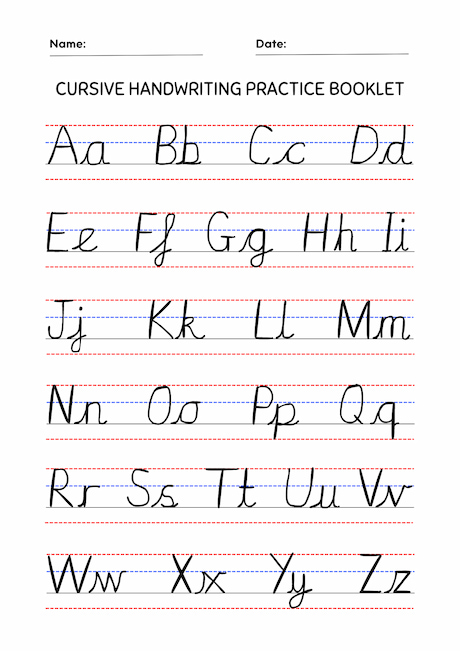
6 more reasons why cursive writing is good for your brain
According to an online article,The Case for Cursive: 6 Reasons Why Cursive Handwriting is Good for Your Brain, cursive writing have many benefits to your child's brain development and these can be translated into:
1. Cursive enhances thought flow, as well as flow of words.
Research, like the 1976 study in Academic Therapy, shows that writing in cursive promotes a better understanding of complete words (as opposed to the interrupted format of block letters), aligning with our structural thinking.
2. Cursive aids focus.
Proficiency in cursive reduces the gap between thought and action. It mentions that SAT exam takers who wrote in cursive for their essays scored slightly higher, likely due to fewer interruptions in their thought process. “By not having to slow down with block printing, experts believed they could put virtually all of their focus on the content of their work.”
3. Cursive activates the whole brain.
Unlike typing, cursive engages and involves both brain hemispheres more evenly. In the van der Meer experiment, studies have found that it activates different neurological pathways than typing.
4. Cursive improves memory.
Handwriting notes requires selective processing, enhancing information retention compared to typing. “That’s because when we type, we’re able to transcribe speech almost verbatim. When we write, we have to be more selective and the brain has to process information to decide what’s important enough to write down. That level of brain engagement tends to make information “stick” rather than just pass through our typing fingers.”
5. Cursive boosts motor control.
Regular cursive practice strengthens fine motor skills, especially benefiting those with developmental dysgraphia.
6. Cursive improves spelling.
Writing words as a continuous unit in cursive helps with accurate spelling retention. “The act of writing out words and thinking of them as a single unit means you’re more likely to retain their proper spelling.”
Does your child need help in cursive writing?
According to an article, Cursive Writing: A Dying Form of Skill in Philippine Schools, “In the Philippines, acquiring to master cursive writing is a form of achievement during the elementary stage.” Students typically begin learning cursive writing in the second or third grade, transitioning from manuscript writing once they have mastered it.
The article explains, ”The teacher shows in clear, easy-to-follow strokes just how to write it. Each letter is made exactly the same strokes in the same order every time it is written.” Initially, students focus on replicating individual letters, observing the teacher's demonstrations, and practicing the exact order of strokes. “Teachers spend a long and rigid amount of time to accentuate the said form of writing,“ the article points out, and over time, students learn to assess their own.
However, as students progress to high school, the article claims, cursive writing often falls out of regular use.
So, how do we keep this art form alive? We’ve rounded up a list to help your kids learn and practice the art of cursive writing.
Easy and Smart Cursive Class
Email: easyandsmartcursive@gmail.com
Facebook: facebook.com/easyandsmartcursiveclass
Conducts Zaner-Bloser Cursive Class for ages 9 and above, Classes led by Teacher Sab de Leon, Fine Arts Graduate from UP Diliman and is a licensed professional teacher, with 30+ cursive experience.
Inquire here.
Cafe Mithi
131 V. Luna Extension, Sikatuna Village, Quezon City
Contact Number: 0917 830 2323
The art of cursive writing needs practice. Cafe Mithi has dedicated craft kits especially catered to young artists—complete with guides and drills for cursive writing, intro to lettering, and basic calligraphy. Soon they will be launching a specifically designed activity book for young artists aged 6-12, which turns the art of lettering and calligraphy into an exciting adventure. They also have kits for adults so you can turn writing (and calligraphy) into an enjoyable activity with the kids.
Order your craft for kids here.
Udemy
udemy.com
This cursive writing on-demand video from the Little House of Learning can be purchased from this education technology company. The video is about a simplified, modern cursive handwriting course for kids. The course covers learning how to write cursive letters by repeated practice of a few different strokes, utilizing a simplified method to write a modernized version of cursive letters, and form all uppercase and lowercase letters of the English alphabet in cursive.
Get access to the on-demand video here. For beginners, click here.
‘Pen is mightier than the keyboard’
Despite the shift towards digital communication, cursive writing proves that there is more than just the strokes–it’s about preserving an artform, a part of history; a cognitive exercise. It’s about ensuring that future generations reap developmental benefits that cursive writing provides.
For kids trying to write for the first time, Diretso lapis nga ba? Find out here.
More from sp

Lorem ipsum dolor sit amet, consectetur adipisicing elit, sed do eiusmod
Lorem ipsum dolor sit amet, consectetur adipisicing elit, sed do eiusmod
