
This article was written in collaboration with Promil.
For parents, it's easy to see that our children are growing physically. During our regular visits to the pediatrician, we see how much weight they gained or how tall they have grown. However, knowing how their brains are developing well is not as straightforward.
Dr. Ed Posecion, a pediatrician and medical director of Wyeth Nutrition, says this is where developmental milestones come in. "All milestones start from a gifted brain. Sometimes, we don't immediately see whether a child's development is normal or if anything is wrong. But the signs are there—you just need to know what to look for."
What are developmental milestones?
Developmental milestones are age-specific markers that help indicate if a child’s brain is developing well. These include physical, cognitive, social, and emotional milestones.
According to the Centers for Disease Control and Prevention (CDC), cognitive milestones cover learning, thinking, and problem-solving. About 75 percent of children by age 3, for example, can do the following cognitive milestones: draw a circle when you show them and avoid touching hot objects when you warn them.
"So for every stage and age group, they have to learn skills. These skills reflect the growing brain, the developing brain. In reverse, if there's a delay or anything wrong with the growing brain, they cannot move, or there will be a slow down," Dr. Posecion explained at the Promil Gifted Talks event on February 13 at Shangri-la at the Fort Manila.

He emphasized the importance of building a strong foundation, especially during the early stages of a child's life. This crucial period impacts a child’s learning, health, and behavior later in life.
How parents can support their child's brain development
Dr. Nora Schneider, an expert in pediatric cognitive development, shared simple yet effective activities parents can do at home to support milestones:
1. Talk to your child.
Engage them in conversations. Ask them how they feel or what they think. Storytelling and asking open-ended questions help develop language skills and memory.
2. Read together.
Reading fosters language acquisition and creativity. "Sometimes you don't have to read the story until the end. Leave it open and let the child maybe engage and come up with creative solutions," Dr. Schneider suggests.
3. Play board games as a family.
Board games allow children to start learning social rules. Dr. Schneider advises parents whose children want to make their own rules: "Maybe give it time to say, okay, now you make up the rules, but then there's also a time where the rules are set and they have to follow." She says these are important social components that they will also need once they go to school.

4. Prepare food together.
She considers food preparation and eating time to be fantastic teaching moments. "You can prepare a salad together. The child has to focus on the activity, and there's a sequence to it. You have to start with chopping the ingredients, putting them together, then adding a dressing. It's usually not the reverse," she explains.
Dr. Schneider also encourages practicing motor skills by cutting fruits under supervision, "You can engage them in a conversation while they do it. You have a complete activity that fosters all these different things linked to brain development."
These are just some of the activities parents can do at home to help their child's brain development. It doesn't have to be complicated, Dr. Posecion says. "Just doing things together is important. Playing with your children is very important because, as you know, play is the biggest skill for brain development in this age group."
Good nutrition: Why DHA alone is not enough
While playing and engaging our children help stimulate their brains, both experts agree that having a balanced diet is equally important.
One of the known nutrients that help brain development during early childhood is DHA (Docosahexaenoic acid), which offers several benefits. However, Dr. Schneider stresses, "DHA alone is not enough. Different nutrients support growth and brain development."

Aside from DHA, Lutein, Choline, and Milk Oligosaccharides (MOS+) Sialic Acid are clinically proven to improve brain performance. Dr. Schneider also mentioned that combining these nutrients enhances brain connections more effectively than DHA alone.
"[Developmental] milestones can be a window into your child's brain development," Dr. Schneider says. "They are age-specific, so you have to look for a different type of markers at each age."
She emphasized that parents should guide their children, especially in meeting their four brain developmental milestones: language, focus, memory, and problem-solving. This can be done by engaging them in easy-to-implement daily activities and a balanced diet. "The right nutrition in DHA alone is not enough; we need more nutrients from a balanced diet to support optimal development," she concluded.
Moms share how they boost their child's brain development
Actress and mom of two, Solenn Heusaff Bolzico shared how being a present parent to her 5-year-old daughter Thylane Katana or Tili is essential, especially in this day and age when gadgets are taking over our children's lives. "Sometimes I go out at dinner and see a whole family, and they're all on their phones. No one's talking. I feel like, where is this generation going? Where are we going?"
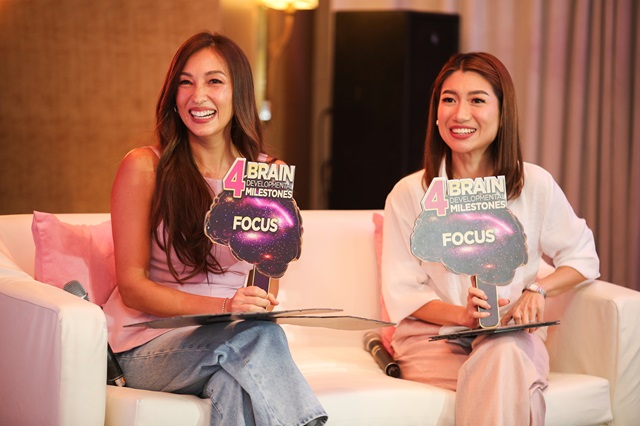
Solenn adds, "You have to refocus on the simple things in life like playing, outdoor play, and I do a lot of activities with them. I cook with Tili, we read, and we create stories together. It's really about being present and playing and proper nutrition. There's no secret."
Meanwhile, TikTok content creator Prax Yap shared that she gives her 4-year-old son, Marcus, opportunities to learn independently.

"Pag may mga tanong siya, as much as gusto ko sagutin, minsan binabalik ko yung tanong, 'What do you think?' Kasi nagkakaroon sila ng chance to observe, to think. Minsan nagkakamali sila and it's okay. They learn from it."
When it comes to nutrition, both moms agree that parents are responsible for providing their children with healthy meals and sources of nutrients, like Promil, which both Solenn and Prax say helped develop their kids' four brain developmental milestones, including focus, memory, language, and problem-solving.
"I think that it's important to have a partner in this journey because as a parent, you're also learning every day. And at the end of the day, we're not experts. We're just trying to do our best. So, I'm so happy that Promil is with us," Solenn shared.
Prax added, "We give Promil because it gives me the confidence that I’m providing my child with more brain nutrients for optimal brain development."
The bottom line
Supporting a child's brain development goes beyond physical growth. Parents must focus on cognitive, social, and emotional milestones through engaging activities and balanced nutrition.
When it comes to nutrition, the right combination of nutrients—from a balanced diet and a nutrition partner like Promil, which contains four more clinically proven brain nutrients than regular milk—can help ensure your child reaches their full potential.
Does eating sweets have an effect on kids' learning and intelligence? Read this article to know more.
ASC: W0194P032825P
More from sp

Lorem ipsum dolor sit amet, consectetur adipisicing elit, sed do eiusmod
Lorem ipsum dolor sit amet, consectetur adipisicing elit, sed do eiusmod