
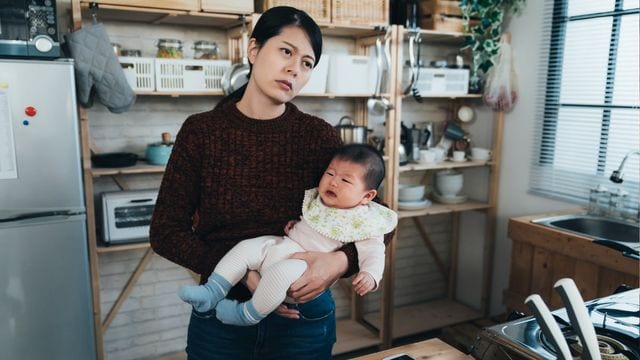
American psychotherapist and psychoanalyst Dr. Barbara Almond writes, “Maternal ambivalence is ‘the crime that dare not speak its name’ in the 21st century.”
She adds, “Everyone feels it, but has trouble talking about it, and those who do speak up raise feelings of alarm in those who are pushing these feelings out of consciousness.”
Almond is the author of the book, The Monster Within: The Hidden Side of Motherhood, which delves into the complex and often-taboo topic of maternal ambivalence based on her clinical observations and theories: the mixture of love and frustration that many mothers feel but rarely discuss. She argues against the myth of the "perfect mother" and emphasizes how societal expectations intensify feelings of guilt and anxiety for mothers.
“I believe that today’s expectations for good mothering have been so hard to live with—the standard's so draconian, that maternal ambivalence has increased and at the same time become more unacceptable to society as a whole,” Almond writes in her book.
Also Read: What If It's Not Postpartum Depression? Understanding Matrescence
But "Ambivalence is a normal phenomenon,” according to Almond. She adds, “It is ubiquitous. It is not a crime or a failing."
Spectrum of mothers with ambivalent feelings
According to research, the term “maternal ambivalence” was ‘proposed over a hundred years ago by Freud and then further developed by Klein and Winnicott in the mid-fifties,’ which is used to describe as “mixed, simultaneous positive and negative feelings, thoughts, and behaviours from the mother towards being a mother (e.g., newly imposed roles) or towards the baby and can affect all women, both actual or potential mothers.”
Ambivalence is more than just ‘baby blues’ or the hormones being in haywire postpartum, it is when ‘there is a conflict between the needs of the parents and those of their children,’ according to Almond.
Also Read: Postpartum Depression or the Baby Blues? Know How To Tell The Difference
In a forum about her book, Almond identifies three kinds of mothers according to ambivalent feelings: The “too good mother” (the one who doesn’t recognize her ambivalence at all), the “ambivalent mother who internalizes her feelings” and feels guilty, and “mothers who externalize their ambivalence” and blame their children and feel punished by being mothers.
"Everyone who's a mother knows this already: we're overburdened, overstretched, overworked, carrying the majority of the emotional labour, carrying the majority of the domestic sphere, the pressures of paid work... and then we're expected to hold up a mask of, 'I've got this all together. I'm the perfect mother. I'm not struggling.'" — Sophie Brock, sociologist
It feels like motherhood isn't for me
In a BBC article, ambivalence is thought as a mix of emotions that isn’t surprising at all. It reads, “Mothering is, after all, a time-consuming, labour-intensive, emotional task—one that means a fundamental shift in one's identity as well as often— difficult physiological changes. Mothers have likely had conflicting feelings about it as long as mothers have existed.”
It translates maternal ambivalence today as a uniquely challenging situation due to several factors. One is the unrealistic expectations surrounding what defines a "good" mother—or even a "good" child—amplified by the constant flood of parenting advice, internet resources, and social media comparisons.
Also Read: Motherhood Is Like Having Two Full-time Jobs, Study Says
Another is the pervasive shame and stigma mothers often feel in a culture that idealizes sentiments like, "Treasure every moment!" These cultural norms make it particularly difficult for mothers to openly discuss their struggles. While acknowledging that parenting is hard might be acceptable, admitting to not fully enjoying the role remains a significant taboo.
It’s okay to feel the ‘and’ of motherhood
But Australian sociologist Sophie Brock, as mentioned in the article, talks about embracing the “and” of motherhood—it’s about admitting you feel “both”.
To cite an example, she describes it as 'I am so grateful my child exists, and I can't stand what my life has become.' Or, 'I want to be the best mother possible, and I'm so angry about how much my identity has changed.' Or even, 'I love my child intensely and, in this moment, I also hate him.'
Also Read: 'Naaawa Ako Sa Anak Ko'—A Mom's Letter To The Baby She Neglected Because Of Postpartum Depression
The unspoken side of motherhood
"Everyone who's a mother knows this already: we're overburdened, overstretched, overworked, carrying the majority of the emotional labour, carrying the majority of the domestic sphere, the pressures of paid work," Brock says in the article. "And then we're expected to hold up a mask of, 'I've got this all together. I'm the perfect mother. I'm not struggling.'"
“Like all other feelings, maternal ambivalence varies in the intensity, frequency, and persistence with which it is felt. While some maternal ambivalence is considered healthy and ‘normative,’ mothers who are unable to manage their ambivalence and experience barriers to seeking support can experience negative consequences, such as maternal depression, attachment issues in the child, child abuse, and child neglect,” according to a research by Smith College highlighting the narratives on anonymous digital spaces.
Out of curiosity, I tried to access digital spaces that talk about maternal ambivalence and I’ve come across comments about this rarely-discussed aspect of motherhood.
“I do not regret having my daughter, but I am highly resentful about how little mothers are actually supported, how much we are expected to do, and how we are harshly judged for every choice we make and everything our child does,” said one.
“If people were willing to talk about regretting parenthood I think the numbers would be far, far higher than we think,” said another.
And one believes that motherhood (or parenthood) is not for her, “I never had children myself for a number of reasons, but the most important one in my mind is that having children, in my view, is something you should only do if the desire is of an almost primal level and I never felt that desire myself. Too many people have children because their parents want grandbabies, or because they think they're supposed to, or because their friends are having kids and they don't want to be the oddball in the crowd. Those aren't valid reasons in my mind.”
In this respect, how can we manage this range of emotions that come with motherhood?
How to deal with maternal ambivalence
5 ways to deal with maternal ambivalence
1. Talk about the hard things. Discuss feelings with a partner, a trusted friend, or a therapist. In a story told by Almond in her forum, she talked about a woman who gave birth to twins and referred to the other twin as the husband’s child because she does not have good feelings with the other child at the beginning. Caring for twins is a demanding role and she seemed unprepared for it but through the conversation with Almond, she eventually improved her relationship with her other child and found a solution on how to care for both babies.
This happened when she was treated with respect and understanding rather than condemnation. If we learn to discuss how we feel, we’re able to clear our heads and process our emotions, as opposed to bottling it up inside in shame, allowing resentment to take more space.
2. Seek support. Following the same story, the woman’s husband helped her in caring for the twins and supplementing their babies’ needs. They were able to share the load of parenthood. Sometimes, resentment grows when, as mothers, we’re the only ones left to do everything for the kids and for the family—we eventually get tired of the role and feel punished for being a mother.
Also Read: Beyond 'Baby Blues': Understanding Maternal Mental Health
3. Lower the pressure you put on yourself. Almond argues that there is no “perfect mother.” If we find ourselves at the helm of motherhood demands—take a step back, breathe, and tell yourself, it’s okay. It’s okay that the house is a mess today. It’s okay that the kids are eating fast food today. It’s okay that the kids are jumping and shouting and bickering at each other. Every day doesn’t have to be perfect—because it really isn’t. And not all aspects of motherhood are enjoyable either.
4. Keep real friends close, yourself closer. Motherhood can be isolating. In the mentioned BBC article, a mom shares, "It was very isolating, and made more isolating by dint of the fact that on the internet, and in these mothers' circles, everyone seems to love and enjoy and take fulfillment out of it. I found the whole thing uncomfortable and isolating, and I was riddled with anxiety the whole time."
It is important to keep your real friends close, who will listen and understand what you’re going through and find ways how they can share the journey with you so it doesn’t feel so overwhelming.
At the same time, motherhood can channel all the energy towards care-giving to others, which makes moms forget herself. The baby is now perceived as someone who 'steals joy' as another woman shares in the article, "I've not managed to have a nice experience of becoming a mother. Looking after a young infant has been full of stress and worry."
You can’t lose your identity, Momma. Always keep yourself intact, as well as the things that you enjoy on your own. Remember, you are not just a mother.
5. Let go of the guilt. Although not a lot is discussed about maternal ambivalence, know that it happens, it is common, and it is normal. If you focus on guilt, shame, and resentment, it can lead you to darker paths such as anxiety and depression.
Also Read: Mama, Let Me Tell You Something: You Are Enough
So embrace the other sides of motherhood—it’s not all bliss and fulfillment and all the beautiful words you’ve read about— it's a commitment, often a sacrifice, and a continuous learning experience. And you don’t have to pressure yourself to figure out everything at once. You are allowed to rest and feel your emotions. Your motherhood journey is an experience that is uniquely yours, own it and take it to one’s heart, including all the ‘ands’.
How to be a better mom without losing yourself in the process? Find out here.
More from sp

Lorem ipsum dolor sit amet, consectetur adipisicing elit, sed do eiusmod
Lorem ipsum dolor sit amet, consectetur adipisicing elit, sed do eiusmod
